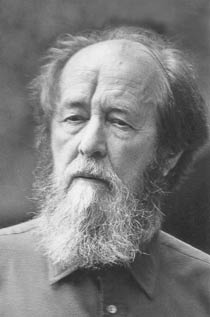
Solzhenitsyn: What Intellectuals Need

“There is not a way left to us to pass from our present contemptible amorphousness into the future except through open, personal and predominantly public (to set an example) sacrifice. We all have to “rediscover our cultural treasures and values” not by erudition, not by scientific accomplishment, but by our form of spiritual conduct.”

Alexander Solzhenitsyn in “The Smatterers,” from Under the Rubble, p. 273 (author’s italics).

Guns forbidden to those deemed dangerous or treated involuntarily for mental illness

AP April 30, 2007

Story Highlights

• Database lists people barred from busing guns
• List would include anyone ordered to undergo mental health treatment
• Virginia Tech gunman was treated as an outpatient
• Court finding that shooter was a danger never made it into database
RICHMOND, Virginia (AP) — Virginia Gov. Timothy M. Kaine said Monday he has closed the loophole that allowed a mentally disturbed Virginia Tech student to acquire the guns he used to kill 32 students and faculty members.

Kaine issued an executive order requiring that a database of people who are prohibited from buying guns include anyone found to be dangerous and ordered to undergo involuntary mental health treatment.

Seung-Hui Cho had been ordered by a court to undergo psychiatric counseling after a judge ruled that he was a danger to himself.

But because Cho was treated as an outpatient and never committed to a mental health hospital, the court finding never made it into the database that gun dealers must check before selling a firearm. The law prohibits selling firearms to people judged to have mental disabilities.

“Whether that treatment is to be provided in an inpatient or outpatient facility is of no moment,” Kaine said.

Cho did not disclose his mental health problems or the court-ordered treatment in a form he completed before buying the guns.

“His lie on the form would have been caught,” had the order been in place before Cho attempted to buy the guns, Kaine said.

But it would not prevent Cho from acquiring guns by several other means that require no background check in Virginia, including buy-and-trade publications, individual transactions among gun collectors or hobbyists, and gun shows — vast firearms bazaars where scores of people sell or swap firearms.

Legislation that would also subject firearms sales at gun shows to instant background checks is introduced annually in Virginia, and just as often it dies without reaching a floor vote in the General Assembly.

Kaine, a Democrat, has said he expects new support for the legislation this year and that he would support it, as he has in the past.

The executive order does not apply to people who seek mental health care of their own will. After the report is added to Virginia’s state police database, it becomes part of a federal database that gun dealers nationwide use.

Cho, a 23-year-old Virginia Tech senior described as a troubled loner, bought his guns legally through gun shops before gunning down 32 people on campus, then killing himself.

No motive has been established for his rampage.

Jefferson On Compromise In Public Debate

“Every man cannot have his way in all things. If his opinion prevails at some times, he should acquiesce on seeing that of others preponderate at other times. Without this mutual disposition we are disjointed individuals, but not a society.” –Thomas Jefferson to John Dickinson, 1801. FE 8:76

A Response to Wolf From Jewcy

Wolf’s piece drew this acerbic response from Joey Kurtzman:

I am including it here on the basis of Kurtzman’s confession to libertarian tendencies, and because I thought it was funny and well-written, although ultimately evasive. Even if Wolf is not right on every point or even particularly insightful from a historical viewpoint, she nevertheless voices that sense of rottenness-in-the-state- of-Denmark that hangs pretty thick in the air right now, no matter whom you blame for it.

American Fascism in Ten Hysterical Steps: Naomi Wolf in the Guardian:

During the six years I was marooned in the British Isles, I became, by necessity, an amateur taxonomist, like those dilettante Victorian naturalists who poked around looking for new types of dung beetles or butterflies. I wasn’t after dung beetles, though; I was cataloguing the diverse forms of obeisance with which American liberals try to elicit the condescending approval of Europeans, that sublime reassurance that “You, you’re not quite like most Americans, are you? You’re rather…European.”

I lovingly collected my specimens, and identified the occasional species—for example, Declinatio pessumus absurdus (Kurtzman, 2003), the warbly faux-British intonation with which the American Europhile triumphantly peppers the end of any sentence in which he’s asking a question. Or the dreaded Fellatio iratus michaelmooricus (Kurtzman, 2003), which sees the disgruntled American lecturing his European hosts on the exquisite sophistication of their own culture, and the hopeless barnyard vulgarity of American culture.

But every so often I would be so mesmerized by some virtuoso performance, some unclassifiable peacock display of American self-loathing, that I’d pine for a systematizing genius, a sociological Linnaeus who would catalogue the entire fauna of overseas American life and just hand me the multi-volume taxonomy necessary to describe the whole writhing ecosystem…

Read more at Jewcy.com.

My Comment:

Yes, Wolf could have been more precise. But sometimes intellectual rigor is not a substitute for moral intuition. I offer this from Orwell, writing here about James Burnham (whose influential work described the inevitable ascendance of a managerial class in both fascist and socialist states that would make the two virtually indistinguishable):

“One cannot always make positive prophecies, but there are times when one ought to be able to make negative ones. No one could have been expected to foresee the exact results of the Treaty of Versailles, but millions of thinking people could and did foresee that those results would be bad. Plenty of people, though not so many in this case, can foresee that the results of the settlement now being forced on Europe will also be bad. And to refrain from admiring Hitler or Stalin – that, too, should not require an enormous intellectual effort. But it is partly a moral effort. That a man of Burnham’s gifts should have been able for a while to think of Nazism as something rather admirable, something that could and probably would build up a workable and durable social order shows, what damage is done to the sense of reality by the cultivation of what is now called ‘realism’. “

Can Fascism Come to America ?

Ten Steps To Close Down an Open Society

By Naomi Wolf, the Guardian, Tuesday April 24, 2007.

Last autumn, there was a military coup in Thailand. The leaders of the coup took a number of steps, rather systematically, as if they had a shopping list. In a sense, they did. Within a matter of days, democracy had been closed down: the coup leaders declared martial law, sent armed soldiers into residential areas, took over radio and TV stations, issued restrictions on the press, tightened some limits on travel, and took certain activists into custody.

They were not figuring these things out as they went along. If you look at history, you can see that there is essentially a blueprint for turning an open society into a dictatorship. That blueprint has been used again and again in more and less bloody, more and less terrifying ways. But it is always effective. It is very difficult and arduous to create and sustain a democracy – but history shows that closing one down is much simpler. You simply have to be willing to take the 10 steps.

As difficult as this is to contemplate, it is clear, if you are willing to look, that each of these 10 steps has already been initiated today in the United States by the Bush administration.

Because Americans like me were born in freedom, we have a hard time even considering that it is possible for us to become as unfree – domestically – as many other nations. Because we no longer learn much about our rights or our system of government – the task of being aware of the constitution has been outsourced from citizens’ ownership to being the domain of professionals such as lawyers and professors – we scarcely recognise the checks and balances that the founders put in place, even as they are being systematically dismantled. Because we don’t learn much about European history, the setting up of a department of “homeland” security – remember who else was keen on the word “homeland” – didn’t raise the alarm bells it might have.

It is my argument that, beneath our very noses, George Bush and his administration are using time-tested tactics to close down an open society. It is time for us to be willing to think the unthinkable – as the author and political journalist Joe Conason, has put it, that it can happen here. And that we are further along than we realise.

Conason eloquently warned of the danger of American authoritarianism. I am arguing that we need also to look at the lessons of European and other kinds of fascism to understand the potential seriousness of the events we see unfolding in the US.

1 Invoke a terrifying internal and external enemy

After we were hit on September 11 2001, we were in a state of national shock. Less than six weeks later, on October 26 2001, the USA Patriot Act was passed by a Congress that had little chance to debate it; many said that they scarcely had time to read it. We were told we were now on a “war footing”; we were in a “global war” against a “global caliphate” intending to “wipe out civilisation”. There have been other times of crisis in which the US accepted limits on civil liberties, such as during the civil war, when Lincoln declared martial law, and the second world war, when thousands of Japanese-American citizens were interned. But this situation, as Bruce Fein of the American Freedom Agenda notes, is unprecedented: all our other wars had an endpoint, so the pendulum was able to swing back toward freedom; this war is defined as open-ended in time and without national boundaries in space – the globe itself is the battlefield. “This time,” Fein says, “there will be no defined end.”

Creating a terrifying threat – hydra-like, secretive, evil – is an old trick. It can, like Hitler’s invocation of a communist threat to the nation’s security, be based on actual events (one Wisconsin academic has faced calls for his dismissal because he noted, among other things, that the alleged communist arson, the Reichstag fire of February 1933, was swiftly followed in Nazi Germany by passage of the Enabling Act, which replaced constitutional law with an open-ended state of emergency). Or the terrifying threat can be based, like the National Socialist evocation of the “global conspiracy of world Jewry”, on myth.

It is not that global Islamist terrorism is not a severe danger; of course it is. I am arguing rather that the language used to convey the nature of the threat is different in a country such as Spain – which has also suffered violent terrorist attacks – than it is in America. Spanish citizens know that they face a grave security threat; what we as American citizens believe is that we are potentially threatened with the end of civilisation as we know it. Of course, this makes us more willing to accept restrictions on our freedoms.

2 Create a gulag

Once you have got everyone scared, the next step is to create a prison system outside the rule of law (as Bush put it, he wanted the American detention centre at Guantánamo Bay to be situated in legal “outer space”) – where torture takes place.

At first, the people who are sent there are seen by citizens as outsiders: troublemakers, spies, “enemies of the people” or “criminals”. Initially, citizens tend to support the secret prison system; it makes them feel safer and they do not identify with the prisoners. But soon enough, civil society leaders – opposition members, labour activists, clergy and journalists – are arrested and sent there as well.

This process took place in fascist shifts or anti-democracy crackdowns ranging from Italy and Germany in the 1920s and 1930s to the Latin American coups of the 1970s and beyond. It is standard practice for closing down an open society or crushing a pro-democracy uprising.

With its jails in Iraq and Afghanistan, and, of course, Guantánamo in Cuba, where detainees are abused, and kept indefinitely without trial and without access to the due process of the law, America certainly has its gulag now. Bush and his allies in Congress recently announced they would issue no information about the secret CIA “black site” prisons throughout the world, which are used to incarcerate people who have been seized off the street.

Gulags in history tend to metastasise, becoming ever larger and more secretive, ever more deadly and formalised. We know from first-hand accounts, photographs, videos and government documents that people, innocent and guilty, have been tortured in the US-run prisons we are aware of and those we can’t investigate adequately.

But Americans still assume this system and detainee abuses involve only scary brown people with whom they don’t generally identify. It was brave of the conservative pundit William Safire to quote the anti-Nazi pastor Martin Niemöller, who had been seized as a political prisoner: “First they came for the Jews.” Most Americans don’t understand yet that the destruction of the rule of law at Guantánamo set a dangerous precedent for them, too.

By the way, the establishment of military tribunals that deny prisoners due process tends to come early on in a fascist shift. Mussolini and Stalin set up such tribunals. On April 24 1934, the Nazis, too, set up the People’s Court, which also bypassed the judicial system: prisoners were held indefinitely, often in isolation, and tortured, without being charged with offences, and were subjected to show trials. Eventually, the Special Courts became a parallel system that put pressure on the regular courts to abandon the rule of law in favour of Nazi ideology when making decisions.

3 Develop a thug caste

When leaders who seek what I call a “fascist shift” want to close down an open society, they send paramilitary groups of scary young men out to terrorise citizens. The Blackshirts roamed the Italian countryside beating up communists; the Brownshirts staged violent rallies throughout Germany. This paramilitary force is especially important in a democracy: you need citizens to fear thug violence and so you need thugs who are free from prosecution.

The years following 9/11 have proved a bonanza for America’s security contractors, with the Bush administration outsourcing areas of work that traditionally fell to the US military. In the process, contracts worth hundreds of millions of dollars have been issued for security work by mercenaries at home and abroad. In Iraq, some of these contract operatives have been accused of involvement in torturing prisoners, harassing journalists and firing on Iraqi civilians. Under Order 17, issued to regulate contractors in Iraq by the one-time US administrator in Baghdad, Paul Bremer, these contractors are immune from prosecution

Yes, but that is in Iraq, you could argue; however, after Hurricane Katrina, the Department of Homeland Security hired and deployed hundreds of armed private security guards in New Orleans. The investigative journalist Jeremy Scahill interviewed one unnamed guard who reported having fired on unarmed civilians in the city. It was a natural disaster that underlay that episode – but the administration’s endless war on terror means ongoing scope for what are in effect privately contracted armies to take on crisis and emergency management at home in US cities.

Thugs in America? Groups of angry young Republican men, dressed in identical shirts and trousers, menaced poll workers counting the votes in Florida in 2000. If you are reading history, you can imagine that there can be a need for “public order” on the next election day. Say there are protests, or a threat, on the day of an election; history would not rule out the presence of a private security firm at a polling station “to restore public order”.

4 Set up an internal surveillance system

In Mussolini’s Italy, in Nazi Germany, in communist East Germany, in communist China – in every closed society – secret police spy on ordinary people and encourage neighbours to spy on neighbours. The Stasi needed to keep only a minority of East Germans under surveillance to convince a majority that they themselves were being watched.

In 2005 and 2006, when James Risen and Eric Lichtblau wrote in the New York Times about a secret state programme to wiretap citizens’ phones, read their emails and follow international financial transactions, it became clear to ordinary Americans that they, too, could be under state scrutiny.

In closed societies, this surveillance is cast as being about “national security”; the true function is to keep citizens docile and inhibit their activism and dissent.

5 Harass citizens’ groups

The fifth thing you do is related to step four – you infiltrate and harass citizens’ groups. It can be trivial: a church in Pasadena, whose minister preached that Jesus was in favour of peace, found itself being investigated by the Internal Revenue Service, while churches that got Republicans out to vote, which is equally illegal under US tax law, have been left alone.

Other harassment is more serious: the American Civil Liberties Union reports that thousands of ordinary American anti-war, environmental and other groups have been infiltrated by agents: a secret Pentagon database includes more than four dozen peaceful anti-war meetings, rallies or marches by American citizens in its category of 1,500 “suspicious incidents”. The equally secret Counterintelligence Field Activity (Cifa) agency of the Department of Defense has been gathering information about domestic organisations engaged in peaceful political activities: Cifa is supposed to track “potential terrorist threats” as it watches ordinary US citizen activists. A little-noticed new law has redefined activism such as animal rights protests as “terrorism”. So the definition of “terrorist” slowly expands to include the opposition.

6 Engage in arbitrary detention and release

This scares people. It is a kind of cat-and-mouse game. Nicholas D Kristof and Sheryl WuDunn, the investigative reporters who wrote China Wakes: the Struggle for the Soul of a Rising Power, describe pro-democracy activists in China, such as Wei Jingsheng, being arrested and released many times. In a closing or closed society there is a “list” of dissidents and opposition leaders: you are targeted in this way once you are on the list, and it is hard to get off the list.

In 2004, America’s Transportation Security Administration confirmed that it had a list of passengers who were targeted for security searches or worse if they tried to fly. People who have found themselves on the list? Two middle-aged women peace activists in San Francisco; liberal Senator Edward Kennedy; a member of Venezuela’s government – after Venezuela’s president had criticised Bush; and thousands of ordinary US citizens.

Professor Walter F Murphy is emeritus of Princeton University; he is one of the foremost constitutional scholars in the nation and author of the classic Constitutional Democracy. Murphy is also a decorated former marine, and he is not even especially politically liberal. But on March 1 this year, he was denied a boarding pass at Newark, “because I was on the Terrorist Watch list”.

“Have you been in any peace marches? We ban a lot of people from flying because of that,” asked the airline employee.

“I explained,” said Murphy, “that I had not so marched but had, in September 2006, given a lecture at Princeton, televised and put on the web, highly critical of George Bush for his many violations of the constitution.”

“That’ll do it,” the man said.

Anti-war marcher? Potential terrorist. Support the constitution? Potential terrorist. History shows that the categories of “enemy of the people” tend to expand ever deeper into civil life.

James Yee, a US citizen, was the Muslim chaplain at Guantánamo who was accused of mishandling classified documents. He was harassed by the US military before the charges against him were dropped. Yee has been detained and released several times. He is still of interest.

Brandon Mayfield, a US citizen and lawyer in Oregon, was mistakenly identified as a possible terrorist. His house was secretly broken into and his computer seized. Though he is innocent of the accusation against him, he is still on the list.

It is a standard practice of fascist societies that once you are on the list, you can’t get off.

7 Target key individuals

Threaten civil servants, artists and academics with job loss if they don’t toe the line. Mussolini went after the rectors of state universities who did not conform to the fascist line; so did Joseph Goebbels, who purged academics who were not pro-Nazi; so did Chile’s Augusto Pinochet; so does the Chinese communist Politburo in punishing pro-democracy students and professors.

Academe is a tinderbox of activism, so those seeking a fascist shift punish academics and students with professional loss if they do not “coordinate”, in Goebbels’ term, ideologically. Since civil servants are the sector of society most vulnerable to being fired by a given regime, they are also a group that fascists typically “coordinate” early on: the Reich Law for the Re-establishment of a Professional Civil Service was passed on April 7 1933.

Bush supporters in state legislatures in several states put pressure on regents at state universities to penalise or fire academics who have been critical of the administration. As for civil servants, the Bush administration has derailed the career of one military lawyer who spoke up for fair trials for detainees, while an administration official publicly intimidated the law firms that represent detainees pro bono by threatening to call for their major corporate clients to boycott them.

Elsewhere, a CIA contract worker who said in a closed blog that “waterboarding is torture” was stripped of the security clearance she needed in order to do her job.

Most recently, the administration purged eight US attorneys for what looks like insufficient political loyalty. When Goebbels purged the civil service in April 1933, attorneys were “coordinated” too, a step that eased the way of the increasingly brutal laws to follow.

8 Control the press

Italy in the 1920s, Germany in the 30s, East Germany in the 50s, Czechoslovakia in the 60s, the Latin American dictatorships in the 70s, China in the 80s and 90s – all dictatorships and would-be dictators target newspapers and journalists. They threaten and harass them in more open societies that they are seeking to close, and they arrest them and worse in societies that have been closed already.

The Committee to Protect Journalists says arrests of US journalists are at an all-time high: Josh Wolf (no relation), a blogger in San Francisco, has been put in jail for a year for refusing to turn over video of an anti-war demonstration; Homeland Security brought a criminal complaint against reporter Greg Palast, claiming he threatened “critical infrastructure” when he and a TV producer were filming victims of Hurricane Katrina in Louisiana. Palast had written a bestseller critical of the Bush administration.

Other reporters and writers have been punished in other ways. Joseph C Wilson accused Bush, in a New York Times op-ed, of leading the country to war on the basis of a false charge that Saddam Hussein had acquired yellowcake uranium in Niger. His wife, Valerie Plame, was outed as a CIA spy – a form of retaliation that ended her career.

Prosecution and job loss are nothing, though, compared with how the US is treating journalists seeking to cover the conflict in Iraq in an unbiased way. The Committee to Protect Journalists has documented multiple accounts of the US military in Iraq firing upon or threatening to fire upon unembedded (meaning independent) reporters and camera operators from organisations ranging from al-Jazeera to the BBC. While westerners may question the accounts by al-Jazeera, they should pay attention to the accounts of reporters such as the BBC’s Kate Adie. In some cases reporters have been wounded or killed, including ITN’s Terry Lloyd in 2003. Both CBS and the Associated Press in Iraq had staff members seized by the US military and taken to violent prisons; the news organisations were unable to see the evidence against their staffers.

Over time in closing societies, real news is supplanted by fake news and false documents. Pinochet showed Chilean citizens falsified documents to back up his claim that terrorists had been about to attack the nation. The yellowcake charge, too, was based on forged papers.

You won’t have a shutdown of news in modern America – it is not possible. But you can have, as Frank Rich and Sidney Blumenthal have pointed out, a steady stream of lies polluting the news well. What you already have is a White House directing a stream of false information that is so relentless that it is increasingly hard to sort out truth from untruth. In a fascist system, it’s not the lies that count but the muddying. When citizens can’t tell real news from fake, they give up their demands for accountability bit by bit.

9 Dissent equals treason

Cast dissent as “treason” and criticism as “espionage’. Every closing society does this, just as it elaborates laws that increasingly criminalise certain kinds of speech and expand the definition of “spy” and “traitor”. When Bill Keller, the publisher of the New York Times, ran the Lichtblau/Risen stories, Bush called the Times’ leaking of classified information “disgraceful”, while Republicans in Congress called for Keller to be charged with treason, and rightwing commentators and news outlets kept up the “treason” drumbeat. Some commentators, as Conason noted, reminded readers smugly that one penalty for violating the Espionage Act is execution.

Conason is right to note how serious a threat that attack represented. It is also important to recall that the 1938 Moscow show trial accused the editor of Izvestia, Nikolai Bukharin, of treason; Bukharin was, in fact, executed. And it is important to remind Americans that when the 1917 Espionage Act was last widely invoked, during the infamous 1919 Palmer Raids, leftist activists were arrested without warrants in sweeping roundups, kept in jail for up to five months, and “beaten, starved, suffocated, tortured and threatened with death”, according to the historian Myra MacPherson. After that, dissent was muted in America for a decade.

In Stalin’s Soviet Union, dissidents were “enemies of the people”. National Socialists called those who supported Weimar democracy “November traitors”.

And here is where the circle closes: most Americans do not realise that since September of last year – when Congress wrongly, foolishly, passed the Military Commissions Act of 2006 – the president has the power to call any US citizen an “enemy combatant”. He has the power to define what “enemy combatant” means. The president can also delegate to anyone he chooses in the executive branch the right to define “enemy combatant” any way he or she wants and then seize Americans accordingly.

Even if you or I are American citizens, even if we turn out to be completely innocent of what he has accused us of doing, he has the power to have us seized as we are changing planes at Newark tomorrow, or have us taken with a knock on the door; ship you or me to a navy brig; and keep you or me in isolation, possibly for months, while awaiting trial. (Prolonged isolation, as psychiatrists know, triggers psychosis in otherwise mentally healthy prisoners. That is why Stalin’s gulag had an isolation cell, like Guantánamo’s, in every satellite prison. Camp 6, the newest, most brutal facility at Guantánamo, is all isolation cells.)

We US citizens will get a trial eventually – for now. But legal rights activists at the Center for Constitutional Rights say that the Bush administration is trying increasingly aggressively to find ways to get around giving even US citizens fair trials. “Enemy combatant” is a status offence – it is not even something you have to have done. “We have absolutely moved over into a preventive detention model – you look like you could do something bad, you might do something bad, so we’re going to hold you,” says a spokeswoman of the CCR.

Most Americans surely do not get this yet. No wonder: it is hard to believe, even though it is true. In every closing society, at a certain point there are some high-profile arrests – usually of opposition leaders, clergy and journalists. Then everything goes quiet. After those arrests, there are still newspapers, courts, TV and radio, and the facades of a civil society. There just isn’t real dissent. There just isn’t freedom. If you look at history, just before those arrests is where we are now.

10 Suspend the rule of law

The John Warner Defense Authorization Act of 2007 gave the president new powers over the national guard. This means that in a national emergency – which the president now has enhanced powers to declare – he can send Michigan’s militia to enforce a state of emergency that he has declared in Oregon, over the objections of the state’s governor and its citizens.

Even as Americans were focused on Britney Spears’s meltdown and the question of who fathered Anna Nicole’s baby, the New York Times editorialised about this shift: “A disturbing recent phenomenon in Washington is that laws that strike to the heart of American democracy have been passed in the dead of night … Beyond actual insurrection, the president may now use military troops as a domestic police force in response to a natural disaster, a disease outbreak, terrorist attack or any ‘other condition’.”

Critics see this as a clear violation of the Posse Comitatus Act – which was meant to restrain the federal government from using the military for domestic law enforcement. The Democratic senator Patrick Leahy says the bill encourages a president to declare federal martial law. It also violates the very reason the founders set up our system of government as they did: having seen citizens bullied by a monarch’s soldiers, the founders were terrified of exactly this kind of concentration of militias’ power over American people in the hands of an oppressive executive or faction.

Of course, the United States is not vulnerable to the violent, total closing-down of the system that followed Mussolini’s march on Rome or Hitler’s roundup of political prisoners. Our democratic habits are too resilient, and our military and judiciary too independent, for any kind of scenario like that.

Rather, as other critics are noting, our experiment in democracy could be closed down by a process of erosion.

It is a mistake to think that early in a fascist shift you see the profile of barbed wire against the sky. In the early days, things look normal on the surface; peasants were celebrating harvest festivals in Calabria in 1922; people were shopping and going to the movies in Berlin in 1931. Early on, as WH Auden put it, the horror is always elsewhere – while someone is being tortured, children are skating, ships are sailing: “dogs go on with their doggy life … How everything turns away/ Quite leisurely from the disaster.”

As Americans turn away quite leisurely, keeping tuned to internet shopping and American Idol, the foundations of democracy are being fatally corroded. Something has changed profoundly that weakens us unprecedentedly: our democratic traditions, independent judiciary and free press do their work today in a context in which we are “at war” in a “long war” – a war without end, on a battlefield described as the globe, in a context that gives the president – without US citizens realising it yet – the power over US citizens of freedom or long solitary incarceration, on his say-so alone.

That means a hollowness has been expanding under the foundation of all these still- free-looking institutions – and this foundation can give way under certain kinds of pressure. To prevent such an outcome, we have to think about the “what ifs”.

What if, in a year and a half, there is another attack – say, God forbid, a dirty bomb? The executive can declare a state of emergency. History shows that any leader, of any party, will be tempted to maintain emergency powers after the crisis has passed. With the gutting of traditional checks and balances, we are no less endangered by a President Hillary than by a President Giuliani – because any executive will be tempted to enforce his or her will through edict rather than the arduous, uncertain process of democratic negotiation and compromise.

What if the publisher of a major US newspaper were charged with treason or espionage, as a rightwing effort seemed to threaten Keller with last year? What if he or she got 10 years in jail? What would the newspapers look like the next day? Judging from history, they would not cease publishing; but they would suddenly be very polite.

Right now, only a handful of patriots are trying to hold back the tide of tyranny for the rest of us – staff at the Center for Constitutional Rights, who faced death threats for representing the detainees yet persisted all the way to the Supreme Court; activists at the American Civil Liberties Union; and prominent conservatives trying to roll back the corrosive new laws, under the banner of a new group called the American Freedom Agenda. This small, disparate collection of people needs everybody’s help, including that of Europeans and others internationally who are willing to put pressure on the administration because they can see what a US unrestrained by real democracy at home can mean for the rest of the world.

We need to look at history and face the “what ifs”. For if we keep going down this road, the “end of America” could come for each of us in a different way, at a different moment; each of us might have a different moment when we feel forced to look back and think: that is how it was before – and this is the way it is now.

“The accumulation of all powers, legislative, executive, and judiciary, in the same hands … is the definition of tyranny,” wrote James Madison. We still have the choice to stop going down this road; we can stand our ground and fight for our nation, and take up the banner the founders asked us to carry.

My Comment:

I sympathize with the general direction of Naomi Wolf’s argument but the comparison with Germany is simply too facile…..and ultimately empty.

Is fascism always about Hitler and is what we have..or might have..fascism? I am not sure.There are similarities of style. There are similarities in tactics. But the US in 2007 is not Germany in 1933. If and when the US becomes fully fascist it will look different from Germany. Of that I am certain.

Germany was a deeply traumatized country that had been at war and then had suffered the chaos of economic collapse. It was a late comer to the position of a major power; as a state, it had developed out of militaristic Prussian Junker culture. It was not a multi-ethnic society of the type we have here. It had neither those strengths nor those weaknesses. These are not the only differences, of course. I can’t address them all now, but I’d like to get to them. I don’t think broad categorizations actually help the debate. They are too one-sided and tend to turn people off more than they do anything else. Historical equivalencies are rare and never very sustained.

V-Tech timeline/other contradictions, media framing, families contact law firm, 5/3

Update: Explanation of why he chose the 2nd floor of Norris – the only classrooms were there…

The rest of the building consisted of labs and offices.

It still doesn’t explain why he chose the engineering building rather where he had no classes and presumably didn’t know his way around as well. Maybe the entrances were easier to chain. See this comment:

Erin Sheehan, a survivor of the shootings in the German class, said “[Cho] peeked in twice, earlier in the lesson, like he was looking for someone, somebody, before he started shooting.” It seems likely that his peeking resulted in spotting the person he was looking for (since he then burst in and started shooting). This means, probably, that another part of the story lies with one of the students in this class. Most likely this student is dead, but there’s a chance he/she is among the wounded/unharmed.

And this (not so certain about its origin):

nytimes failed to report that the mother of Cho Seung-Hui took overdose drug and his father cut his wrists, as reported on chinese tv stations last nite
Update: this report expresses initial doubts about how he was shot….and how many died in the dorm (is that because both victims, Ryan and Emily, were not at the time dead or because initially police thought only person had been shot?)
Update: This account describes how police entered through a side door, since they couldn’t shoot through the chains to the maindoor. The side door had a deadbolt, and someone had to rush and find bolt cutters (the five minute delay?).

OK, my question – how come they didn’t know about the auditorium entrance that some employees used to escape? Or about the basement entrance through which the police escorted others? Also, the construction area was left open by the gunman, it seems. The report also suggests that the police had already decided that the first shooting was an intentional distraction by Cho, who was waiting outside the dorm for Emily and didn’t follow her upstairs (?? – what does that mean?), but apparently shot her inside (on the fourth floor?)….this part is not clear to me. (more here: Jesse Paul, 20, of Warrenton said a friend who lives in the dorm told him she heard an argument, then shots, then saw a man run past along a hallway.That means, he DID go up.

Update: What happened to the second gun in this account? Cho is reported to have been holding one gun with both hands, dressed all in black (no tan vest here). The account also indicates that the auditorium was one way that people could escape. It places the gun fire in the German classroom as roughly 20 minutess after the first email at 9: 26 and close to the 911 call at 9:45 (and, of course, before the second email at 9:50). That means, the gunfire in the German classroom could not have started at 9:46 (as the 911 was called in before that) but must have started a bit earlier at 9:40 – confirmed here (the student counts about 15 shots, which is what the Glock would fire).

The gunfire probably started even earlier, as the chances are that the student was just estimating the 20 minute time frame. That means the shooting likely went on from 9:40-9:55 at least which is 15 minutes, not 9.

Update: More on the timeline. This states that firing in the German class began around 9:50, and that the doors were chained AND padlocked, but that a construction area was open. SWAT teams came in by other means than the door..

Update: use of stun grenades, more confirmation of hesitation by police, and the audibility of the gun fire.This report also shows that students in Torgerson Hall nearby could hear the gun shots. Why didnt the police and administration at Burrus (next to Norris) hear them too?

Update: Further report that the police hesitated outside and used tear gas or something similar to clear the area..

Update: This account says that Cho came back to the classroom where he was found, came right to the survivor, and then walked to the front of the room. Two shots were hears by the survivor and then silence, then the sound of the cops bursting in and saying the shooter was down. Very suggestive.

Update: This report suggests the cops came out of nowhere.. which supports the video evidence that they were hiding around the building and did not immediately rush to break in, as they now argue. There is a description of a man with a machine gun and someone being tackled by the police as well in this account.

Update: The Queen’s visit to V Tech – early May. Also the UK Home Minister visited V Tech recently. He used to be a student.

Update: OK – this new report says that police have cleared Thornhill of connection to the murder.

Highly relevant to the issue of V Tech’s responsibility is that the college defeated a recent state attempt to end its gun free zone school policy. V Tech thus has even greater responsibility and needs to show much more proof that it actually did what it took to protect its students.

V Tech had a 55 man (corrected from 28) police team – no lack of officers. Yet there does not appear to have been an armed security guard near the dorm room. And how did the police verify that the campus was gun free – were there periodic checks or metal detectors around campus?

How did Cho leave the campus and return that morning, while carrying weapons – or did he leave the weapons elsewhere?

The Official Time Line:

This NY Times article is very interesting to me on several counts. It reports the official timeline of what happened on 4/16:

Cho gets to Ambler Johnston Hall a bit before 7 am; he kills his first 2 victims with the Glock 9 mm with two rounds; his second bout of killing (30 people) at Norris Hall takes 9 minutes. Police take 3 minutes to get to the building and 5 minutes to get inside.

Student Recollections:

Now, here is an earlier NY Times article from April 22. It’s not exhaustive, but it quotes what student reported happened at Norris Hall. I am not suggesting that what they descibe happen could not have taken in place in 9 minutes, but it is certainly a tight fit. This article also suggests a longer time period and indicates that the shots were more methodical, with pauses in between and that only one gun was used to fire.

Bear in mind that witness accounts are often contradictory and mistaken and an intense situation can, in recollection, seem to have taken much longer than it actually did.

Notice that Cho is described in the student accounts as walking up and down the halls (2, 3 minutes, at least), poking his head into a few classrooms and leaving without doing anything, firing with pauses in between, methodically breaking through doors that have been barricaded (should take a minute each), shooting, leaving and returning at least two classrooms (another minute or so each), standing over shot students and firing individually at each (at least a minute?) in at least two classrooms.. Although the students are trapped inside, they are running away or jumping through windows, so they are moving targets requiring him to aim and move too.

If he fired 170 (or 255, some say) rounds in Norris Hall, as we have learned, we can infer that he fired almost 18 rounds per minute or .3 per second or a round roughly every 3 seconds (I made a mistake earlier and transposed seconds and rounds). I am not a marksman, so I don’t know if that is likely or very difficult. If you also take into account that he was also reloading (as he is described doing) and sometimes not firing, he must have been firing an even higher number of rounds per minute than that most of the time. In any case, would that kind of continuous firing be described as hammering?

I am not sure, and again I don’t doubt the descriptions, I am simply evaluating what is being said.

Here is a report describing the shooter as masked, by the way.

Media Framing:

Now going back to the first article, reporting the official time line . It contains some criticism by other police officers of the 5 minute delay and the significance of this in increasing the number of those killed.

There is also discussion in the report (for the first time in the media) of the ‘active shooter’ paradigm I talked about in my earlier posts on this blog (the post on police response). However, notice that ‘active shooter’ is referenced only in terms of the five minute delay – as though that delay were the dispositive element in the whole tragedy, instead of the previous two hour delay.

What the focus on the time of entry does, of course, is to introduce into the public debate the Immediate Action Rapid Deployment paradigm (which is a new, more aggressive style of tackling such crises that was developed in the nineties and came into prominence after Columbine) but to do that without blaming either the administration or the police for the delay.

IARD is very much a part of the increasing erasure of the boundaries between wartime military actions and domestic policing. Increasingly, domestic crises will be described and tackled in military terms, and conversely, foreign military actions will be described as policing.

Here is how the alleged 5 minute delay is referenced in the article: ”This is a seminal moment for law enforcement as far as I’m concerned because it proves that minutes are critical,” runs a quote in the article.

Now, the 2 hour delay (between the shootings) is subtly being framed too. The V-Tech review panel appointed by Governor Kaine today introduced this meme: that shutting down the campus would not have helped, because the shooter could have gone back into his dorm and shot the 900 or so people who lived there.

“On Thursday, Gov. Timothy M. Kaine said that the massacre may not have been averted if the Virginia Tech campus had been locked down after the two shooting deaths at the dorm.

”Well, if the campus had been locked down — because the shooter lived on campus — I mean he could have gone into his dorm with 900 people instead of going into a classroom (and) he could have shot people there,” Kaine said in his monthly listener-question program on WRVA-AM and the Virginia News Network.”

My comment here is – surely this is a strawman? Locking down the campus was not the only option. They could also have made a PA announcement for students to lock themselves into their rooms or not enter campus. A siren could have gone off to alert people, not emails. There is also the matter of why, on a campus where the student population was disarmed by policy, there were no monitoring cameras or armed security guards near the dorms to stop the shooter in the first place. Or how Cho entered a dorm without a security card and why students were entering and leaving Ambler Johnston until 10 am (according to reports) after the shooting at 7:15. That sounds remarkably lax.

To add to this media framing of the timeline, notice this report on 4/27 in the NY Times about students standing behind the V-Tech President and administration on this matter. It contrasts strikingly with earlier reports about students vocally questioning the administration. It appears that this show of student confidence has emerged in reponse to strong alumni response.

“Johnson plans to present the university Board of Visitors on Thursday with an online petition with thousands of signatures of support for Steger and Flinchum.

Steger also received an endorsement from the governor.

”Charlie has been acting as a very, very good president,” Gov. Tim Kaine said this week. ”This kind of event could happen anywhere on any campus, and there has been an innocence taken away from the students. But the positive values, and academic tradition of this university will help the community stay strong, and keep this university attracting students.” (my emphasis).

I have addressed this kind of media framing at length in my writing. First, the media sensationalizes. This is what I call the pulp drama. They report excessively on human interest stories, personal accounts and so on.

Then, when administrative failures are being descibed, the focus shifts to broad questions of law and policy and everything is blamed on lack of proper policy or poor communication. Human error or neglience is minimized or overlooked. That tactic lets upper level officials escape scrutiny or blame.
Political Implications:

That’s exactly the MO that was followed in the media coverage of the torture debate. Questions about what actually happened were quickly framed out. The public debate became a debate about changing or adding to existing laws, and not looking at what top officials did.

In the case of V-Tech, notice how quickly the public debate moved toward advocating more federal laws, more regulation (gun control), and more militarization in the state’s response to any emergency. Of course, this fits in perfectly with the overall direction of the government’s policies.

(See James Bovard’s article on how new legislation has made the imposition of martial law much easier, from The American Conservative Magazine, posted earlier on this blog).

Difficulties with a Potential Lawsuit:

Letting the wider political debate take over also creates a problem for the victims.

Here is an article in the Chronicle of Higher Education about the possibility of a lawsuit being filed, in which lawyers suggest that the university may have shown gross negligence in this case. That report got little play from the major media, which gave much more coverage to the official response and has spent so much time on intrusive coverage of the human interest angle. And the lack of coverage actually creates a serious problem for the victim. Here’s how:

Victims have a limited time to press claims

Please note that under the doctrine of sovereign immunity which holds good in Virginia, it is quite hard to sue the state. Any plaintiff would have to establish a case of gross negligence – a higher standard than usual – and would have only 6 months to press claims. That means any stalling by the university (or its reported withholding of documents) materially helps it to avert a lawsuit by reducing the amount of time victims have to collect information and prepare a case.

It’s very likely that victims are also unaware of this fact.

From the point of view of the dead and injured, a prolonged official investigation, which the media covers uncritically is not only not helpful, but a potential difficulty as is distracts or complicates independent inquiry.

Uncritical acceptance of the administrations’ explanations end up doing further injustice to the victims of the shooting.

Wiki Time line:

  • Around 9:05 a.m. to 9:15 a.m.: Cho is seen in Norris Hall, an Engineering building. Using the chains he had purchased at Home Depot, Cho chains the building’s entry doors shut from the inside in order to stop anyone from escaping. [53][39]
  • 9:26 a.m.: E-mails go out to campus staff, faculty, and students informing them of the dormitory shooting.[54]


    A French class takes cover in Holden Hall / photo by William Chase Damiano

  • Around 9:30 am: A female student walks into Norris 211 and alerts the occupants that a shooting occurred at West Ambler Johnston [10].
  • 9:42 a.m.: Students in the engineering building, Norris Hall, make a 9-1-1 emergency call to alert police that more shots have been fired. [55] [56] [57]
  • 9:45 a.m.: Police arrived three minutes later and found that Cho had chained all three entrances shut.[58]
  • Between 9:30 and 9:50 am: Using the .22 caliber Walther P22 and 9 millimeter Glock 19 handgun with 17 magazines of ammunition, Cho shoots 60 people, killing 30 of them. [39] Cho’s rampage lasts for approximately nine minutes [11]. A student in Room 205 noticed the time remaining in class shortly before the start of the shootings [12].
  • Around 9:40 a.m.: Students in Norris 205, while attending Haiyan Cheng’s [13] issues in scientific computing class, hear Cho’s gunshots. The students, including Zach Petkewicz, barricade the door and prevent Cho’s entry [14].
  • 9:50 a.m.: After arriving at Norris Hall, police took 5 minutes to assemble the proper team, clear the area and then break through the doors. [59] They use a shotgun to break through the chained entry doors. Investigators believe that the shotgun blast alerted the gunman to the arrival of the police.[39] The police hear gunshots as they enter the building. They follow the sounds to the second floor.
  • 9:50 a.m.: A second e-mail announcing: “A gunman is loose on campus. Stay in buildings until further notice. Stay away from all windows” is sent to all Virginia Tech email addresses. Loudspeakers broadcast a similar message.[56]
  • 9:51 a.m.: As the police reached the second floor, the gunshots stopped. Cho’s shooting spree in Norris Hall lasted 9 minutes. [60] Police officers discovered that after his second round of shooting the occupants of room 211 Norris, the gunman fatally shot himself in the temple. [15] [61]

The Original Time Line:

I still have some feelings that there was an accomplice or second gun man, who did the first killing and then helped with the second. If Cho wanted to massacre people, why not at Ambler Johnston? What, if any connection, has been shown between Hilscher’s boyfriend, who also frequented the fire range, and Cho? Is the boyfriend cleared in the first shooting? The last account on this post, from the LA times, has material related to these questions. Here is an Washington Post article from the 18th that shows that the boyfriend, Karl D. Thornhill, was not completely accurate in what he told police. Thornhill told them that his guns were at his parents’ house, but they were found elsewhere. My sense is that Thornhill indeed might have had something to do with the crime. He might, for instance, have helped Cho train at that firing range, without knowing what Cho planned. But we need more information to theorize any further. OK – this new report says that police have cleared Thornhill of connection to the murder.

Two points here interest me:

In an early account of the shootings, a student (see first post on this blog, Columbine in Virginia) noted that police entered Norris Hall at 10.32 AM.

The second point is that the original time line given by Virginia Tech showed that police took only a minute to break in, just after 9:45.

Both accounts seem very different from the latest account.

For comparison, here is the first time line put out by the administration, taken from Salem News archives:

Tragedy at Virginia Tech – [Original] Timeline of Events

7:15 AM

Virginia Tech Police Department (VT PD) receives a 911 call to respond to a dormitory room at West Ambler Johnston Residence Hall.

Within minutes, Virginia Tech Police and Virginia Tech Rescue Squad respond to find two gunshot victims, a male and a female, inside a dormitory room within the Hall. The residence hall was immediately secured by VT PD and students within the hall were notified and asked to remain in their rooms for their safety. VT PD immediately secured the room for evidence collection and began questioning dorm residents and identifying potential witnesses. In the preliminary stages of the investigation, it was believed the deaths were an isolated incident, domestic in nature.

Blacksburg Police Department were also on scene assisting VT PD with establishing a safety perimeter around the residence hall and securing Washington Street.

7:30 AM Investigators were following up on leads concerning a person of interest in relation to the double homicide. Investigators from VT PD and Blacksburg PD were actively following up on various leads.

8:25 AM

Virginia Tech Leadership Team, which includes the university president, executive vice president, and provost, assembled to begin assessing the developing situation at the residence hall and determining a means of notifying students of the homicide.

9:00 AM

Leadership Team was briefed on the situation by VT PD Chief W.R. Flechum [sic – his real name is Flinchum] on the latest developments in the ongoing investigation at the residence hall.

9:26 AM

The Virginia Tech community – all faculty and students – were notified by e-mail of the homicide investigation and scene at West Ambler Johnston Residence Hall, and asked to report any suspicious activity to. The Virginia Tech Emergency/Weather Line recordings were also transmitted and a broadcast telephone message was made to campus phones. A press release was drafted and posted on the Virginia Tech Website.

9:45 AM The VT PD received a 911 call of a shooting at Norris Hall, which contains faculty offices, classrooms and laboratories. VT PD and Blacksburg PD immediately responded to Norris Hall. Notice in leadership command center via our police rep of a shooting in Norris.

Upon arrival to Norris Hall, the officers found the front doors barricaded. Within a minute the officers breached the doors, which had been chained shut from the inside.

Once inside the building, the officers heard gunshots. They followed the succession of gunshots to the second floor. Just as the officers reached the second floor, the gunshots stopped.

The officers discovered the gunman, who had taken his own life. There was never any engagement between the responding officers and the gunman.

9:55 AM

By the same means as prior notice, Virginia Tech notified campus community of the second murder scene. Other notifications followed via other means.

*****************************************************

Salem-News.com will have more on this story as soon as it becomes available.

And here is CNN with an account from students:

UNIDENTIFIED MALE: At about 7:15 this morning, a 911 call came to the university police department concerning an event in West Ambler Johnston Hall. There were multiple shooting victims.

O’BRIEN: Matt Lewis and Matt Green of the campus EMT service were on duty. Their unit was one of the first on the scene.

MATT LEWIS, VIRGINIA TECH CAMPUS EMT: Well, the first call came out for a patient who had fallen out of a loft. And once they got on scene, they noticed that there were two patients with gunshot wounds.

O’BRIEN (on camera): At point, can you tell us if the victim was alive?

LEWIS: Both patients were at that time.

O’BRIEN (voice-over): Police began sweeping the dormitory. The gunman was still on the loose.

WENDELL FLINCHUM, VIRGINIA TECH POLICE CHIEF: It was an isolated event to that building and the decision was made not to cancel classes at that time.

O’BRIEN: Classes had been disrupted three days earlier after a bomb threat, but this time, no false alarm. The shooting left two students dead: 19-year-old Emily Hilscher, a freshman majoring in animal and poultry sciences, and 22-year-old Ryan Clark. His friends called him Stack. He was a resident adviser and played in the marching band. As an R.A., his job was to look at students and his friends speculate he may have been caught in the crossfire.

SHADIE TANIOUS, FRIEND: As an R.A., and a good person, he apparently was going to break up an argument or something like that and wrong place, wrong time. That’s kind of hard to think about.

O’BRIEN: At first, police believe the shooting was a domestic dispute, a romance gone horribly wrong. Their chief suspect, Emily’s boyfriend, Carl Thornhill who attended college nearby and was said to own guns. Investigators related all this to university administrators. By then, morning classes were underway, and Virginia Tech president Charles Steger saw no need to cancel them.

CHARLES STEGER, PRESIDENT, VIRGINIA TECH: The situation was characterized as being confined to that dormitory room. We thought we had it under control.

O’BRIEN: Thornhill would be held all day then released. So students and faculty weren’t told about the shootings. It was business as usual. Engineering student, Ryan Brody, had to be at work at 9:00 a.m.

RYAN BRODIE, ENGINEERING STUDENT, VIRGINIA TECH: I woke up and checked my e-mails because of the bomb threats that we had Friday and the buildings were being closed. So I checked the website and checked the e-mail and there was nothing in there. So I went to work.

O’BRIEN: Leslie Mel’s morning wasn’t off to a good start.

LESLIE MEL, STUDENT, VIRGINIA TECH: That morning I didn’t hear my alarm go off so I overslept.

O’BRIEN: And Laura Massey who lives off campus was facing an unusually chilly spring day.

LAURA MASSEY, STUDENT, VIRGINIA TECH: My roommate and I drive to campus. It was cold and we didn’t want to walk in the cold, so we decided to take the bus.

CLINT GRIFFON, STUDENT, VIRGINIA TECH: From even inside your room, you could hear it. Almost like in the movies, you know, you can tell something bad is going to happen.

O’BRIEN: Reama Samah (ph) and Erin Peterson (ph) bundled up and walked to class.

(on camera): Friends say that at about ten minutes of 9:00, Erin Peterson (ph) and Reama Samaha (ph) would be making their way out of their dorm room straight through this tunnel and off to French class in Norris Hall. The two are friends. They went to high school together and lived next door to each other in the dorm. And the fastest way to class was straight across the drill field.

(voice-over): 9:26 a.m., more than two hours after the shooting, a campus-wide e-mail was finally sent out notifying students and faculty. The e-mail urged caution, told students to call police with anything suspicious. But Reama (ph) and Erin (ph) French class was already under way. Was it too little too late?

STEGER: I don’t think anyone could have predicted that another event was going to take place.

O’BRIEN: But it did. By 9:46, there’s a hail of gunfire in Norris Hall. Coming up, the killer strikes again.

(END VIDEOTAPE)

(COMMERCIAL BREAK)

(BEGIN VIDEOTAPE)

O’BRIEN (voice-over): 9:45 a.m., more gunshots are heard.

UNIDENTIFIED MALE: How many shots do you exactly recall hearing?

UNIDENTIFIED MALE: It was at least 30 to 40.

O’BRIEN: This time the shots came from Norris Hall Engineering Building.

(on camera): The very first pictures we see come from right here where people are now diving behind these pillars to stay safe. Up on the second floor you could hear the gunfire. People are scrambling inside to get out any way they can. Those who try to get down the stairs discovered chained doors.

UNIDENTIFIED FEMALE: Right after we got that e-mail, we heard five shots from campus. And we could hear the emergency speaker system.

UNIDENTIFIED MALE: This is an emergency, this is an emergency.

UNIDENTIFIED FEMALE: So we all got down underneath the desks and moved away from the windows.

O’BRIEN: More images of the shooting captured by two Swedish exchange students who had just arrived the night before.

9:50 a.m., the university sends a second campus-wide e-mail warning of a gunman on the loose. Units from three police departments rush to Norris Hall.

NICK MALCO, WITNESSED SHOOTING: And we hear this loud sound out in the hallway. It was just bang, bang, bang, bang out in the hallway and you don’t really recognize what it is at all. It’s just kind out of place on campus.

ERIN SHEEHAN, WITNESSED SHOOTING: He just stepped in five feet from the door and started firing. He seemed very thorough about it.

MALCO: Not five, 10 seconds later, he tried to come into our room and tried to shove the door open. And at that point, we were like, OK, this is very, very serious, and he shot the door twice. We heard him reload outside and shot the door again and then just continued on.

O’BRIEN: 10:17, a third e-mail, this time ordering a campus lockdown.

BRODIE: They told us to stay inside. The gunman is on the loose on campus. He’s still at large and to stay in any buildings, or wherever you are, stay away from doors and windows, to try to keep everybody safe and to keep him from being attracted to other buildings.

REBECCA MACDANIEL, STUDENT, VIRGINIA TECH: They locked all of us in the bookstore and kept us in the center of the bookstore.

STEGER: Upon arrival to Norris, the officers found the front doors barricaded. Within a minute, the officers breached the doors which had been chained shut from the inside. Once inside the building, the officers heard gunshots. They followed the succession of gunshots to the second floor. Just as officers reached the second floor, the gunshots stopped. The officers discovered the gunman who had taken his own life.

O’BRIEN: Police discovered the gruesome crime scene, students and faculty, dead, in four classrooms and in a stairway. The wounded were carried outside to emergency medical teams.

SARAH WALKER, EMT: There were five very seriously injured people in front of me and they needed to get out and they were my priority.

O’BRIEN: One of the injured was Emily Haas. Two bullets grazed her head.

EMILY HAAS, SHOOTING VICTIM: When I got hit, I felt it, and I didn’t know if I was hurt, if I was shot, and I did try to keep really still and hoping that he would think I was already dead.

O’BRIEN: 12:22 p.m., university officials announce the campus was secured. But still the enormity of the tragedy was still not clear.

From the LA Times, an account of what happened:

April 18, 2007

As community mourns dead, details of gunman’s rampage, background emerge. A dark day: Sequence of events paints tragic picture

BLACKSBURG, Va. — It was still dark at 5:30 a.m. when Karan Grewal bumped into his roommate in the bathroom of their suite in Virginia Tech’s Harper Hall. Grewal had been up all night studying, but he knew better than to grumble to Cho Sueng-Hui.

None of the guys in the suite talked to Cho. They had tried, at first, but Cho never answered; he rarely responded even to a simple, “Hi.” His roommates figured he didn’t speak much English.

On this blustery Monday, Cho was in boxer shorts and a T-shirt, getting ready for the day. Grewal, 21, washed up and went back to his bedroom to get some rest. He fell asleep about 7 a.m.

Twelve hours later, police would come knocking.

The first shots

The 911 call came in at 7:15 a.m.: Gunshots at a college dorm.

Campus police rushed to West Ambler Johnston Hall, a century-old stone building on the east side of the expansive campus. On the fourth floor, officers found two bodies.

There was no weapon and no sign of the gunman. There was also little panic. Several of the nearly 900 students in the co-ed dorm said they slept through the gunfire. Some noticed police outside; a few heard ambulance sirens. But many went about their morning as usual, bundling in warm clothes as they headed off to class in the swirling snow.

Heather Haugh, who had been off campus for the weekend, walked up to the dorm shortly before 7:30 a.m. She was planning to meet her roommate, Emily Hilscher, so they could walk to chemistry class together. But police pulled her aside at the door.

Investigators told Haugh, 18, that her roommate had been shot. They began asking about Hilscher’s romances. Haugh told them what she knew: Her roommate had spent the weekend on another college campus with her boyfriend, Karl Thornhill.

The police asked about guns; Haugh told them Thornhill recently had taken both girls to a shooting range for fun. She told police she believed he kept the weapons at his home in Blacksburg.

Though Haugh described her roommate as having “a perfect relationship with her boyfriend,” investigators suspected the shooting was prompted by a lovers’ quarrel. They relayed their theory to university administrators at an 8:25 a.m. meeting. By then, classes were under way, and President Charles W. Steger saw no need to cancel them. “We had no reason to suspect any other incident was going to occur,” he said.

Investigators, meanwhile, had pulled Thornhill over as he was driving off campus. He raised their suspicion at once by contradicting Haugh’s account. His guns were not at his home, he said; he had taken them to his parents’ house in Boston, Va., about 370 miles away. He also denied that he and Hilscher had spent the weekend at Longwood University in Farmville, about 140 miles from Blacksburg.

Campus Police Det. Stephanie Henley requested a search warrant for a residence believed to be linked to Thornhill. She was looking, she wrote, for “firearms, ammunition, bloody clothing … ”

Authorities are as yet unwilling to clear Thornhill; he “remains a person of interest,” according to the state police superintendent, Col. Steven Flaherty.

But Flaherty also said it’s “reasonable to assume” that Cho committed the murders at Ambler Johnston Hall. Why he might have targeted that dorm, that room, is murky. There’s no evidence that he knew Hilscher. He was a 23-year-old English major, a taciturn loner; she was an upbeat 19-year-old studying animal sciences, so close to her family, she called her mom every day.

If Cho had planned a massacre, he had ample opportunity to shoot other victims; the dorm was filled with sleeping students. But only one other student, 22-year-old senior Ryan Clark, was shot in the dorm, known as AJ. Then the gunman fled.

Nearly 21/2 hours later, Cho turned up in Norris Hall, a science and engineering building a half-mile from AJ. ….

Cho bought a Glock 9 mm pistol here for $535, 30 rounds (other reports say 50?) of ammunition included…………

As required by law, he presented identification: A Virginia driver’s license, checks that matched the address on the license and a federal immigration card to prove he’s a legal U.S. resident. He passed a background check and left the store with his gun.
*********
At the end of the semester, Giovanni gave him an A- not for talent or effort, but because she feared angering him.
“I think he liked the idea that he was a scary guy,” Giovanni said…………..

…. Ian MacFarlane, now an AOL employee, wrote in a blog posted on an AOL Web site. He said he and other students “were talking to each other with serious worry about whether he could be a school shooter.”

His five roommates found him hard to read. He worked out in the gym. He downloaded music. Other than that, they could identify few of his habits, except that he sometimes just sat in his room, staring vacantly ahead.

Norris Hall rampage

The shootings inside Norris Hall unfolded in fragments of sounds.

The clank of an empty ammunition clip falling to the floor. A scream. A siren. The scrape of a desk being pushed to barricade a classroom door.

And the shots, an unrelenting staccato. Bang. Bang. Bang. Bang. Bang.

It started about 9:40 a.m., about 15 minutes after campus administrators sent a brief e-mail to all students and staff titled: “Shooting on campus.” The e-mail made note of “a shooting incident” in the AJ dorm and urged everyone “to be cautious.” But it raised no specific alarm.

The students in Herr Bishop’s German class, in Room 207, didn’t feel particularly concerned when a young man poked his head into their classroom. He took a look and left.

Moments later, he was back.

He shot the professor, Christopher James Bishop, in the head. Students screamed and hid under desks; Cho kept shooting. He said nothing. (LR: early account says he said “Hello, how are you?”) He did not appear to be looking for anyone in particular. He just fired and fired again.

***************
At 9:45 a.m., police responded to a 911 call from Norris Hall. Officers found the front doors blockaded. A second e-mail went out to students and staff: “A gunman is loose on campus. Stay in buildings until further notice. Stay away from all windows.”

Police began blaring warnings over loudspeakers: (Should have been done at 7:15) This is an emergency. Take shelter. Resident advisers went door to door in the dorms, pounding on walls, yelling at students to stay in their rooms — or in some cases, to come down to a common area where they could wait out the lockdown together.

The scene outside Norris was chaotic. Within moments of arriving, heavily armed officers had broken through the chained doors (LR – New reports say they took 5 minutes) and stormed up the stairs, following the sound of gunshots. Law-enforcement personnel lined the street outside, carrying rifles and assault weapons.

They screamed at any student who wandered close: “Get back! Get back!”

But from outside, the terror was not obvious. Chris Hinkel, 18, heard the bang-bang-bang and assumed the noise had something to do with the construction work going on nearby. “Nobody,” he said, “was as worried as they should’ve been.”

Students, escorted by officers, began fleeing Norris Hall, hands in the air. An ambulance was pulled up to the sidewalk and a still body, strapped to a gurney, was loaded.

Finally secure

The scale of the tragedy would not emerge for several hours.

At 10:16 a.m., students and staff got a third e-mail telling them that classes had been canceled. “Those on campus are asked to remain where they are, lock their doors and stay away from windows.”

At 10:52, a fourth e-mail described “multiple shooting with victims in Norris Hall.” Again, everyone was asked to stay inside.

It was not until shortly after 1 p.m. that Campus Police Chief Wendell R. Flinchum made this announcement: “We believe campus is secure.” Slowly, students came out of their rooms.

Some went to Norris Hall. The sidewalk outside was stained with blood. Others headed to counseling sessions held inside the AJ dorm. ROTC cadets gathered to pray at the War Memorial Chapel, on the vast green field at the heart of campus.

At 7 p.m., law-enforcement officers rapped on the door of Harper Hall 2121. (LR: Seems very late to get to Cho)

They went into Cho’s bedroom and began packing his belongings into brown bags.

According to the search warrant, police were seeking, “tools, documents, computer hardware … weapons, ammunition, explosives … instructional manuals for criminal acts of mass destruction and acts of terror.”

The police spent five hours examining Cho’s room and interviewing roommates. When they left at midnight, they told Grewal that Cho was suspected in the mass shooting. He had been found dead in Norris Hall, apparently of a self-inflicted wound, the guns at his side, a receipt for one still in his backpack.


James Bovard on the John Warner National Defense Authorization Act

From the April 23, 2007 Issue of The American Conservative

Working for the Clampdown

What might the president do with his new power to declare martial law?

by James Bovard

How many pipe bombs might it take to end American democracy? Far fewer than it would have taken a year ago.

The Defense Authorization Act of 2006, passed on Sept. 30, empowers President George W. Bush to impose martial law in the event of a terrorist “incident,” if he or other federal officials perceive a shortfall of “public order,” or even in response to antiwar protests that get unruly as a result of government provocations.

The media and most of Capitol Hill ignored or cheered on this grant of nearly boundless power. But now that the president’s arsenal of authority is swollen and consecrated, a few voices of complaint are being heard. Even the New York Times recently condemned the new law for “making martial law easier.”

It only took a few paragraphs in a $500 billion, 591-page bill to raze one of the most important limits on federal power. Congress passed the Insurrection Act in 1807 to severely restrict the president’s ability to deploy the military within the United States. The Posse Comitatus Act of 1878 tightened these restrictions, imposing a two-year prison sentence on anyone who used the military within the U.S. without the express permission of Congress. But there is a loophole: Posse Comitatus is waived if the president invokes the Insurrection Act.

Section 1076 of the John Warner National Defense Authorization Act for Fiscal Year 2007 changed the name of the key provision in the statute book from “Insurrection Act” to “Enforcement of the Laws to Restore Public Order Act.” The Insurrection Act of 1807 stated that the president could deploy troops within the United States only “to suppress, in a State, any insurrection, domestic violence, unlawful combination, or conspiracy.” The new law expands the list to include “natural disaster, epidemic, or other serious public health emergency, terrorist attack or incident, or other condition”—and such “condition” is not defined or limited.

These new pretexts are even more expansive than they appear. FEMA proclaims the equivalent of a natural disaster when bad snowstorms occur, and Congress routinely proclaims a natural disaster (and awards more farm subsidies) when there is a shortfall of rain in states with upcoming elections. A terrorist “incident” could be something as stupid as the flashing toys scattered around Boston last fall.

The new law also empowers the president to commandeer the National Guard of one state to send to another state for up to 365 days. Bush could send the Alabama National Guard to suppress antiwar protests in Boston. Or the next president could send the New York National Guard to disarm the residents of Mississippi if they resisted a federal law that prohibited private ownership of semiautomatic weapons. Governors’ control of the National Guard can be trumped with a simple presidential declaration.

The story of how Section 1076 became law vivifies how expanding government power is almost always the correct answer in Washington. Some people have claimed the provision was slipped into the bill in the middle of the night. In reality, the administration clearly signaled its intent and almost no one in the media or Congress tried to stop it.

The Katrina debacle seems to have drowned Washington’s resistance to military rule. Bush declared, “I want there to be a robust discussion about the best way for the federal government, in certain extreme circumstances, to be able to rally assets for the good of the people.” His initial proposal generated a smattering of criticism and no groundswell of support. There was no “robust discussion.” On Aug. 29, 2006, the administration upped the ante, labeling the breached levees “the equivalent of a weapon of mass effect being used on the city of New Orleans.” Nobody ever defined a “weapon of mass effect,” but the term wasn’t challenged.

Section 1076 was supported by both conservatives and liberals. Sen. Carl Levin (D-Mich.), the ranking Democratic member on the Senate Armed Services Committee, co-wrote the provision along with committee chairman Sen. John Warner (R-Va.). Sen. Ted Kennedy openly endorsed it, and Rep. Duncan Hunter (R-Calif.), then-chairman of the House Armed Services Committee, was an avid proponent.

Every governor in the country opposed the changes, and the National Governors Association repeatedly and loudly objected. Sen. Patrick Leahy (D-Vt.), the ranking Democrat on the Senate Judiciary Committee, warned on Sept. 19 that “we certainly do not need to make it easier for Presidents to declare martial law,” but his alarm got no response. Ten days later, he commented in the Congressional Record: “Using the military for law enforcement goes against one of the founding tenets of our democracy.” Leahy further condemned the process, declaring that it “was just slipped in the defense bill as a rider with little study. Other congressional committees with jurisdiction over these matters had no chance to comment, let alone hold hearings on, these proposals.”

Congressional Quarterly’s Jeff Stein wrote an excellent article in December on how the provision became law with minimal examination or controversy. A Republican Senate aide blamed the governors for failing to raise more fuss: “My understanding is that they sent form letters to offices. If they really want a piece of legislation considered they should have called offices and pushed the matter. No office can handle the amount of form letters that come in each day.”

Thus, the Senate was not guilty by reason of form letters. Plus, the issue was not on the front page of the Washington Post within the 48 hours before the Senate voted on it. Surely no reasonable person can expect senators to know what they were doing when they voted 100 to 0 in favor of the bill? In reality, they were too busy to notice the latest coffin nails they hammered into the Constitution.

This expansion of presidential prerogative illustrates how every federal failure redounds to the benefit of leviathan. FEMA was greatly expanded during the Clinton years for crises like the New Orleans flood. It, along with local and state agencies, floundered. Yet the federal belly flop on the Gulf Coast somehow anointed the president to send in troops where he sees fit.

“Martial law” is a euphemism for military dictatorship. When foreign democracies are overthrown and a junta establishes martial law, Americans usually recognize that a fundamental change has occurred. Perhaps some conservatives believe that the only change when martial law is declared is that people are no longer read their Miranda rights when they are locked away. “Martial law” means obey soldiers’ commands or be shot. The abuses of military rule in southern states during Reconstruction were legendary, but they have been swept under the historical rug.

Section 1076 is Enabling Act-type legislation—something that purports to preserve law-and-order while formally empowering the president to rule by decree. The Bush team is rarely remiss in stretching power beyond reasonable bounds. Bush talks as if any constraint on his war-making prerogative or budget is “aiding and abetting the enemy.” Can such a man be trusted to reasonably define insurrection or disorder? Can Hillary Clinton?

Bush can commandeer a state’s National Guard any time he declares a “state has refused to enforce applicable laws.” Does this refer to the laws as they are commonly understood—or the laws after Bush fixes them with a signing statement?

Some will consider concern about Bush or future presidents exploiting martial law to be alarmist. This is the same reflex many people have had to each administration proposal or power grab from the Patriot Act in October 2001 to the president’s enemy-combatant decree in November 2001 to the setting up the Guantanamo prison in early 2002 to the doctrine of preemptive war. The administration has perennially denied that its new powers pose any threat even after the evidence of abuses—illegal wiretapping, torture, a global network of secret prisons, Iraq in ruins—becomes overwhelming. If the administration does not hesitate to trample the First Amendment with “free speech zones,” why expect it to be diffident about powers that could stifle protests en masse?

On Feb. 24, the White House conducted a highly publicized drill to test responses to IEDs going off simultaneously in ten American cities. The White House has not disclosed the details of how the feds will respond, but it would be out of character for this president to let new powers he sought to gather dust. There is nothing more to prevent a president from declaring martial law on a pretext than there is to prevent him from launching a war on the basis of manufactured intelligence. And when the lies become exposed years later, it could be far too late to resurrect lost liberties.

Senators Leahy and Kit Bond (R-Mo.) are sponsoring a bill to repeal the changes, but it is not setting the woods on fire on Capitol Hill. Leahy urged his colleagues to consider the Section 1076 fix, declaring, “It is difficult to see how any Senator could disagree with the advisability of having a more transparent and thoughtful approach to this sensitive issue.”

He deserves credit for fighting hard on this issue, but there is little reason to expect most members of Congress to give it a second look. The Section 1076 debacle exemplifies how the Washington establishment pretends that new power will not be abused, regardless of how much existing power has been mishandled. Why worry about martial law when there is pork to be harvested and photo ops to attend? It is still unfashionable in Washington to worry about the danger of the open barn door until after the horse is two miles down the road.

_____________________________________

James Bovard is the author of Attention Deficit Democracy and eight other books.


V-Tech: Cho – Important early conflicts in reports- 5/1

I am trying to keep track of early reporting.

Update: This article from April 17th night (the day after)

talks about the NY Times and Washington Post reporting on two notes – one next to the body and one in the dorm, but also says that the police so far have found no suicide note – after they just went through the dorm. Now, of course, there is a suicide note, only it’s not entirely sure where it was found. That’s besides the bomb threat note next to Cho. Quite the author. Video clips, photos, web posting, manifestos, 1 or more bomb threat notes, 8-page confessional, a suicide note…

Here is the most significant divergence I can find. Chen is the Chinese student whose interview seems to have been the source of the early report that the gunman had been shot in the back of the head which had blown apart his face and also of the report that the first killing had been sparked by jealousy. Here there is also Steger’s comment that two gunmen had been involved and that the two incidents were unrelated.

Here is a blog post that suggests evidence for a second shooter. The evidence that is cited could be interpreted otherwise. Some of the discrepancies are likely due to confusion. The only parts that are strong are the alleged statement of the last survivor in the room that the shooter ran away, the nature of the wounds Cho received (not confirmed), differences observed between the video Cho and the photo we have, the tightness of the schedule of events that day, and a statement that Cho was seen with 3 Americans in the days preceding (no confirming report). Also the killer was not descibed having a backpack. whereas Cho’s was found in the hall. This is easily explained. Cho simply put his book bag down before shooting. This Richmond Times article also contradicts the theory as it states that Cho was shot in the temple. Here is another report. This also describes a single shot to the head that left the face unrecognizable. But it says nothing about Cho bringing a book bag, whereas this one says he had a ruck sack with knives and the ammo as well as chains I suppose. Another report also contends that he did not have books with him. I don’t know if this was just the reporter’s inference or whether it was based on an eyewitness account.

In any case, Cho did not seem to have classes in Norris. The Richmond Times account also describes Cho having had two speeding tickets (not one, as later reports have stated) and photographing the women’s basketball team (he was reportedly an avid basketball player). It also describes his routine in the previous days — that he had been getting up earlier and earlier. I am not sure if it is Grewal who pulled the all-nighter that Sunday or Cho. Cho is descibed as taking his usual medication in the bathroom, though what medication is not specified. He is also described elsewhere as applying acne medicine. We learn from the report that according to the time stamp on the video, parts of it were shot (probably in his room) at around 7: 45 just after the shooting. Yet, his roommates do no recall him remembering to Harper. The packet was received at the post office just after 9 and he entered Norris at 9:15 it seems.

At this point, it just seems like the usual confusion when a story breaks, but I am keeping note of the changes.

1. Cho was first reported as being Chinese and here is a report that he was 6 ft and in a boy scout outfit – tan vest and black jacket. No book bag carried. This report also says 6 ft. Cho was actually 5 ft. 8″ – much smaller. That could be confusion of course.Here’s an article in the Chicago Sun Times with hat information. This is reportedly the google cache of the original story which is now off the web. It appears to have caused a flurry in the Chinese media and some speculation on how or why the mistake was made. There is also a theory that I saw posted on a Korean blog, which includes more details of the crime scene, and speculates that Cho was killed himself and had an accomplice. It says he was killed with 1 shot to the back of the head and 2 to the chest (haven’t seen this elsewhere), that the real killer was 6 ft and was seen running away (that is supported by other early reports that describe 2 shooters either running away or being apprehended. It also compares Columbine where 3 guns, 2 shooters and 900 bullets were involved in the death of 13 people and notes Cho’s remarkable performance as incompatible with what we know of his firearm skill.

2. He was first reported as having had a relationship with Emily Hilscher, later denied.

3. There was also the early report about his obsession with Counterstrike, subsequently denied by a suite mate.

4. A report on the package – clarifies what the number 43 referred to – the photos. 28 (or 29) seems to be the number of the video clips.

It contained an 1,800-word diatribe and 43 photos, 11 of them showing Cho aiming handguns at the camera. He also sent 28 video clips.

5. Cho described in later reports as laughing after each shot…but early witness reports that he was impassive.

6. The chains with which he locked three entrances to Norris Hall (the number was from later reports) are not from Home Depot has reported.

7. I haven’t seen any correction of the reporting of this as the worst school shooting, which it is not.

8. This is a report of the second time CIA recruiters visited the campus in 2005, Nov 16. Students were planning a teach in to protest the visit because of the news of the CIA torture policies just then published in the Washington Post (including the outsourcing of torture). No evidence linking Cho to the visit or the teach in though. Cho’s behavior however had been sullen and/or mean prior to the recruitment visit, from the testimony of teachers that fall.

Just in case, it’s pulled, here it is:

CIA recruiting at Virginia Tech

The Truth Will Set You Free
Tuesday April 17, 2007

“The single shooter was unusally effective at killing, almost as if he had been trained to do so.” –mparent7777

From November 2005 . . .
For the second time this year, the Central Intelligence Agency will be coming to Virginia Tech to recruit students.

And for the second time this year, they will be met with protests from students who view the CIA as an immoral organization that engages in torture and murder.

Nicholas Kiersey organized a protest last spring when the CIA came to campus. He released the following statement Monday about the CIA’s trip to Torgeson 3100 Thursday at 7 p.m.:

“Blacksburg, VA November 13, 2005 – A coalition of concerned graduate students and campus organizations at Virginia Tech are this Thursday staging a ‘teach in’ to protest CIA recruitment on campus. Planned events also include the protest of a ‘career information’ session to be held by the CIA later that evening.

On November 2nd, 2005 the Washington Post published an article entitled “CIA Holds Terror Suspects in Secret Prisons”. The article reported that the CIA has set up a covert network of secret prisons and interrogation centers, known as “black sites”, in several countries around the world, including several democracies in Eastern Europe and Guantanamo Bay, Cuba.

Prisoners at these facilities are held indefinitely and often in isolation, without due process of the law. Moreover, CIA interrogators working at these sites are permitted to use the CIA’s approved “Enhanced Interrogation Techniques,” some of which are prohibited by the U.N. convention and by U.S. military law. Among the tactics approved for use are “waterboarding”, intended to induce in prisoners the idea that they are drowning.

While intelligence officials defend the unrestricted operation of these sites as necessary for the successful defense of the country, it should be noted that both the sites and the suspected practices carried out at them would be illegal if operated within the USA, which is a signatory to the U.N. Convention Against Torture and Other Cruel, Inhuman or Degrading Treatment or Punishment. Importantly, the same is true for the democratic host states in Eastern Europe where some of these sites are located.

The ‘Teach In’ will take place on Thursday, Nov. 17, 5-6.30pm, in Torgerson 3100. The event will feature talks by Virginia Tech instructors and the presentation of a draft letter to President Steger’s office, signed by a number of concerned Virginia Tech faculty and students.

The letter will request that Virginia Tech place a moratorium on all CIA activities on Virginia Tech’s campus until such time as a thorough and independent investigation certifies that the organization has been thoroughly reformed and no longer engages in practices that contravene international law and basic standards of human rights.

The CIA’s scheduled ‘career information’ session will take place at 7pm in the same location.

Sponsoring campus organizations include: The International Club and Amnesty International at Virginia Tech.”

Lucinda Roy, a co-director of the creative writing program at Virginia Tech, taught Cho in a poetry class in fall of 2005 and later worked with him one-on-one after she became concerned about his behavior and themes in his writings.

Roy spoke outside her home Tuesday afternoon, saying that there was nothing explicit in Cho’s writings, but that threats were there under the surface.

Roy told ABC News that Cho seemed “extraordinarily lonely–the loneliest person I have ever met in my life.” She said he wore sunglasses indoors, with a cap pulled low over his eyes. He whispered, took 20 seconds to answer questions, and took cellphone pictures of her in class. Roy said she was concerned for her safety when she met with him.”

Note that Cho accordint to this never spoke above whispers..many of his suite mates had never heard him speak. He is said to have had a form of autism or speech impediment. But yet, he spoke clearly on the videotape and the psychologist made no mention on his evaluation of a speech problem.

Here are the plays that Cho wrote in ?? that were posted

One play attributed to him, called “Richard McBeef,” describes a 13-year-old boy who accuses his stepfather of pedophilia, and ends with the boy’s death.

In another, called “Mr. Brownstone,” three high-school students face an abusive teacher.

“I wanna kill him,” says one character.

“I wanna watch him bleed like the way he made us kids bleed,” says another.

The two plays were posted on AOL after a staffer named Ian MacFarlane, a December 2006 graduate of Virginia Tech, brought them to his editors’ attention.

MacFarlane said he was in a class with Cho in which students were required to post their plays online for peer review and comment.” ( so that places the plays also in the fall of 2005)

My Comment: If something caused this much rage (assuming this is not just imagination or fantasy at work)

why were Cho’s earlier creative efforts (he must have taken creative writing in high school or something earlier in college) not filled with stuff like this? Could the triggering event have occurred in 2005?

Under Virginia law, state residents can only buy one handgun in any 30-day period, suggesting Cho bought his second weapon after April 13 or sometime over the weekend.

“He clearly spent some time figuring out how he was going to take care of business once classes began on Monday morning,” said Garrett.

The date of the first gun purchase will likely serve as the time of “some triggering mechanism that was very important” to Cho said Garrett, an expert on profiling murderers. http://blogs.abcnews.com/theblotter/2007/04/massacre_gun_57.html

http://blogs.roanoke.com/campuswatch/archives/cia_recruiting.html

Also, information that Cho’s uncle was a contractor to the state department.

More contradictions in the archives of the Salem news
http://salem-news.com/articles/april162007/shooting_update_41607.php

Here’s the original explanation:

When he was asked why students weren’t alerted to the imminent danger from a man with a gun, he said, “They had reason to believe the shooter had left the campus.”

Now, they say, the campus was too big, they were afraid people would run into the shooter and what if he had gone into his dorm room anyway.

Sadly, many of the students failed to see the email and as a consequence, walked into the gunman’s line of fire. Many are saying that the school should have closed immediately, and that they were far from prepared for this kind of a situation. That, in spite of a shooting on the campus on the first day of the school year and the recent bomb threats.

These are the emails that were sent to student from the University:

E-MAIL 1
Sent: Monday, April 16, 2007 9:26 AM
To: Multiple recipients
Subject: Shooting on campus.

A shooting incident occurred at West Amber Johnston earlier this morning.

Police are on the scene and are investigating.

The university community is urged to be cautious and are asked to contact Virginia Tech Police if you observe anything suspicious or with information on the case. Contact Virginia Tech Police at XXX – XXXX

Stay attuned to the www.vt.edu. We will post as soon as we have more information.

E-MAIL 2
Sent: Monday, April 16, 2007 9:50 AM
To: Multiple recipients
Subject: PLease stay put

A gunman is loose on campus. Stay in buildings until further notice. Stay away from all windows

Subject: PLease stay put

A gunman is loose on campus. Stay in buildings until further notice. Stay away from all windows

E-MAIL 3
Sent: Monday, April 16, 2007 10:17 AM
To: Multiple recipients
Subject: All Classes Canceled; Stay where you are

Virginia Tech has canceled all classes. Those on campus are asked to remain where there are, lock their doors and stay away from windows. Persons off campus are asked not to come to campus.

E-MAIL 4
Sent: Monday, April 16, 2007 10:53 AM
To: Multiple recipients
Subject: Second Shooting Reported; Police have one gunman in custody

In addition to an earlier shooting today in West Ambler Johnston, there has been a multiple shooting with multiple victims in Norris Hall.

Police and EMS are on the scene.

Police have one shooter in custody and as part of routine police procedure, they continue to search for a second shooter.

All people in university buildings are required to stay inside until further notice.

All entrances to campus are closed.

They first thought it was Morva:

Media outlets are reporting the name of the accused gunman as William Morva. Again, there are conflicting reports at this time, but most indicate that the gunman is dead.

Cho – new details: security, shooter theories, psych profile, updated 5/2

Update: Apparently he fired 225 rounds altogether, according to this report:

Cho fired as many as 225 shots in rampage

WASHINGTON (CNN) — Cho Seung–Hui fired off as many as 225 shots as he gunned down 30 students and faculty on the campus of Virginia Tech before turning the gun on himself, a law enforcement source told CNN Friday.

That figure is based on the number of bullets and the 17 empty ammunition magazines found at Norris Hall, the source said.

Another law enforcement source familiar with the investigation said most of the victims were shot at least three times. A doctor who treated some of the survivors Monday said they also had multiple gunshot wounds, and no one had less than three. –From CNN’s Deb Feyerick and Kevin Bohn (Posted 2:08 p.m.)

Update: There is an ABC report, May 2, saying that a note was left after the first shooting at Ambler Johnston. This gets really confusing. Are they talking about the 8 page note said to be in his backpack or found in his room, depending on which report you read? Or is this something new? Puzzled.

Update: 45 hits (dead and injured) according to some, 61 according to Wiki -http://en.wikipedia.org/wiki/List_of_victims_of_the_Virginia_Tech_massacre

OK….each victim was hit at least 3 times, so that’s 135 hits…and maybe more, say 150, out of 170 rounds fired, which is a very high hit rate. If we use wiki’s figure, that’s 183…out of 170!

Have to check when that report about 255 rounds came out .Is that old? Unsubstantiated? A new version to make the whole thing make sense? No idea right now.


Wiki’s description of Cho before high school makes him sound very normal; it’s even positive:

Cho studied at Poplar Tree Elementary School in Chantilly, an unincorporated section of Fairfax County. According to Kim Gyeong-won, Cho’s friend in elementary school for three years (and currently a student of Seoul’s Kyung Hee University), Cho finished the school’s three-year program in one and a half years. Cho was noted for being good at mathematics and English, and teachers pointed to him as an example for other students.[18]

Kim met Cho in fifth grade, attending the same classes and riding the school bus together. There were only three Korean students in the school.[19] Back then, he said, nobody hated Cho and he “was recognised by friends as a boy of knowledge… a good dresser who was popular with the girls.” Cho kept a distance from others because he chose to do so. Kim added that “I only have good memories about him.”[18][19]


In an interview with WSLS News Channel 10 in Roanoke, Chastity Frye told the station she was hired by Cho for an hour of services.“He was so quiet, I really couldn’t get much from him, he was so distant,” said Frye. “It seemed like he wasn’t all there.” In relation to this, I want to note that there were also reports that Cho had been interested in a college mate and then had complained that he saw “promoscuities” in her eyes.

Others have speculated about Cho’s isolation, pointing out that V Tech was renowned for the beauty of the young women who studied there and that the taciturn, moroseCho might have felt acutely isolated. Cho was actually a Math A student in high school who switched to English. Others have suggested that Cho was a narcissist whose complete self-abosrption , grandiosity and lack of empathy led him to avenge his own failings on others. They point out the exhibitionism displayed in the methodical nature of the killings, the exibitionism in the videos, the dress-up aspect of it – cutting his hair close and working out in the weeks before, as well as discarding his gold rimmed glasses.

This post suggests schizophrenia, associated with the children of parents who work as dry-cleaners, and caused by chemicals used in their work.

Here he is described as having conversations with himself and having stopped coming to class for a month before the killing. Doesn’t anyone keep track of attendance?

One blog post theorizes that Cho could not have been the killer, because of the nature of the gunshots that killed him. The poat also notes the early descriptions of a killer fleeing the building and of someone who was 6 ft doing the shooting.

There was no one who actually witnessed him killing himself as everone in the room (except one person) was dead in the classroom in which Cho’s body was found. That story is repeated in this account too.

Now, this report states that the police heard the last shot just as they climbed to the second floor. They didn’t say they actually aw him do it.
Another interesting fact is reported in this article which suggests that Cho might have been of Japanese origin (??? doesn’t look Japanese to me, but I know nothing about the area) and that he might be one of a group of children (maybe it means Korean children) kidnapped and trained to harass adults. Need to learn more about this.

And this:

A school official points to the name of Cho Seung-Hui, the gunman in the Virginia Tech shootings in Blacksburg, Va., in a school record at the Shinchang Elemetary School that Cho attended for first grade and half of second grade in Seoul, South Korea, Wednesday, April 18, 2007. Cho‘s family had struggled while living in South Korea and emigrated to the U.S. to seek a better life, a newspaper reported Wednesday. The Korean words read ” Immigrate to oversea, Cho Seung-Hui.”

I am not certain if this next post is authentic, but, in it apparently the gun-owner who sold the Glock to Cho says that the ATF ( Bureau of Alcohol Tobacco and Firearms) indicated to him that they would keep the information about the receipt (not clear) low-key. (Warning: not clear about this thread’s authenticity)

A Washington Post report describes the killer as impassive and in blue jeans and blue jacket (later he was laughing and wearing all black):

“The shooter, whose name was not released last night, wore bluejeans, a blue jacket and a vest holding ammunition, witnesses said. He carried a 9mm semiautomatic and a .22-caliber handgun, both with the serial numbers obliterated, federal law enforcement officials said. Witnesses described the shooter as a young man of Asian descent — a silent killer who was calm and showed no expression as he pursued and shot his victims. He killed himself as police closed in.”
By the way, the media is mistaken in calling this the biggest school killing. The most prolific school killer is Andrew Kehoe (45 people) in the Bath School disaster, three bombings in Bath Township, Michigan, USA, on May 18, 1927.

This report talks about the number of rounds: 170 rounds were fired in 9 minutes. His body was found in a classroom with his victims. That time frame sounds incredible to me, although I hear that the Glock is capable of it.
More on Security:

Here, for comparison, is the security routine that is actually practiced on most campuses. V- Tech, despite its prior experiences, seems to be quite lax:

Boise State is actively patrolled by campus security officers, law enforcement officers and parking services personnel. The Boise Police Department is physically located on campus with a dispatch center that monitors alarms and then sends security and police officers to incidents on campus.
We are assigned six police officers plus one lieutenant exclusively. There are 38 emergency blue light phones on campus that have a direct line to the Boise police substation.


In the residence halls, there are on-site professional staff members 24 hours a day, seven days a week. There are two security officers assigned exclusively to the residence halls. All doors require electronic card access to open.


Boise State operates a department of public safety. Campus security is very active in crime prevention. For example, Boise State offers an emergency cell phone program, online crime reporting services and an Ask-A-Cop program among other safety initiatives.


*******************


Now here are some timelines/explanations I’ve gathered:
This report details early explanations given by by the school.

And this has an early description of the shootings.

Monday, April 16th 2007 12:23PM
Virginia Tech police have confirmed 22 fatalities resulting from the campus shootings today. The gunman has also been confirmed dead.

Three people were escorted out of Norris Hall by police. The three were handcuffed, separated, questioned, unhandcuffed and then canine teams were sent into Norris Hall said junior computer engineer Nick Saunders who watched the events unfold from the the second floor of Randolph Hall.

According to the university, classes have been cancelled for Tuesday, April 17.

Monday, April 16th 2007 11:57AM
Three people were escorted out of Norris Hall in handcuffs by police. The three were then unhandcuffed and canine teams were sent into Norris Hall.
http://collegemedia.com/

Further details:

An Arlington County consulting firm that evaluated the emergency response to the 1999 Columbine High School shootings and other public safety crises has been hired by state officials to assist the panel that will investigate the Virginia Tech massacre.

TriData Corp. will provide staff and research support to the eight-member panel named last week by Gov. Timothy M. Kaine (D). Kaine, in Northern Virginia yesterday for a community meeting with the South Korean ambassador, met privately with Philip S. Schaenman, TriData’s president. Schaenman said the contract terms are being worked out.

A division of defense contractor System Planning Corp., TriData is best known for studying fire safety issues. But it also conducted a study for the Federal Emergency Management Agency on police and emergency medical response to the shootings at Columbine, in which two students killed 15, including themselves, at the Colorado school. The report pointed out problems with communications and management of the disaster scene.

The firm was retained by Virginia officials to review the chaotic response to a false positive anthrax test at the Pentagon’s remote mail facility and a similar alarm at Defense Department sites in Fairfax County in March 2005.

Again the firm concluded that poor communication and unclear chains of command hampered coordination between federal officials and local jurisdictions.Schaenman told a congressional committee that the response was “the homeland security version of the fog of war.”

ABC made an interesting gaffe related to whether the Feds actually have a data base of all drugs:

http://abcnews.go.com/US/story?id=3048108&page=2

“Some news accounts have suggested that Cho had a history of antidepressant use, but senior federal officials tell ABC News that they can find no record of him in the governments files on controlled substances. This does not completely rule out prescription drug use, including samples from a physician, drugs obtained through illegal Internet sources, or a gap in computer databases, but the sources say theirs is a reasonably complete search.

(NOTE: Some readers may have inferred from an earlier edition of this story that the federal government keeps a comprehensive record of all prescriptions. The Drug Enforcement Agency says it does track prescriptions of so-called controlled substances — including some mood-altering medications — but not all prescriptions made in the United States.)

More details:

Sections of chain similar to those used to lock the main doors at Norris Hall, the site of the second shooting that left 31 dead, were also found inside a Virginia Tech dormitory, sources confirmed to ABC News.

One neighbor, Marshall Main, describes Cho’s parents as quiet and polite. Neither Main nor another neighbor recalled seeing the son in recent years.

Mask and speech mentioned in early report of killer’s demeanor

http://www.iol.co.za/index.php?set_id=1&click_id=22&art_id=nw20070418093520510C653345

By The Associated Press

BLACKSBURG, Va. — A shooting at a Virginia Tech dorm Monday left one person dead and one wounded, a state government official with knowledge of the case told The Associated Press.

A government official with knowledge of the shooting said the gunman had been arrested. [emphasis added]

The state university said on its Web site that a shooting had occurred at a residence hall and that students should stay in their homes away from windows.

“There’s just a lot of commotion. It’s hard to tell exactly what’s going on,” said student Jason Anthony Smith, 19, who lives in the building where the shooting took place.

The shooting was reported at West Ambler Johnston Hall.

Officials ordered the campus closed, the second time in less than a year the 26,000-student campus was shut because of a shooting.

In August 2006, the opening day of classes was canceled and the campus closed when an escaped jail inmate allegedly killed a hospital guard off campus and fled to the Tech area. A sheriff’s deputy involved in the manhunt was killed on a trail just off campus.

The accused gunman, William Morva, faces capital murder charges.

Cho suspected his Taiwanese girlfriend of seeing another man and had a row with her in the West Ambler Johnston Residence Hall, a co-ed dormitory in the sprawling campus of the university Monday morning. When a residentadvisor came to resolve the problem between the two students, Cho shot him. He then shot the girl.

University police, who came to West Ambler in response to an emergency call, told inmates of the dormitory to stay inside and started investigations.

Cho reported as smiling in early reports:

According to one witness, “he shot every person thrice” with a smile on his face. G.V. Loganathan, the 51-year-old Indian origin professor of civil and environmental engineering, was taking a class when Cho shot him in his head.

According to reports, also killed was Minal Panchal, a 26-year-old female Indian student who was attending Loganathan’s class.

http://www.drudge.com/news/93413/cho-seung-hui-spoke-class-monday

In recent weeks his routine had changed. His roommates say he went to the campus gym at night, lifting weights to bulk up. He went for a haircut — surprising them by coming back to the room with a military-style buzz cut.

Aust and another roommate, Karan Grewal, say they were aware that Cho had pursued women on campus. They said he also seemed to have an imaginary girlfriend, a supermodel named “Jelly.” ”

Uh-oh. Cho was sneakin’ around with Sick Willy’s main squeeze, Jelly.

Think her initials are K Y.?

And that military buzz cut. That’s a dead give away. All atheist Buddhist mass murderers have those, if you will notice.

Delay in reporting deaths:

Ross Alammedine

Mass. man slain in Virginia Tech massacre mourned in Saugus

by jay lindsay / associated press writer

> email this to a friend

APR 17, 2007 10:10 PM EDT

SAUGUS, Mass. (AP) — When the computers went down at Austin Preparatory School, there was no need to call the technicians if Ross Alameddine was around.

Alameddine was a well-known a computer whiz, fixing problems so quickly that teachers didn’t bother with the IT guys. He also sold computers during a summer job at a mall a few miles from his Saugus house.

On Tuesday, the drapes at that house were drawn as his family mourned the 20-year-old Alameddine’s death at the hands of a senior who killed 32 in a mass murder at the Virginia Tech campus, before turning the gun on himself.

A few feet from the door of his Saugus home, a police cruiser was parked around midday to keep the media away and help the family deal with their grief in private.

“I’m just trying to get through the day here,” said Alameddine’s mother, Lynnette, said earlier Tuesday.

Stunned friends and former teachers remembered Alameddine not only for his smarts in a range of subjects, from math to foreign languages, but also for his dry wit and ironic sense of humor.

“We’re very sad that he’s gone,” said David Boschetto, a math teacher at Austin Prep, the private school in Reading where Alameddine’s sister also attended. “It was very, very shocking to me and the rest of his teachers … He was just a wonderful kid.”

The sophomore was in French class at the Blacksburg, Va., school on Monday when Cho Seung-Hui, a 23-year-old, moved between classrooms, indiscriminately shooting at students in morning classes.

Lynnette Alameddine didn’t find out her son was one of the victims until more than 12 hours later, which she called “outrageous.”

“It happened in the morning and I did not hear (about her son’s death) until a quarter to 11 at night,” she said. “That was outrageous. Two kids died, and then they shoot a whole bunch of them, including my son.”

At Best Buy in Saugus, store manager Rich Stoney followed the news of the shootings because he knew his summer worker Alameddine went to Virginia Tech. He was devastated to learn the young employee was among the dead.

Stoney said Alameddine was fun-loving, good-humored and had a great touch with customers because he was able to relate his “exceptional” computer skills to the average person.

“There’s not enough good things to say about that kid,” Stoney said.

Classmate Katherine Williams said Alameddine was known in the tight Austin Prep community as a genial kid who was ready to lend a hand with homework, if needed.

Later in his high school career, Alameddine developed at interest in drama, and performed in the school’s production of the Agatha Christie play, “The Mousetrap.”

His interest in gaming was seen in a March post on a blog about Guild Wars, an online role-playing game.

At a facebook.com tribute, friends recalled Alameddine as “extraordinarily witty and sarcastic, strong willed and a grammar god far superior to all of us.”

At the Web site, some longtime classmates wrote about their days in school withAlameddine, dating back to St. Mary’s elementary and middle school in Melrose. They recalled everything from his “crazy legs” on the dance floor to where he sat in French class.

Some expressed their grief with poems and others, like a student from Bridgewater State College, kept the goodbyes simple. He wrote, “rest easy ross.”

——


The Psychology of Taboo

The psychologist Philip Tetlock has argued that the mentality of taboo–the belief that certain ideas are so dangerous that it is sinful even to think them–is not a quirk of Polynesian culture or religious superstition but is ingrained into our moral sense. In 2000, he reported asking university students their opinions of unpopular but defensible proposals, such as allowing people to buy and sell organs or auctioning adoption licenses to the highest-bidding parents. He found that most of his respondents did not even try to refute the proposals but expressed shock and outrage at having been asked to entertain them. They refused to consider positive arguments for the proposals and sought to cleanse themselves by volunteering for campaigns to oppose them. Sound familiar?

The psychology of taboo is not completely irrational. In maintaining our most precious relationships, it is not enough to say and do the right thing. We have to show that our heart is in the right place and that we don’t weigh the costs and benefits of selling out those who trust us. If someone offers to buy your child or your spouse or your vote, the appropriate response is not to think it over or to ask how much. The appropriate response is to refuse even to consider the possibility. Anything less emphatic would betray the awful truth that you don’t understand what it means to be a genuine parent or spouse or citizen. (The logic of taboo underlies the horrific fascination of plots whose protagonists are agonized by unthinkable thoughts, such as Indecent Proposal and Sophie’s Choice.) Sacred and tabooed beliefs also work as membership badges in coalitions. To believe something with a perfect faith, to be incapable of apostasy, is a sign of fidelity to the group and loyalty to the cause. Unfortunately, the psychology of taboo is incompatible with the ideal of scholarship, which is that any idea is worth thinking about, if only to determine whether it is wrong.

– Stepehen Pinker

in The New Republic

Spengler on the Media

“The press today is an army with carefully organized weapons, the journalists its officers, the readers its soldiers. But, as in every army, the soldier obeys blindly, and the war aims and operating plans change without his knowledge. The reader neither knows nor is supposed to know the purposes for which he is used and the role he is to play. There is no more appalling caricature of freedom of thought. Formerly no one was allowed to think freely; now it is permitted, but no one is capable of it any more. Now people want to think only what they are supposed to want to think, and this they consider freedom.”

V-Tech: Cho Video-fatigues,bullets, symbols, clip between killings- 4/27

Update: Link to a portion of the manifesto – read the language…

Update on Ismail Ax:

(Includes various theories: Ismail, as a reference to the email program….or a misspelling of Turkish hip-hop artist Ismail YK… the name of a character that he created for a computer game — but his roommates said he did not play games, though they did note that he liked to download and listen to music, particularly the song “Shine” by Collective Soul.

Then there is the Moby Dick theory but the problem is that the spelling of the name is different…or a character in The Prairie by James Fenimore Cooper, Ishmael Bush, who clears land with an axe wherever he goes, but there is the problem again of the spelling of the name…too subtle.

Then there is the Islamic retooling of the Abraham, Isaac account…see here. There’s also about Ibrahim taking his axe to the temple idols. The thing is, it’s Ibrahim, not Ismail using the axe.

Some people are thinking it might be an anagram….and here’s more info on that.

See also this column by Frank Salvato.
Three points made in a Mirror (UK) article:

1. On page two, sandwiched between a picture of the sky and a photo of Cho in combat fatigues, he wrote: “Are you happy now that you have destroyed my life? Now that you have stolen everything you could from me?”

(I should note that there was a photo circulated on the net said to be Cho on campus in uniform. I haven’t posted it, because I couldn’t tell how authentic it was).

2. Cho made the final changes to the booklet and is thought to have filmed as least one of the video films then as well. In the clip he is seen wearing the military-style vest described by massacre witnesses.

Having finished his manifesto, Cho walked to a post office and mailed it to NBC.

3. On page 11, Cho drew two bizarre sketches. The first is a red heart with a cross and pair of eyes inside. The second is a stylised number 88 -with a caption that reads: “Number of the anti-terrorist.”

My Comment:

The number is thought to be a reference to an Indonesian police anti-terror unit named Detachment 88 in memory of the 88 Australians who died in the 2002 Bali bombings.

Again – it sounds like he is just picking up things from all over the place. He is identifying here with anti-terror, not terror, just as his references (to me) sound like identification with all victims, including the victims of 9-11.

I will try to find out more about the heart and the eyes and 88.


The Lutheran church uses the heart and cross, as does the Sacred Heart. The all seeing eye is a well known Hermetic and Masonic symbol but it is also a widely used convention in its own right. The eye set in a triangle is said to be non- Masonic. It is used on the US dollar bill as well in in DARPA as a symbol for the Total Information Awareness Program.I do not know what the eye in the heart signifies.

Update:

Aresume posted on the VT Computer Science Department website by Robert G. Ball notes grants awarded to the university by ARDA/DTO, short for Advanced
Research and Development Activity, Disruptive Technology Office. “ARDA was created in 1998 after the model of the Defense Advanced ResearchProjects Agency (DARPA) by the Director of Central Intelligence and the
Department of Defense, and took responsibility for funding some of DARPA’s projects,” explains Wikipedia.
“There has been speculation that the DTO is continuing research efforts started under the Total Information Awareness program (TIA) in DARPA’s
Information Awareness Office (IAO)…. Although ARDA’s budget is presumably classified as part of the intelligence budget, the New York Times quoted an unnamed former government official saying the agency spent about $100 million a year in 2003. The Associated Press reports that ARDA had a staff of only eight in 2004.” Early last year, DTO is reported to be run by John Negroponte) (need confirmation).


VT is also the site of micro air vehicle technologies research –

Micro air vehicles are airborne vehicles that are no larger than six inches in either length, width or height and perform a useful military mission at an affordable cost.

http://209.85.165.104/search?q=cache:x3i7FHynTU4J:www.fas.org/irp/news/1997/b12121997_bt676-97.html+blacksburg+and+darpa&hl=en&ct=clnk&cd=9&gl=us&lr=lang_en&client=firefox-a


I have read- although I can’t confirm the information – that the symbols are a mish-mash of symbols drawn from Christian identity or Aryan symbology. I can’t speak to this. Cho, as a literature student, probably put together a number of symbols in his environment in a creative way, which is why I stick with the “classic school shooter” profile.

“On page 21, Cho is pictured clutching both fists to his chest and in another photo points both his guns at the camera. Above the photo he wrote: “Let the revolution begin!”
Also interesting were comments by an expert that he showed two alternating personalities, one very impassive and zombie-like (in the clip thought to have been photographed in the interim between the two shootings), which the expert felt indicated drug usage

and the other, seen in the clips photographed prior to the shooting, very aggressive and exhibitionistic, almost play-acting, something I also observed earlier on in my posts.

It’s also reported that he wore combat fatigues (p.2) and a military vest and that the bullets were the type (hollow point), intended to expand on impact and reduce the victims’ chances of surviving. I have read that these bullets are only intended for target shooting.


V-Tech: Oddities – Photo of 30 bullets, Cho suicide note, updated 4/26 AM

This article from the Sidney Morning Herald draws attention to something that also puzzles me. Granted that Cho trained at a firing range (and also possibly through video games, although this is controversial and possibly mistaken) and may have been at it for a long time for all we know, still, how could he have figured he was going to shoot 30 people and then actually go and kill 30 people (in the second killing)?

Did he practice some kind of autohypnosis, taking the photo and then dwelling on the image to “psych” himself into doing it? It’s possible. Certainly, visualization is a very important part of peak performance training in many areas for a good reason; it works.

But then, if he was really able to shoot that accurately (the reports say he was firing from close range and missing a lot, as well), why not be completely accurate; why not 32 bullets for his 32 victims?

Could this be interpreted to mean that he only focused on the second killing not the first? Or only committed the second?
Could there still be a chance that there was another killer involved, as well (- which the police themselves haven’t entirely ruled out)? Theories will abound. We still need a lot more.

Another point: I found this early report saying no suicide note had been left. This is two days after the killing. That’s clearly wrong, since the suicide note was reported quite early on, although its location has never been made clear. That might be understandable. There was a lot of confusion at the crime scene.
The suicide note was reported in one account to have been in the room. Now I hear it was found either in the back pack found in the hall of Norris Hall OR in the room.

Another point is made in this quote:

“Along with 23 short videos of himself, Cho included a well-produced but rambling 1800-word manuscript, replete with 80 photographs, including some of him brandishing weapons and dressed as he was on Monday when he murdered 32 students before killing himself.”

Comment: So – the 43 photos mentioned in other reports must just be the photos that NBC has decided to release. That means they have more. Wonder why they have been withheld.

I would understand if they’re holding back to minimize copycat shootings or to protect the the victims, with which I would fully agree. But, of course, they were willing to release the other pictures, so I doubt that’s the reason. Maybe there is inflammatory material or things that need to be private so the investigation isn’t jeopardised.

Or – here’s a thought. Maybe, the photos (if they exist) are just more of the same; but withholding them allows them to create nebulous suspicions, on both sides of the political aisle.

Final Point:

Another quote from the same article:

“In it, Cho, 23, also makes a chilling reference to the “martyrs Eric and Dylan.”

Eric Harris and Dylan Klebold were responsible for the Columbine High School shooting in 1999, when 12 students and a teacher were killed before they turned the guns on themselves.”

My Comment:

Notice the jihadi-type of language – “martyrs.” Of course this language (what with all the Osama videos we’ve seen in the past few years) is part of the zeitgeist in which Cho grew up. This could be nothing more than that cultural baggage. To counterbalance that, here’s the actual language from this report:

He wrote (apologies for quoting offensive material): “Now that you have gone on a 9/11 on my life like (expletive deleted) Osama. Now that you have (expeletive deleted) your own people like (expletive deleted) Kim Jong-Il. Now that you have gone on a hummer safari on my life like (expeletive deleted) Bush? Are you happy now?”

My Comment:

Sounds more like a diatribe…he’s not exactly endorsing Osama or Kim Il Jong; he also identified himself with the crucified Christ, but that won’t stop the bloggers.
In one sense, it doesn’t really matter how you interpret the evidence. Just the fact of speculating and being anxious or uncertain creates a kind of trauma in the mind. That ‘s a technique that is extensively researched and used in specific acts of coercion and mental torture. And propaganda against foreign populations. What may be less understood is how it is used in propaganda against the domestic population.

Update: here’s a link to my post on the new, declassified IG’s report on the involvement of psychologists in framing torture techniques, and inferentially, torture  policy. 

V-Tech-Mid-East Connections/oddities in Cho’s family – updated 5/3

Update: This article says that Cho’s father went to Saudi Arabia to work in the oil fields, after he was married, not before, as the others state.

The piece also claims that the Cho’s bought a house worth $145,000 in Virginia in 1997, when Cho Sung Hui would have been 13, an age when psychological problems often become worse. This doesn’t square with the theory that the family was too poor to afford mental health care for him, as they likely carried medical insurance. The more plausible explanation is the stigma attached to talking about family problems to others, a stigma felt especially in Asian families.

There is also speculation in this piece that Cho might have wanted to get into V Tech’s engineering program and failed; and that that was the motive for his attack on Norris Hall — revenge.I am not entirely convinced by it.

Another interesting angle here is Cho’s sister’s intense involvement with her faith – prayer meetings and so on. I wonder whether Cho was involved in any of it. Cho was not unattached to his family – he seems to have called home every Sunday evening while he was at V Tech.

This little additional piece of information will spark more jihadi/psyop speculation:

I saw it on this blog. (OK, I found it on einnews.com, as well as in the Guardian and it’s been out since 4/19. I just hadn’t seen it, since it was a foreign source).

It seems that Cho’s father (now 61) worked in Saudi Arabia in oil for ten years. Reports describe the family as poor and living in a two-room basement apartment in S. Korea where they owned a second-hand book store. The story from relatives was that they went to the US to make good because they were poor. Of course, it depends on what the father did. I found further details in this Mirror (UK) article:

After they were married, he went away twice to Saudi Arabia in the 80s to try to make some money in the construction boom. He came back with about £2,000, which was enough to buy a small house in Seoul. He also ran a second-hand bookstore. His mother was living in the States on a long term visit to stay with his sister. She asked him to bring his family to live there.

“His sold the house to pay for the emigration costs and rented instead but there were lots of delays and eventually the whole process to get the permissions and organise things took eight years.

“By that time the money from the house was nearly gone. They were barely making ends meet so they had nothing to lose and had this idea of the American dream where there was a lot of money to be made.”

Here’s the excerpt from the Guardian:

“Cho Seung-Hui was born in South Korea. His mother, Kim Hyang-im and his father, Sung-tae were from two different backgrounds. She was from a well-educated family of North Korean landowners, who had been forced to flee without possessions during the Korean war; he was from a poor family in the south, but had made enough money to marry by working in Saudi Arabia for 10 years on construction sites and oil fields. He was 10 years her senior. Cho’s mother was forced into an arranged marriage with his father.

As Hyang-im was 29 – a late age for a woman to find a husband in South Korea – Her father told her she had to accept the proposal. “She didn’t want to marry, but she gave in,” said Yong-soon (her Aunt). “Her husband was not fit for her. But she always followed and obeyed him. She never fought him, though sometimes I wish she had done.” No one in the family recalls any violent behaviour from Cho or his parents that might have hinted at the carnage to come.

Cho’s maternal grandfather said even as a young child Cho was not like other grandchildren and would never come running to him. “The boy was so different from his super-intelligent older sister. His extreme shyness worried his parents. I thought he might be deaf and dumb.” Cho “didn’t talk much when he was young. He was very quiet, but he didn’t display any peculiarities to suggest he may have problems,” Kim(An Uncle) said. “We were concerned about him being too quiet and encouraged him to talk more.” Soon after they got to America, Cho was diagnosed as being clinically withdrawn. It amazes me that he ever made it into university. I guess he must have had some mental problems from birth.” Even though his parents worried about him because he was shy and withdrawn Cho was always well behaved.”

End of quote

The blog also has additional information about Cho’s text messages to women. Apparently, they included a quote from Romeo and Juliet:

ROMEO
By a name
I know not how to tell thee who I am:
My name, dear saint, is hateful to myself,
Because it is an enemy to thee;
Had I it written, I would tear the word.
*

Now, I have no idea how the blogger got hold of this information, perhaps from information from students that escaped media attention, and I haven’t seen it confirmed anywhere. It might be from a local newsreport that escaped the national media.

It seems to fit in with the general picture we have of Cho, who made references to Macbeth (Richard McBeef) and to Moby Dick (Ismail – at least, that’s my take on it, so far) as well.

The Guardian and Mirror reports seem to hint at problems between the parents, (they were 10 years apart in age) although this isn’t enough information to go on.

1. What I find odd here is this description of the relationship between father and children:

“But the father doted on his son and daughter. “He lived for his children. He would have done anything for them,” the grandfather recalled. “But now this has happened. It’s as if everything they’ve done, the reason for their whole existence has been for nothing. It’s as if they’ve not lived at all.”

Overtly, that doesn’t fit with the portrait of the father figures in those two wretched plays, Mr. Brownstone and Richard McBeef. But, on the other hand, we have no idea how much of this rage was based in any real life abuse. It might just be a product of Cho’s own anger, for whatever reason. OR, the rage could be directed against a teacher/mentor/some other family member.

2. The other oddity is one I have noted before:

“Soon after they got to America, he was diagnosed as being clinically withdrawn. It amazes me that he ever made it into university. I guess he must have had some mental problems from birth.” (Yong Soon, Cho’s mother’s aunt)

Now, how come there are no records of that? Shouldn’t Cho’s university health care also have had theatrecord?

Cho’s mother was described as very devoted and she apparently cared enough about him to plead with his dorm mates to help him. She reportedly spent time in church praying that he would grow more outgoing. There is also information in the Mirror article that the family was too poor to pay for a specialist, when they first came to the US:

“Both his parents knew he had mental problems but they were poor and they couldn’t send him to a special hospital in the United States.

“His mother and sister were asking his friends to help instead.”

His parents worked and did not have time to look after his condition and didn’t give him special treatment.

“They had no time or money to look after his special problem even though they knew he was autistic.”

3. The third point I find odd is that again, in these articles, Cho is described as extremely fond of video games, spending all his time on them. (Now, there was a Washington Post account that had mentioned this and then that information was withdrawn. I will try to find the URL).

But, Karan Grewal who lived with him in the same suite at V-Tech says he didn’t ever see him playing video games. It could be Grewal was mistaken, of course. But I find this odd. Of course, these reports are from his high school years or earlier. By college he might have given up the games.

So far, the Middle Eastern connections are:

1. Father worked in Saudi oil fields for 10 years

2. Sister worked in Iraq reconstruction. I hear contradictory reports, some saying she was a contractor and not in the state department; others saying she headed up some department. I think the former is more likely to be the case.

3. The name Ismail Ax marked in red ink on Cho’s arm and the name A. Ismail on the video package he sent to NBC

4. The words al quaed and anti-terror and the reference to Osama on the tape. There are also more ambiguous references to ‘my brothers and sisters who have been oppressed’ (I am using a euphemism here for Cho’s actual words on the tape).

The context of the references though, tend to go against this. I just found this in a Mirror (UK) article:

He wrote: “Now that you have gone on a 9/11 on my life like (deleted) Osama. Now that you have (depleted) your own people like (deleted) Kim Jong-Il. Now that you have gone on a hummer safari on my life like (deleted) Bush? Are you happy now?”

And what about this:

“You loved crucifying me. Do you know what it feels like to be impaled on a cross and left to bleed to death for your amusement. ”
As I said in another post, that sounds like a generalized rant to me. The right-wing blogs are convinced that Cho was a jihadi and the left-wing blogs that it was a psyop. The evidence could lend itself to both speculations. At this point, I still think it was a case of anti-social loner, the classic school shooter profile, according to many experts. One expert thinks the video shows that he wanted to win notoriety in popular culture – which of course, replaying the video on TV had done.

What I am certain about is that this will only further drive the federalization of data bases and the imposition of more stringent gun laws as well as other security-related changes.

I wrote extensively (a whole chapter on the Nick Berg beheading video as well as on other material) in the Abu Ghraib book about the use of video material in public propaganda and the difficulties of judging the accuracy of what is presented. You could be dealing with information, disinformation, deliberate hoaxes, genuine mistakes, red herrings…

Again, the political/historical context and the overall trend of public policy and laws are often better guides to deciphering the significance of material in the public realm.

V-Tech: Cho’s Guns – Doubts/Debate – updated 4/24

Update at bottom of post

This from CNN:

Flaherty, who is overseeing the investigative team looking at the shootings, said police also have been unable to answer one of the case’s most vexing questions: Why the spree began at the West Ambler Johnston dorm, and why 18-year-old freshman Emily Hilscher was the first victim.

Police have searched Hilscher’s e-mails and phone records looking for a link. While Flaherty would not discuss exactly what police found, he said neither Cho’s nor Hilscher’s records have revealed a connection.

Flaherty said there was also no link to 22-year-old senior Ryan Clark, who was also killed at the dorm. Nor do investigators know why Cho, an English major, selected Norris Hall — a building that is home primarily to engineering offices — to culminate his attack. Cho killed 30 people there before taking his own life.

Just heard the police conference this evening on Brit Hume on FOX atound 6:30PM – apparently Cho fired (more than) 170 rounds. They confirmed that his body was found in a classroom in Norris Hall.

My Comment:

Note, that at this point, Cho has also not yet been definitively linked to the first shooting (scroll down to my prior post on this), although they have stated that

i) One of the two guns was used in both shootings

ii) And that Cho’s fingerprints were found on both (the serial numbers had been filed off, although the receipt for one gun (?) was reportedly found in his back pocket….of his trousers? not sure..).

Remember that the two earlier bomb threats, that the police say they have not connected to this obviously disturbed young man (why I don’t know), were also directed against the engineering buildings. The police are saying that there is nothing in Cho’s writing/emails that specifically links him, motive-wise, to either the first shooting (there is ballistic evidence, although what I don’t know) OR the second, beyond the video confession or announcement of rage and revenge and the record of a very angry man whom many people thought was capable of harming others.

Then there is the matter of the third threatening note (8 pages long), which was found in his backpack in the hallway in Norris Hall near where the shootings took place OR in his dorm room (not clarified yet in reports), which was also directed against the engineering buildings. This note was also filled with rants against women and rich kids like the video. I have a theory about this, but I will hold off with it until I find enough to support it. Right now, it’s more in the nature of a vague suspicion.

I haven’t heard anything more about the bomb scare which led to the clearing of the engineering buildings on Wednesday, April 18. Has that third note been definitevely linked to the earlier two on April 3 and 13? Do the police now link Cho to the two earlier bomb threats because of this third note, or are they still holding off on that and why?
And was the other ( fourth?) bomb scare on Wednesday, after Cho’s death, a copy-cat? Who sent that? Have I got something wrong here?

A thought: Did he choose the engineering building because a lot more classes were held there that day?

Another thought: I still don’t know anything more about that report of arson in the Chicago Tribune which the same AP report from 4/17 that I quote here mentions. You’d think we’d have learned more by now from the university records, that is, if they are prepared to disclose them. This piece in Time which calls for Steger’s resignation, says the university is stone-walling.

OK….I understand that if the two young women didn’t press charges, the police could not give Cho a record, but what about arson? How do you commit arson and not have a record? This is a very vital isse to me, because I think some people are going to be try to deflect the debate more and more to gun control and increasing centralization.

But I see the failure as primarily (some more fine tuning needed obviously) that of the university and health care system (besides the security failure), which under current law could have protected the students. Here’s why:
1. The assessment of his mental condition is required to be by a Medical MD, according to the law, unless I misunderstood. First mistake, they had a PhD Psychologist evaluate him.

2. The evaluation was not even a day. If you look at the documents posted on Slate, they got the temporary detention order on Dec 13, 2005, they informed him of his rights on the 14th and they decided he was OK the same day. Barely a day. No other records of his confinement or evaluation or monitoring. All that goes against current law.

3. Even under current law, the university is not absolved by its own policy guidelines from protecting the community, which means they should have monitored him. They didn’t. That’s another failure to follow extant policy just there.

By taking the focus off the negligence of current laws, the debate is moved toward further centralization, as though that is the issue.

In any case, the issue of campus security will be equated with Homeland security through the Homeland Security and Government Affairs Committe, which held a hearing on college campus security on 4/23. A House cmte is holding a similar hearing on 4/26.
What some are suggesting is that even the original detention order for insanity that was requested by a licensed social worker – even if reversed by an MD later on – might be enough to trigger a record in the federal database that would prevent you owning a gun. Hmmm…

I think there’s some potential for abuse just there.

And what if there was another Cho undetected, the tightening of gun laws wouldn’t help much if he decided to set fire to the campus, would it? I think not….

Update: Found this Sun (UK) piece which says that he fired

more than 175 shots in under 15 minutes; that he visited a firing range three times and practiced on a cardboard box 25 yards away. Heather Haugh (roommate of Emily Hilscher one of the two he first shot) also visited the Jefferson National Forest firing range. Emily’s boy friend – initially a suspect – was also a gun owner.

This from a blog in Australia which seems to echo the opinion of the Florida professor of criminology about handguns and how difficult it would be to kill that many people with them without a lot of skill:

“Statistically, massacres are a rarity in Australia, despite a large presence of handguns (both pistol and revolver) and the reason for this is that handguns are not accurate enough to be a chosen weapon for this type of crime. I know this first hand because I did weapons training when I was a security officer. Beyond 20 metres, handguns are more or less useless in the clutches of a madman shooting at moving targets. Accuracy with a handgun takes practice and skill.

To an extend, this is why massacres in Australia have been committed with rifles and shotguns. They have always been easier to procure and are far more accurate over distance.”

Oddities in Cho’s Psychiatric Confinement

Here is a Salon piece by Bonnie Goldstein with the relevant documents. I had posted it last night, with detailed commentary and then deleted it this morning – darn!

So – here goes again:

First, the Salon piece:

In December 2005, two undergraduate women at Virginia Tech complained about inappropriate messages they’d received from fellow student Cho Seung-Hui. A licensed social worker, Kathy Godbey, assessed Cho’s behavior and petitioned a Virginia magistrate for Cho’s “involuntary admission” to a mental-health facility (see below). The magistrate found “probable cause” to believe the young man was “mentally ill and in need of hospitalization” and issued a temporary detention order.

Cho was taken to the Carilion Saint Albans Behavioral Health facility in New River Valley, Va. Using the four-page involuntary admission form provided by Virginia’s Department of Mental Health, Mental Retardation and Substance Abuse Services, psychologist Roy Crouse observed that, although the patient’s affect was “flat” and his mood “depressed,” he “denie[d] suicidal ideations” (see Page 3). Crouse (a Ph.D., though not a physician as state law requires) wrote that Cho did not “acknowledge symptoms of a thought disorder.” Cho’s “insight and judgment [were] normal.” Also noted in the exam: Cho had no previous psychiatric care and was not on medication.

The patient exercised his right to counsel by court-appointed attorney Terry W. Teel (see Page 2), and his case was considered and decided by Special Justice and Guardian Ad Litem Paul M. Barnett. Justice Barnett found that although Cho presented “an imminent danger to himself as a result of mental illness,” there were suitable “alternatives to involuntary hospitalization” available. Cho was ordered instead to get outpatient treatments (see Page 5). No record has been found to confirm whether Cho, who killed 32 people and himself on April 16, ever sought or received the court-ordered treatment.

Also, in this regard, here is what we know about the possibility that he was taking drugs:

“Some news accounts have suggested that Cho had a history of antidepressant use, but senior federal officials tell ABC News that they can find no record of him in the governments files on controlled substances. This does not completely rule out prescription drug use, including samples from a physician, drugs obtained through illegal Internet sources, or a gap in computer databases, but the sources say theirs is a reasonably complete search. (NOTE: Some readers may have inferred from an earlier edition of this story that the federal government keeps a comprehensive record of all prescriptions. The Drug Enforcement Agency says it does track prescriptions of so-called controlled substances — including some mood-altering medications — but not all prescriptions made in the United States.)”

My Analysis:

1. It looks like Cho was never seen at any point in all this by a medical MD.

2. He was assessed by a licensed social worker, a magistrate, a special justice and guardian ad litem, and a PhD psychologist whose evaluation of his mental state ranged from finding him mentally ill and a threat to society and finding him largely normal and just depressed.

3. He clearly was not evaluated for any extended length of time – hardly a day at best.

4. No records were retained (perhaps not even kept) of his subsequent treatment.

5. No one followed up or monitored his treatment, or if they did, we have no records of it now.

6. No one informed the university or his parents. The argument is that privacy laws prevented the health system from doing so.
7. Cho went voluntarily to the police, and they referred him which posed a problem under Virginia law, since, as I said the Chris Wallace post, the form that Virginia courts use to notify the state police about a mental health disqualification only addresses the state criteria, which lists two potential categories that would warrant notification to the state police – someone who was “involuntarily committed” or ruled mentally “incapacitated,” neither of which ended up applying to Cho.

So, the problem was that Cho went “voluntarily” and wasn’t ruled incapacitated. From my earlier post:
“But didn’t anyone realize the potential danger here. OK. the two V-Tech students didn’t press stalking charges, but what happened to the arson charge? How does that not pose a threat to anyone else? Didn’t any of the teachers, like Nikki Giovanni, who found him so intimidating in class, want to find out where he was with his treatment?

Here’s a comment from one of the students (I think he was in Edward Falco’s class):

“Before Cho got to class that day, we students were talking to each other with serious worry about whether he could be a school shooter. I was even thinking of scenarios of what I would do in case he did come in with a gun, I was that freaked out about him. When the students gave reviews of his play in class, we were very careful with our words in case he decided to snap. Even the professor didn’t pressure him to give closing comments.

After hearing about the mass shootings, I sent one of my friends a Facebook message asking him if he knew anything about Seung Cho and if he could have been involved. He replied: “dude that’s EXACTLY what I was thinking! No, I haven’t heard anything, but seriously, that was the first thing I thought when I heard he was Asian.”

While I “knew” Cho, I always wished there was something I could do for him, but I couldn’t think of anything. As far as notifying authorities, there isn’t (to my knowledge) any system set up that lets people say “Hey! This guy has some issues! Maybe you should look into this guy!” If there were, I definitely would have tried to get the kid some help. I think that could have had a good chance of averting yesterday’s tragedy more than anything.”

So, as I argued from the beginning, there is a clear case of negligence here, and indeed that is what experts are saying now:

“So here was a man who was actively intimidating other students and who had inappropriately and repeatedly photographed and contacted female students. His own suite mates say he was a stalker. That the university did not suspend Cho for such violations makes a solid case for negligence.

In a rational legal system, the school would be held accountable for its errors. But Virginia Tech is a state institution, and Virginia is a state where the doctrine of sovereign immunity remains quite robust. That doctrine, a relic of English common law, essentially says the state can do no wrong because the state creates the law and thus cannot be subject to it. Many states have relaxed sovereign immunity and made it possible for victims of, say, botched operations to sue state hospitals. But Krauss of George Mason University says the Virginia Tech victims’ families would probably have to seek an exception to sovereign immunity from the Supreme Court of Virginia in order to sue the school.

There’s a simpler way: Steger, the university president, should stop withholding documents on how the university mishandled Cho and take responsibility for his school’s lax approach. And then he should resign.”

Radical Libertarianism…

From a piece by Anthony Gregory called “Real World Politics and Radical Libertarianism on Lew Rockwell.

” In short, the problem was the principled abolitionists and other radicals were too few in number, and what existed throughout the 19th century was a confused political dynamic in which no major faction appeared to favor liberty above all. The Antebellum Democrats were great on trade but not so good on war and slavery. The Hamiltonians were cautious of some wars but bad on everything else. This continues to this day, when we have one party that speaks of economic freedom (but doesn’t come through) and another that speaks of personal choice but neither that embraces the full program and philosophy of freedom.

“The reason America is not as free as it should be is there hasn’t been enough principled libertarian thought in American history, and there’s where we come in. To the extent we do have freedom, it is because of the radicals of the past. To the extent we have oppression, socialism and imperialism, it is because of insufficient radicalism of the past, an attempt to mix the libertarian instincts of the American Revolution with the statist values of corporate conservatism, centralized statism, mixed economics, policed morality and continual foreign war.”

Well said. Read the article in its entirety. What I like is it’s optimistic, even upbeat, outlook and its hopefulness about where right libertarianism is and where it could go.
I share the optimism. I think, we – right (and left) libs – are not extremists (which is how we are derided) but principled.

Still, though we are not extremists, we are at the extreme ends of the debate….

Unless your thinking is completely linear, however, the principled right and left do not have to be at the opposite ends of things.

Did Cho Seung-Hui Have the “Herostratos Syndrome”?


4-23-07

An article from the History News Network that supports my previous post about the Copy-Cat Effect:

By William Marina

Mr. Marina is Professor Emeritus in History at Florida Atlantic University.

I doubt that many people have ever heard of Herostratos, a Greek who lived almost 2,400 hundred years ago, but I would suggest that the similarities of Cho’s murderous rampage at Virginia Tech and Herostratos’ actions are striking. They both represent a kind of revolt against Egalitarianism, a craving to be lifted above the faceless and nameless masses, to make one’s mark on history even at the price of becoming infamous in the process.

In 356 BCE, Herostratos burned down the Temple of Artemis at Ephesus, considered one of the Wonders of the Ancient World. When asked, before his execution, why he had done such a dastardly deed, Herostratos replied that he wanted to be “famous.” Alarmed at such thinking, the Greeks attempted to blot his name from history. After Alexander the Great’s fame, it was pointed out that the Gods had caused his birth that same year to overshadow Herostartos’ act.

The Greeks were unsuccessful in their effort to purge history of Herostratos, but at least they understood his motivation—a desire for fame at any cost. This has been the prime motivation for many perverse acts in human history, especially in America.

This writer first discussed these factors some years ago in an essay, Egalitarianism and Empire, Actually, two other factors need to be included, Envy, and Equality. Alexis de Tocqueville believed that Envy was the motivating engine of what he called Democracy in America, but it is important to differentiate between Equality and Egalitarianism. The former implies an opportunity to compete, the latter a leveling distribution of results.

In the fourth century, the emerging Alexanderian Empire was an early sign of the rising tensions within Classical Civilization, which would culminate in the warfare-welfare state of the Roman Empire, to which America is increasingly compared. For men like Herostratos, God was, indeed, dead, and they had no real fear of divine retribution for their actions. Neither did Cho!

The growing sense of Egalitarianism was already evident in Jacksonian Democracy and was heightened by the Centralization prevalent after the Civil War.

In fact, the most cogent analysis of what I call the Herostratos Syndrome was offered in a New York Evening Post editorial after the assassination of President James A. Garfield in 1881, quoted at length in Alexander Stephens’s Pictorial History of the United States (1881). Stephens had served as Vice President of the Confederacy, and also wrote a two-volume history of that conflict, focused around the ideas of “Centralization,” and Empire. In that view, he would later be joined by Oswald Spengler, who wrote about “Civilization [Empire] as Centralization unadulterated,” and Carroll Quigley, Bill Clinton’s teacher at Georgetown, who voiced a similar outlook.

The editorialist wanted to explain what, in picturesque 19th century prose, he called, the rise of the American “Crank,” which seemed so peculiar to our society. He attributed this to a system of business that promised that everyone could succeed, as well as to a schooling system that promised the same. But the real culprit was the press, which offered instant notoriety and infamy to these Cranks, such as Charles Guiteau, the assassin of Garfield.

Since then, of course, we have endured a number of such “Cranks,” including Lee Harvey Oswald, whose “Historic Diary” repeats his failures, or Arthur Bremer, the inept attempted assassin of George Wallace, whose diary also repeats the same word, “failure,” ad nauseum. Oswald’s whole life was an effort to draw attention to himself, as a so-called Marxist, shooting himself in the leg while in the Marines, and so on. It is clear his “Historic (by whose definition?) Diary,” was written on the boat returning to America from the Soviet Union, in anticipation of a large press conference which never materialized, as he was met by a sole representative of the State Department, which had helped pay for his return. The number of his actions intended to gain fame are too numerous to describe here. He even tried to become a critic of Communism from the Right!

In all of these Herostratics, however, perhaps the epitome is James Earl Ray, the assassin of Dr. Martin Luther King Jr. Before Ray grasped what Oswald had instinctively understood in pleading his innocence after his capture in Dallas and before he was himself killed, Ray was asked by his attorney how he could have been so “damned dumb” as to leave a portable radio with his Missouri Prison number etched on it at the scene of the crime. Ray replied that he wanted the whole world to know he was the one who shot that “F***ing N****r.”

It is a terrible tribute to Ray’s skillful mendacity that before his death he was able to convince Mrs. Coretta King, King’s son, and Jesse Jackson, that he was the innocent victim of some larger, nefarious conspiracy. Instead of executing him, as the Greeks would have done, he remained in prison, expanding upon his fame and notoriety by proclaiming his innocence. And, there was no shortage among those in the media as well, adding to that chorus.

With attempts on the lives of both Presidents Gerald Ford and Ronald Reagan, the increased security has made it easier simply to kill masses of innocent people, whether earlier from a Tower at the University of Texas, or, for example, the murders at Columbine.

Now Cho has successfully joined the ranks of the Herostratics and made his name in history. Our media, unlike the flawed effort of the Greeks to wipe such names from history, has seen to that. Cho’s act of putting together a video presentation beforehand, attempting to justify his act as a protest against inequality, and then mailing that to NBC, is hardly the act of an irrational person under immediate stress. He knew exactly what he wished to accomplish and had planned accordingly.

There is also the question of what prescription drugs Cho had been taking. The police have not yet released the names of these drugs. We do know, however, that various drugs have been associated with some of the mass killings of recent years.

In Ancient Greece one of the “designer drugs” was hellebore. We will never know if Herostratos was into such drugs, which, when combined with alcohol, could give one quite a high. For a “nobody,” whose efforts to stand out had simply alienated many around him, that could be the final catalyst in tipping him toward an act of destruction or violence that would achieve the notoriety he so craved.

It is perhaps well to note the closing words of the editorialist in 1881, that our method of handling such events may have simply increased the possibility for more such Cranks.

My Comment:

I should add that I don’t know anything about the killing of King or Kennedy or anyone else and have no opinion on any of those subjects, one way or other. I just thought the analysis of centralization and the media was relevant.

I should also point out that Stephens – whose writings I am not familiar with – was an ardent supporter of slavery. In my view, that does not necessarily have a bearing on his critique of empire, any more than his owning of slaves affected his ability as a lawyer to get a black slave woman accused of murder acquitted.

I have Jewish friends who are able to listen to Wagner with equanimity…as I can read Kipling and accept that he was both a marvellous writer and an ardent colonialist and imperialist (those two things might indeed be tied together in some ways), but that to denounce (or ignore) all the good and the creative in people because some parts of their thinking is reprehensible (or indeed, in the case of slavery, almost incomprehensible to us) is I think, a shallow way of thinking that in the end impoverishes the debate and ultimately leads, as Mill noted, to the very evils we think we are battling. Our salvation lies in widening, not narrowing, the debate.

Tragedy and Irony After V-Tech – Steger versus Winsett

“You are hereby directed not to enter the College campus or any College owned property at any time for any reason”

reads a one- page letter sent through courier by administrators no more than a day after an upsetting classroom incident had come to their attention.

If you thought that was V-Tech officials getting the perp of reportedly the biggest campus massacres in the US out of the classroom, you thought wrong.

Probably nothing says more about the priorities of the political culture nowadays than the reported firing last week of Nicholas Winsett, a teacher at Boston’s Emmanuel College.

On Wednesday, two days after the Virginia massacre, Winsett enacted a little skit in his classroom to illustrate his argument that the massacre could have been prevented had the university policy allowed guns on campus

During the skit, Winsett used a marker to pretend to shoot at a student who had previously been prepped to simulate firing back. He was illustrating his point that had there been guns on campus, the V-Tech shooting might have been averted. That, of course, is debatable.

But, of course, debating things is precisely what professors do.

He seems to have made some thoughtful points:

He asked students what the impact of this tragedy on the stock market was (nil) to show that a sensational tragedy does not equate to something that has a deep social impact.

He also argued that the incidence of such killings is miniscule. You are more likely to be shot in a convenience store or struck by lightning than killed in a mass shooting.

His interpretation is open to question, of course. For one thing, I think he overlooks the importance of the twin issues of psychiatric drug use and the increase in police-state laws. But I doubt he is much off the mark on the statistics.

Here is a video he made for YouTube.

Emmanuel College claims he was making light of the tragedy at Virginia Tech. He is said to have made derogatory references to “rich, white kids.” The college is within its rights to maintain its standards – which may well have been violated by what he said. I don’t claim to know. But notice that they were quick to act without too much investigation.

Meanwhile, the President of V-Tech has yet to step down for the university’s role in witlessly enabling school shooter, Cho Seung Hui. Indeed, if we are to believe Steger, officials did all that could humanly have been done.

But this Time Magazine article calls him on that. V-Tech’s own guidelines contradict him (see my prior posts on this blog on the police response and the legal and psychiatric issues).

A glance at Dr. Steger’s professional record shows it to be an impressive one, which makes this turn in his career all the more tragic.

But this paragraph in his CV struck me as not tragic but ironic:

“Most recently, he has been asked by the Swiss Ambassador to the United States and The World Bank to serve on a committee to establish a foundation in the United States to conduct research on mitigating global natural disasters.”

Indeed.

Still, even if he resigned from V-Tech, Steger’s path is unlikely to be downward.

Right now, that’s not the case with Nicholas Winsett.

More on V-Tech response and crime-scene details

This from an upcoming Newsweek report (4/30) posted online gives some insight into how the university administration operates:

“Virginia Tech’s president, Charles Steger, had been through campus emergencies before. Early last fall, a prison convict had escaped near the university’s sprawling, 2,600-acre campus in rural Virginia, and gunned down a hospital guard and a sheriff’s deputy. Steger had ordered some students to evacuate their classroom building. But as he discussed what to do this time around with other top university officials, he recalled having some second thoughts about that earlier decision. What if an evacuation meant sending the students right into the cross hairs of the shooter? Maybe it was better to keep them where they were and not arouse panic.

(LR: I will go back and find Steger’s earlier excuse about why he did not shut down the campus – which was that it was too large, almost like a town. He didn’t say anything about sending people running into the shooter earlier.

No explanation why the PA system was not used either or a radio announcement made.)

As Steger and his lieutenants debated in the University Board Room in Burress Hall at around 9:45 a.m., a police report came in: there had been another shooting. Steger thought he heard something that sounded like gunshots. He looked up, he recalled to NEWSWEEK. He wondered if the noise was coming from a nearby construction site. Then he noticed police running toward Norris Hall. Steger ordered security to lock the doors to the president’s office. “I thought it could be a target,” he says.

LR: Yes – they had time to do that. No comment needed I think. Steger refused to step down despite requests.
Here’s more. As you can see, they don’t mention anything about student being sent into the arms of the shooter:

“Steger emphasized that the university closed off the dorm after the first attack and decided to rely on e-mail and other electronic means to notify members of the university, but with 11,000 people driving onto campus first thing in the morning, it was difficult to get the word out. He said that before the e-mail went out, the university began telephoning resident advisers in the dorms to notify them and sent people to knock on doors to spread the word. ”

Let’ see that the students thought of that:

Some students bitterly questioned why the gunman was able to strike a second time. “What happened today, this was ridiculous,” student Jason Piatt told CNN. “While they send out that e-mail, 20 more people got killed.”

Students and Laura Wedin, a student programs manager at Virginia Tech, said the first notification they got of the shootings came in an e-mail at 9:26 a.m., more than two hours after the first shooting.

The e-mail had few details. It read: “A shooting incident occurred at West Amber Johnston earlier this morning. Police are on the scene and are investigating.” The message warned students to be cautious and contact police about anything suspicious.

Student Maurice Hiller said he went to a 9 a.m. class two buildings away from the engineering building, and no warnings were coming over the outdoor public address system on campus at the time.

Everett Good, junior, said of the lack of warning: “I’m trying to figure that out. Someone’s head is definitely going to roll over that.”

“We were kept in the dark a lot about exactly what was going on,” said Andrew Capers Thompson, a 22-year-old graduate student from Walhalla, S.C.

*************

And then some details I missed about the crime scene:

The gunman found dead yesterday by authorities from apparently self-inflicted wounds had been described to MSNBC by an injured student as a college-aged Asian with a maroon hat and black leather jacket.

Authorities found a cellphone at the scene that initially led them to believe the killer was a Virginia Tech student from China.

VTech Response Did Not Conform Even to Recent VTech Guidelines

TheOnlineBarAssociation:


There was a time gap of almost two hours between the first two murders at West Ambler-Johnston and the 30 deaths at Norris Hall in Virginia Tech. In the two hour gap, Cho Seung-Hui gathered a 23-page manifesto, 27 videos, and photos; sent the package to NBC as a press release; and then
returned to Virginia Tech to finish his heinous agenda.


During that two hour break, authorities never thought of alerting students about the two on-campus homicides. They assumed that there was no further threat to other students. When asked about their failure to take precautionary measures, authorities answered that random acts of violence cannot be prevented. They also noted that it’s hard to warn 26,000 students at the same time.


Their explanation is unacceptable. As pointed out by concerned organizations, if a simple text messaging system had been in place, and a message had been sent from the authorities, preventive measures could have been taken. At the very least, classes could have been conducted inside closed doors. If precautionary measures were taken, many of those slaughtered students would still be attending class today.


Institutions of higher education have their own policies for handling mentally ill or suicidal students. Recently, the state of Virginia felt compelled to change the law. The Act, H 3064 of Virginia, approved by the Governor on March 21, 2007, reads:


“The governing boards of each public institution of higher education shall develop and implement policies that advise students, faculty, and staff, including residence hall staff, of the proper procedures for identifying and addressing the needs of students exhibiting suicidal tendencies or behavior. The policies shall ensure that no student is penalized or expelled solely for attempting to commit suicide or seeking mental health treatment for suicidal thoughts or behaviors. Nothing in this section shall preclude any public institution of higher education from establishing policies and procedures for appropriately dealing with students who are a danger to themselves, or to others, and whose behavior is disruptive to the academic community.”


A temporary detention order of the court, like that obtained for Cho in 2005, means that under Virginia law, the magistrate found Cho to be both “mentally ill and in need of hospitalization or treatment.” It also found Cho to be “an imminent danger to himself or others, or is so seriously mentally ill as to be substantially unable to care for himself.”


The fact that Nikki Giovanni had Cho removed from her class shows that Cho was disruptive to the academic community.


H 3064 clearly stated that it did not preclude those governing the institution from establishing policies and procedures for appropriately dealing with students who are a danger to themselves or to others, and whose behavior is disruptive to the academic community.

The Spirit of VTech Students

A stone that was meant to represent Cho at a memorial at VTech disappeared and was replaced with this:

“Left behind on Monday in Cho’s position at the memorial were a pile of wilting roses and carnations, burnt-down candles and days-old letters forgiving Cho and expressing sympathy with his family.

“Seung Hui, I hope that if I ever meet someone like you, I will have the courage and strength to reach out,” said one signed David.

‘You have not broken our spirits’

“We forgive you because we’ve been forgiven,” offered a Christian who signed only MEQ.

“To the family of Cho Seung-Hui: We know that you are hurting too,” said another.

But one letter to Cho, whose angry, hateful and violent pictures and statements that were shown on television after the massacre, was more defiant.

“Cho: you greatly underestimated our strength, courage and compassion. You may have broken our hearts but you have not broken our spirits,” wrote a person who signed “Erin T”.

VTech – Questions about damage inflicted by handguns

This interview , apparently with a Florida U. criminologist, is on You Tube and is posted on numerous websites and blogs:

“Charles Mesloh, Professor of Criminology at Florida Gulf Coast University, told NBC 2 News that he was shocked Cho could have killed 32 people with two handguns absent expert training. Mesloh immediately assumed that Cho must have used a shotgun or an assault rifle.”

I don’t know enough myself to assess this statement. Needs more research.

But here is more from another Time article which suggests the same:”Cho’s extraordinary killing effectiveness suggests someone who was trained, or who trained himself, in “execution-style” killing, according to the federal source”

There is a picture circulating on Liberty Forum (and also on other sites and blogs) of what is said to be Cho in a US marine uniform. The picture was apparently uploaded to wiki and then pulled. There is some debate about that.

Looking at it myself, I have no idea whether one of those young men portrayed in it is Cho. It could be, but I am declining to post it, as I have no way of knowing whether it is accurate, a mistake, or a hoax.

In any case, VTech, like many campuses around the country, probably had recruiters onsite. Cho’s sister worked in Iraq construction and he was – from what we have heard so far – an intelligent enough person.

The picture is fuelling the military psyop argument right now.

I will be on the look out for confirmation of this from other sources.

Meanwhile, explaining it a different way, John Markell, the owner of the gunshop which sold the Glock (but not the Walther) to Cho, argues that Cho probably purchased several magazines:

“The Glock 19 is sold with two magazines, each capable of holding 15 rounds, double-stacked to make a compact clip not much bigger than a harmonica. Judging by the number of fatalities and wounded — most of whom reportedly were shot more than once — Cho may have fired a hundred or more rounds. Loading magazines is a slow business, so Markell figures that Cho must have acquired several more magazines and more ammunition from some other source.”

The Glock was also easy to conceal, being very small, which explains how he got away with it:

“As it turned out, the Glock 19 was perfect for Cho’s deadly purpose. The gun is just 6.85 inches long and 5 inches wide, according to a Glock website, and thus easily concealed. A vest with several pockets can hold a number of compact 15-round magazines that fit a Glock 19. Cho surely knew that in cold weather a mass murderer could carry an arsenal on his back and in his pockets, and there would be no way to detect him, short of metal detectors at every entrance to every classroom building and dorm.”

VTech – Psychiatric Drugs in Past School Shootings

Here is a partial list of recent school shootings caused by or linked to the use of psychiatric drugs:

“In eight recent school shootings, psychiatric drugs were the common factor, in other instances, the shooter’s medical records were never made public and their psychiatric drug use remains in question.

September 28, 2006: Bailey, Colorado: Duane Morrison, 53, entered Platte Canyon High School and shot and killed one girl, and sexually assaulted 6 others. Antidepressants were found in his vehicle.

March 21, 2005: Red Lake Indian Reservation, Minnesota: 16-year-old Native American Jeff Weise was under the influence of the antidepressant Prozac when he shot and killed nine people and wounding five before committing suicide.

April 10, 2001: Wahluke, Washington: 16-year-old Cory Baadsgaard took a rifle to his high school, and held 23 classmates and a teacher hostage while on a high dose of the antidepressant Effexor.

March 22, 2001: El Cajon, California: 18-year-old Jason Hoffman was on two antidepressants, Effexor and Celexa, when he opened fire at his California high school wounding five.

March 7, 2000: Williamsport, Pennsylvania: 14-year-old Elizabeth Bush was on the antidepressant Prozac when she blasted away at fellow students in Williamsport, Pennsylvania, wounding one.

May 20, 1999: Conyers, Georgia: 15-year-old T.J. Solomon was being treated with a mix of antidepressants when he opened fire on and wounded 6 of his classmates.

April 20, 1999: Columbine, Colorado: 18-year-old Eric Harris was on the antidepressant Luvox when he and his partner Dylan Klebold killed 12 classmates and a teacher and wounded 23 others before taking their own lives in the bloodiest school massacre to date. The coroner confirmed that the antidepressant was in his system through toxicology reports while Dylan Klebold’s autopsy was never made public.

April 16, 1999: Notus, Idaho: 15-year-old Shawn Cooper fired two shotgun rounds in his school narrowly missing students; he was taking a mix of antidepressants.

May 21, 1998: Springfield, Oregon: 15-year-old Kip Kinkel murdered his own parents and then proceeded to school where he opened fire on students in the cafeteria, killing two and wounding 22. Kinkel had been on Prozac.”

Here is the link to the report, “Psychiatric Drugs And Anger Management Curricula – A Perspective on School Violence,” by the Citizens Commission on Human Rights. (I should point out something I didn’t realize at the time I posted, which is that the CCHR is connected to Scientology. I think the statistics are fairly reliable though. I will add another link to back this material from another source.

The report notes the following interesting statistics about the rise of school shooting.
1991-1996: FDA approval of selected SSI drugs (a class of antidepressants including Prozac and Zoloft) for adult use only.

1990-2005: 38% increase in pediatric use of stimulants that FDA claims cause psychosis, mania, aggression and (on withdrawal) suicidal ideation

1987-2002: 50o% under-18 use of anti-depressants

1974-2000 (1.4 school shootings a year, on average)

1988-2006 (2.5 school shootings a year, on average).

The rise in school shootings has been the rationale for the introduction of Immediate Action Rapid Deployment tactics into the police, especially after the 1999 Columbine shootings).

In turn, that coincides with the increasing militarization of the police in response to terror threats, most noticeably, of course, after 9/11.

The CCHR report above is especially persuasive when it argues that so-called anger-management and counseling approaches are fairly useless, distract from real problems and are mosly nothing more than an excuse for school administrators to claim that they are doing everything they can.

Indeed, at V-Tech we now have cries for further laws, policies and programs, even though it’s pretty clear that the laws and programs already in place have either not been implemented at all or have been implemented so poorly and without common sense that we might as well not have had them.

A plethora of laws also lets everone follow the rules (trivially) without paying attention to what those rules are supposed to foster.

In this case university administration, the mental health system and the police all, in effect, operated on their own, claiming to be responsible “thus far and no further,” and ultimately leaving absolutely no one responsible for seeing the whole process through, treating Cho, or – most importantly – protecting the students he lived with.

A legal and bureaucratic apparatus, in other words, can just as well let everyone off the hook as hold people accountable.

Actually, it seems that Virginia state has been zealous enough, turning in some 80,000 names of people who shouldn’t own guns to the FBI – it’s just that Cho’s was not on them. Why? Because Viriginia law denies guns to the “mentally defective” and those committed to a psychiatric institution – neither of which describes Cho.

So, the problem wasn’t any lack of laws. It was the lack of a common sense application of the law – charges not being pressed, records not being kept, lack of communication between various departments. There’s not much question to my mind that human error or negligence caused this disaster.

http://www.nbc4.com/news/12716444/detail.html

A further thought: even if drugs don’t show up in the blood, this report suggests that withdrawal from drugs could cause similar aggressive moods.

Another thought: in a manic mood, people do a number of things that would be implausible in a normal person. I am noting this since some bloggers are suggesting that the scenario of Cho killing 2 people, walking a couple of miles, and then killing 30 others all in about 2-21/2 hours is improbable.

Live Journal has a comment on the “More Gun Laws or Fewer Idiots,” piece, on which I have some dissenting thoughts, related to the drug issue:

” I think the gendered violence angle has so far been under-explored. This man was a documented stalker, and, at least at first, only targeted women. The perpetrators of all spree school shootings I’m aware of have been angry young men, more often than not targeting young women. In my opinion, the popular press chronically ignores this truism in favor of low-hanging culture targets. Male aggression and male socialization is probably the real issue here.”

I will comment on this later. It’s too far afield for me right now.

Cho shot in temple, not yet definitively linked to first shooting

“Dr. William Massello, the assistant state medical examiner based in Roanoke, said Sunday that Cho died from a self-inflicted gunshot wound to his temple after firing enough shots to wound his 32 victims more than 100 times.

But there was nothing unusual about Cho’s autopsy, he said, and nothing that would have hinted at any psychological problems.”

Also:

Also Sunday, state police said investigators have still been unable to definitively tie Cho to the dormitory where the first two victims were found. One of Cho’s guns was linked to the first shooting, but authorities have no other evidence that ties him to that crime scene.

Keep and Bear Arms – VT Shooting & Guns on Campus

Some comments from Keep and Bear Arms on my article, “More Guns Laws or Fewer Idiots”.
I am posting them, because I want to comment on my implied support for gun-free zones on campus:

QUOTE:

“Taking a momentary aside from the point;- I’ve yet to know any person having undergone the extensive formalities involved with securing for themselves a State-required permit for lawful carry of a concealed weapon as ‘packing heat’. In stark contrast, what is realized by persons who are permitted and other Moral and Conscionable persons, permit required or not–but having assumed their Duty as an American Citizen to provide themselves with Arms for their own Defense is the solemn and additional weight of responsibility for protection of other persons. Forgive my uneducated instinct, but a measure of transparency is indicated within the wording used by an ex-English teacher Lila Rajiva, suggestive that she herself does not ’pack heat’.


Comment by: Slowburn 2 (4/19/2007)
The Crucial Understanding.At the risk of insulting the intelligence of Lila Rajiva, my impression is such and open to any necessary correction; that specific decisions were in fact made by at least two ‘authorities’, Faculty and State legislators–the former prohibiting the carrying of a personal defense weapon even by ‘qualified’ individuals under the penalty of expulsion, and the latter failing to Secure the “Right” of individuals to carry a firearm for defensive purposes on campus. Regardless of their intent–such persons have in fact committed Immoral Offenses.
(Cont’d)


Comment by: Slowburn 3 (4/19/2007)
For certain ‘authorities’ to intentionally and knowingly establish laws, prohibitions or penalties depriving only those who would abide by such laws and prohibitions from possessing an implement which another person could readily use against them in a “Rights”-Violating Act is Immoral.
This primary and most fundamental principle is
EXACTLY WHAT MUST BE UNDERSTOOD or NOTHING HAS BEEN UNDERSTOOD AT ALL.

My Comment:

My position on the bearing of arms on campus has not been extensively thought out, and I admit that I did not know that on many campuses (including that of George Washington University – see the posts on legal issues raised on Chris Wallace’s show), security personnel do not (or can not) carry weapons. That – to me – is amazing, considering the very open nature of many campuses.

I don’t actually object to guns on campuses (which are often sprawling, dangerous places), but then, what happens in a classroom? Are we going to have metal detectors and frisking before each class, or is the teacher supposed to be able to deliver herself of a lecture on Rousseau and a few rounds from a firearm with equal aplomb should she become the target of, say, a student irate about his grades?

That goes a shade beyond the traditional requirement of faculty to maintain discipline, it seems to me….

In a confined space, as in a lab or a classroom or a plane, the same rules should not obtain – since people are not equally able to protect themselves or move out of danger. At least, that’s my intuitive thought on this.
There ought to be an argument here that by-passes the “rights” language altogether, thereby leaving the second amendment substantively uninfringed.

I need to think about this a lot more, though, before I feel I can stake out a position one way or other. In any case, I admit the use of the phrase “packing heat” was intended to load an argument I made on intuitive grounds that the classroom situation is analytically different.

One way to go is suggested by Alexander Cockburn in a recent Counterpunch article:

“A better idea would be for appropriately screened teachers and maybe student monitors to carry weapons. A quarter of a century ago students doing military ROTC training regularly carried rifles around campus. US Supreme Court Justice Antonin Scalia recently recalled regularly traveling on the New York subway system as a student with his rife. Perhaps there should be guns in wall cases, behind glass, at strategic points around campuses, like those fire axes, usually with menacing signs about improper use.”

Get rid of psychiatric drugs, not guns he said. And then bring in the posse.

About time, probably.

VTech-Campus Police Chief led Morva Hunt

Flinchum, the campus police chief was the guy who led the hunt for William Morva, the escaped survivalist who killed security personnel. He became head of the campus police, in December 2005. Said to be very conscientious and unflappable, according to this report:


“Virginia Tech’s administration gave Flinchum the chief’s job in December after a nationwide search that produced 90 candidates. As chief, he is responsible for an 85-member department and the security on the 2,600-acre main campus and more than 26,000 students.

The department earned its third national accreditation and is one of only 35 university police departments nationally with that distinction.

Before his selection, Flinchum had served as Tech’s interim police chief since July 1. He led the Tech department’s response in August when a Montgomery County prisoner escaped from custody at a local hospital. County police said the prisoner killed a security guard during the escape attempt and then a county deputy sheriff on a hiking trail near the university campus.”

Odd – so this is supposed to be a cracker-jack team with a very competent chief. Not to be rude, but what do the lazy ones look like? A scary thought.

I do understand that hindsight can distort perception and make something that was very ambiguous at the time look like a dead cert. in retrospect, but I seriously doubt whether an objective person would look at this and not see massive failure.

Cho’s Reading Material, Email Accounts

This is a PDF file of the contents found from the search of Cho’s room.

I missed this early morning report from AP on Forbes.com in which ebay denies that Cho bought a gun through it (I think eBay is referring to an earlier report saying he ordered the gun through the internet and then picked it up later from a pawnshop, a report I have cited in earlier posts. I will check if that’s the one that is now being refuted, and if so, will correct it).

“During the past 24 hours some news outlets have erroneously reported that Mr. Seung-Hui Cho may have purchased on eBay (nasdaq: EBAY – news – people ) ammunition used in his crimes. To be perfectly clear, guns and ammunition are not permitted on eBay. Mr. Cho did not purchase guns or ammunition on our site,” the company said in a statement.

eBay said Cho did purchase empty ammunition clips and a gun holster from the site, noting that the unregulated items can be legally purchased and sold on the site and in retail stores in the United States.

This from AP. Not only did Cho purchase empty ammo clips from a vendor in Idaho through eBay, he also

Quote:
“used the eBay account to sell items ranging from Hokies football tickets to horror-themed books, some of which [3] were assigned in one of his classes.

A search warrant affidavit filed Friday stated that investigators wanted to search Cho’s e-mail accounts, including the address Blazers5505@hotmail.com. Durzy confirmed Cho used the same blazers5505 handle on eBay.

Virginia State Police spokeswoman Corinne Geller said investigators are “aware of the eBay activity that mirrors” the Hotmail account.

One question investigators hope to answer is whether Cho had any e-mail contact with Emily Hilscher, one of the first two victims. Investigators plan to search her Virginia Tech e-mail account.

Experts say that when the subject of an investigation is a loner like Cho, his computers and cell phone can be a rich source of information. Authorities say Cho had a history of sending menacing text messages and other communications — written and electronic.

On March 22, Cho bought at least two 10-round magazines for the Walther P22. A day later, he made a purchase from a vendor named “oneclickshooting,” which sells gun accessories and other items. It appears that he bought three Walther P22 clips in that purchase, but the seller could not be reached for comment.

Cho sold tickets to Virginia Tech sporting events, including last year’s Peach Bowl. He sold a Texas Instruments graphics calculator that contained several games, most of them with mild themes.

“The calculator was used for less than one semester then I dropped the class,” Cho wrote on the site.

He also sold many books about violence, death and mayhem. Several of those books were used in his English classes, meaning Cho simply could have been selling used books at the end of the semester.His eBay rating was superb — 98.5 percent. That means he received one negative rating from people he dealt with on eBay, compared with 65 positive.

“great ebayer. very flexible,” the buyer said of his Chick-fil-A Peach Bowl tickets, which went for $182.50.

Andy Koch, Cho’s roommate from 2005-06, said he never saw Cho receive or send a package, although he didn’t have much interaction with the shooter. Students can sign up for a free lottery on a game-by-game basis, and the tickets are free.

“We took him to one football game,” he said. “We told him to sign up for the lottery, and he went and he left like in the third quarter, and that was it. He never went again. He never went to another game.”

Cho sold the books on the eBay-affiliated site half.com. They include “Men, Women, and Chainsaws” by Carol J. Clover, a book that explores gender in the modern horror film. Others include “The Best of H.P. Lovecraft: Bloodcurdling Tales of Horror and the Macabre”; and “The Female of the Species: Tales of Mystery and Suspense” by Joyce Carol Oates — a book in which the publisher writes: “In these and other gripping and disturbing tales, women are confronted by the evil around them and surprised by the evil they find within themselves.”

Books by those three authors were taught in his Contemporary Horror class.”

End of Quote

My Comment:

The Lovecroft and Oates are pretty standard fare. I don’t know the other book. I fed myself a steady diet of horror stories, including Poe, Sheridan Le Fanu and Stevenson, in my teens. But I expect there will be some ranting about what is taught in English departments.

It will be interesting to see what people can find on eBay with Cho’s handle on it.

CHO ON EBAY

This is what’s on eBay:

blazers5505

(64Feedback is 50 to 99)

Feedback Score: 64
Positive Feedback: 98.5%
Member since Jan-19-04 in United States

Shipping methods: Media Mail/Ground | Ships from: Blacksburg, VA

And this:

Half.com Item
Item #: 340169354660
Item Category: Books
Price: $5.25
Buyer: ravenwolfie
Seller: blazers5505

http://209.85.165.104/search?q=cache:pLzHLl4kNnUJ:cart.half.ebay.com/ws/eBayISAPI.dll%3FAnonymousTransactionDetail%26transidentity%3D340169354660:327589492+blazers5505&hl=en&ct=clnk&cd=5&gl=us&lr=lang_en&client=firefox-a

This is Cho on a page rating another eBay buyer imabiddy22


Good buyer


Seller
blazers5505(64Feedback score is 50 to 99)

  Jan-16-07   200043065708  

This page also contains a seller, jellyfromctown. Jelly was a name that Cho is supposed to have mentioned at one time- an imaginary girl-friend.


Seller
jellyfromc-town(369Feedback score is 100 to 499)

  Nov-20-06

http://myworld.ebay.com/imabiddy22/

Here he is rating newyorkjetsfan4lif, also on eBay MyWorld:


Good


Buyer
blazers5505(64Feedback score is 50 to 99)

  Oct-21-06  

Here he is selling Microfiction on Half.com on eBay:

rice Seller
(Feedback)
Comments Shipping Ships From

http://209.85.165.104/search?q=cache:U2V2twR3nWcJ:product.half.ebay.com/Micro-Fiction_W0QQprZ155305QQtgZinfo+blazers5505&hl=en&ct=clnk&cd=10&gl=us&lr=lang_en&client=fi

refox-a

And here he is selling the Oates book on Half.com on eBay again:

Price Seller
(Feedback)
Comments Shipping Ships From

http://209.85.165.104/search?q=cache:tzSuu1cWTPIJ:product.half.ebay.com/The-Female-Of-The-Species_W0QQtgZinfoQQprZ45574750+blazers5505&hl=en&ct=clnk&cd=11&gl=us&lr=lang_en&client=firefox-a

This is a page with several books. Not having sold on eBay, I would like clarification if these are all books he had for sale, as it looks to be. Clicking on the pages, finds most are not available. Will go through them again.

blazers5505

(59Feedback is 50 to 99)

Feedback Score: 59
Positive Feedback: 98.4%
Member since Jan-19-04 in United States

Shipping methods: Media Mail/Ground | Ships from: Blacksburg, VA

 Add to Favorite Sellers

 View seller’s items for sale on eBay

Books Books
15 items

Sorted by: Bestselling Sorting by Bestselling | Price | Alphabetical | Publication Year

 Best of H.P. Lovecraft: H. P. Lovecraft
(Paperback, Bloodcurdling Tales of Horror and the Macabre, 1982)

Condition: Like New
Seller Comments: Great condition. More info…

$8.00 buy

 Cathedral: Raymond Carver
(Paperback, 1989)

Condition: Brand New
Seller Comments: Brand new More info…

$6.00 buy

 Hell House: Richard Matheson
(Paperback, 1999)

Condition: Like New
Seller Comments: Great condition. More info…

$9.00 buy

 Fiction Writer’s Workshop: Josip Novakovich
(Paperback, 1998)

Condition: Like New
Seller Comments: Great condition. More info…

$6.00 buy

 Ten Little Indians: Sherman Alexie
(Paperback, 2004)

Condition: Brand New
Seller Comments: Brand new More info…

$3.99 buy

 John Donne’s Poetry: John Donne
(Paperback, Authoritative Texts, Criticism, 1991)

Condition: Like New
Seller Comments: Like new More info…

$9.00 buy

 Jean-Paul Sartre: Stephen Priest
(Paperback, Basic Writings, 2001)

Condition: Like New
Seller Comments: Like new More info…

$19.00 buy

 Playwriting
(Paperback, 1997)

Condition: Like New
Seller Comments: Like new More info…

$29.00 buy

 Micro Fiction
(Paperback, An Anthology of Really Short Stories, 1996)

Condition: Like New
Seller Comments: Like new More info…

$8.14 buy

 The Female Of The Species: Joyce Carol Oates
(Hardcover, Tales Of Mystery And Suspense, 2006)

Condition: Brand New
Seller Comments: Brand New More info…

$4.49 buy

 Men, Women, and Chainsaws: Carol J. Clover
(Paperback, Gender in the Modern Horror Film, 1993)

Condition: Like New
Seller Comments: Great condition More info…

$25.00 buy

 A Guide to the Norton Reader, Tenth Edition: John C. Brereton, Linda H. Peterson
(Binding Unknown, 2000)

Condition: Brand New
Seller Comments: Brand new More info…

$9.99 buy

 Feeding the Ghosts: Fred D’Aguiar
(Hardcover, 1999)

Condition: Like New
Seller Comments: Like new More info…

$1.25 buy

 Sabbath Night In The Church Of The Piranha: Edward Falco
(Paperback, New And Selected Stories, 2005)

Condition: Like New
Seller Comments: Like new More info…

$2.50 buy

 Exploring Poetry: Frank Madden
(Paperback, Writing and Thinking About Poetry, 2002)

Condition: Like New
Seller Comments: Like new More info…

$5.49 buy

And here is a report with a second email account – SC2@vt.edu, which was his school account.

Other Information on Cho’s Records:
1.Blazers5505@hotmail.com was the account used to purchase the gun and was used last in February, according to a police affidavit.

2. Emily Hilscher, one of Cho’s first victims (7:15 am 4/16 in West Ambler Johnston Hall) had the following e-mail address, epixie@vt.edu. Police are investigating whether she had a connection with him.

3. The affidavit states that Cho made regular calls home on Sunday evenings. The police are checking the records for any announcement of his actions on Monday.

(Note from LR – I have moved the autopsy findings to my post on More Oddities. Sorry, some of this material needs to be reorganized on the posts).

More Oddities in V-Tech Shooting

Jihadi and Psyops Speculations:

The blogs, left and right, have their theories about Cho.

The right-wing blogs are concerned about the jihadi aspects of the case – viz., the name Ismail (need to verify exact spelling) Ax in ink on Cho’s arm and on the return address of the video packet sent to NBC; also his high kill rate and the execution-style killing (using a chain purchased at Home Depot to fasten outer doors of Norris Hall) and the use of words like al-qaed and anti-terror in the files on the video sent to NBC.

The left wing blogs are looking at the possibility of a military psy-op of some kind. They are noting that Cho’s sister, who graduated from Princeton, worked for the government. This is the piece that is heading the popular wordpress blog posts on the subject now:

Quote:

“His older sister, Sun-Kyung, graduated from Princeton University in 2004. A source, who asked to be identified as a senior Administration official, said she works for McNeil Technologies, a firm contracted by the State Department to manage reconstruction efforts in Iraq (my emphasis). Woh. Ok. Stop right there.

“What does McNeil Technologies do?

“Oh, the usual black bag intelligence agency cut out kind of stuff… Actually, there’s more here than you can shake a stick at.

“The McNeil Technologies Services page lists the following categories: Language Services, Information Management Services, Program Support Services, Security Services, Intelligence Services.”

End of quote.

My Comment: I honestly don’t know if that’s enough to go on, since DC is filled with people who work for the government in some way or other. I taught at a school in the area for a while, and there were people on the school board, connected to the US government and to the CIA, but the school functioned as any school would. Intelligence is a huge business and recruiters look for people with language skills. Since they pay well, first or second generation immigrants are often attracted to that kind of work – which is mostly not cloak and dagger stuff. So, it’s interesting, certainly, but proves nothing much, IMHO.

However, I did find this rather odd:

“Cho’s high school has produced TWO psychotic young adults who went on gun rampages within one year of each other. Last May, Michael Kennedy, a student at Westfield High School in Chantilly, Virginia, went on a shooting rampage at a police station, killing two police officers before being fatally shot himself (my emphasis). Authorities consider this just a “horrible coincidence”. Adding to the coincidence is that Michael’s father, Brian Kennedy, was just recently released from jail in charges related to that killing. In fact, he was due in court the day after the Cho killings.”

Take a look at this article, cited in the above post, which details the trove of weapons found in Kennedy’s possession:

“The nightmare began May 8, 2006, around 3:40 p.m., when Michael Kennedy carjacked a van and drove into the rear lot of the Sully District Police Station. Unarmed, Garbarino was inside his cruiser after his shift, preparing to leave on vacation. Suddenly, from a few yards away, Kennedy fired more than 20 rounds at him with an AK-47 rifle.

“Garbarino was struck five times; yet though gravely wounded and in pain, he radioed other officers, alerting them to the danger. He provided suspect information, directed responding officers and told the police helicopter where to land.

“Armel went outside to respond to the carjacking and, when she reached her cruiser, Kennedy arrived and began shooting at Garbarino. Drawing Kennedy’s fire away from Garbarino, she and Kennedy exchanged gunfire, and a bullet from his 30.06-caliber rifle pierced her ballistic vest and struck her in the chest.

“ARMED WITH FIVE handguns, an AK-47 assault weapon, a high-powered rifle and more than 300 rounds of ammunition, Kennedy fired 70 rounds-plus before other officers killed him. Later that night, armed with a warrant, Det. Craig Paul and other police officers searched Kennedy’s home at 6200 Prince Way for three hours, seizing a veritable arsenal of weapons and more than 2,500 rounds of ammunition.

“The indictment states that Brian Kennedy illegally possessed 20 firearms, including an AK-47 and several bolt-action and semi-automatic rifles and shotguns. He also owned a large variety of handguns — among them a .38 Special Taurus and a 9 mm Luger Commander semi-automatic pistol.

“Weapons were everywhere in the Kennedy home; the inventory list of items seized is 10 pages long. Under the mattress in the master bedroom were a Colt 9 mm handgun with one round in the chamber and a leather sheath containing a 9-inch knife. On the nightstand were a bayonet plus high-velocity ammunition for a Remington, semi-automatic shotgun.

“A Smith & Wesson knife was under the left, loveseat cushion in the living room, and both a 12-gauge shotgun and a 22-caliber long rifle stood in the corner of the hallway to the basement. An M80 explosive was tucked inside a kitchen cabinet to the right of the stove, and an Atlanta Sharptec knife was stored in the ceiling above the utility-room door.”

My Comment: Whew! My interest is not only in the coincidence of a psychiatric killer with multiple weapons coming out of the same high school, but also in what that suggests about VA Tech police procedures.

Surely, as a state school and with the state already having encountered this classic school shooter incident, they would have had specialized training and a specialized response ready. But they didn’t, despite this shooting and then the Morva shooting, in just the previous year. It would be good to find out why the record of arson and stalking at the school – which they knew about – did not lead them to suspect Cho in the bomb threats – at least to the extent of questioning him.

More on Psyops:

This other thread here strikes me as much more speculative but not unworthy of investigation.

For me right now, though, these are the questions I want to pursue:

Main Questions:

1. What accounts for the failure to enter Cho’s psychiatric condition into the state or federal record (do I have this right)? Or for the university not following up in some way on his treatment?

2. What accounts for the failure of the police to close down the campus after two people were killed and there were two recent bomb threats? Also, the behavior of the police was extremely lax, as this piece by Alexander Cockburn, indicates.

3. Where or how did Cho acquire his expertise in shooting?

4. How does the methodical nature of the killing and the posting of a video in the middle of it all square with the rest of the profile we have of Cho?

5. Cho is said to have had a speech impediment or autism early on, but on the video his voice seems clear enough. Puzzled.

Oddities with regard to possessions and contacts:

I have posted this separately, but felt the contents of his room, emails, and books also warranted classification as oddities, as they may contain clues to his state of mind and his connections:

Contents of Search Warrant

Here is a list of items found in Cho’s room. As you can see there are not video games (so far). I mentioned earlier that the Counterstrike obsession may have been more a rumor set off by accounts from high school classmates that were never fully substantiated, because Karan Grewal, his suite mate said that he never saw evidence of it. But I would still like to learn more.

Results of search of his room, courtesy of gaygamer:

*Chain from top left closet shelf
• Folding knife & combination padlock
• Compaq computer from desktop
• Assorted documents, notepads, writings from desktop
• Combination lock
• Dremel tool and case
• Nine books, two notebooks, envelopes, from top shelf
• Assorted books & pads from lower shelf
• Compact discs from desktops
• Items from desktop & drawers: winchester multi tool, 3 notebooks, mail, checks, credit card
• Items from 2nd door: Kodak digital camera, Citibank statement
• Two cases of compact discs from dresser top
• Drive: Seagate: 80 Gb
• Six sheets of green computer paper
• Mirror with blue plastic housing
• Dremel tool box with receipt
• Dell Latitude service tag

More about those books and CDs from this report:

“Cho, 23, also used the eBay account to sell items ranging from Hokies football tickets to horror-themed books, some of which were assigned in one of his classes.

A search warrant affidavit filed Friday stated that investigators wanted to search Cho’s e-mail accounts, including the address Blazers5505@hotmail.com. Durzy confirmed Cho used the same blazers5505 handle on eBay.

Virginia State Police spokeswoman Corinne Geller said investigators are “aware of the eBay activity that mirrors” the Hotmail account.

One question investigators hope to answer is whether Cho had any e-mail contact with Emily Hilscher, one of the first two victims. Investigators plan to search her Virginia Tech e-mail account.

Experts say that when the subject of an investigation is a loner like Cho, his computers and cell phone can be a rich source of information. Authorities say Cho had a history of sending menacing text messages and other communications — written and electronic.

On March 22, Cho bought at least two 10-round magazines for the Walther P22. A day later, he made a purchase from a vendor named “oneclickshooting,” which sells gun accessories and other items. It appears that he bought three Walther P22 clips in that purchase, but the seller could not be reached for comment.

Cho sold tickets to Virginia Tech sporting events, including last year’s Peach Bowl. He sold a Texas Instruments graphics calculator that contained several games, most of them with mild themes.

“The calculator was used for less than one semester then I dropped the class,” Cho wrote on the site.

He also sold many books about violence, death and mayhem. Several of those books were used in his English classes, meaning Cho simply could have been selling used books at the end of the semester.

His eBay rating was superb — 98.5 percent. That means he received one negative rating from people he dealt with on eBay, compared with 65 positive.

“great ebayer. very flexible,” the buyer said of his Chick-fil-A Peach Bowl tickets, which went for $182.50.

Andy Koch, Cho’s roommate from 2005-06, said he never saw Cho receive or send a package, although he didn’t have much interaction with the shooter. Students can sign up for a free lottery on a game-by-game basis, and the tickets are free.

“We took him to one football game,” he said. “We told him to sign up for the lottery, and he went and he left like in the third quarter, and that was it. He never went again. He never went to another game.”

Cho sold the books on the eBay-affiliated site half.com. They include “Men, Women, and Chainsaws” by Carol J. Clover, a book that explores gender in the modern horror film. Others include “The Best of H.P. Lovecraft: Bloodcurdling Tales of Horror and the Macabre”; and “The Female of the Species: Tales of Mystery and Suspense” by Joyce Carol Oates — a book in which the publisher writes: “In these and other gripping and disturbing tales, women are confronted by the evil around them and surprised by the evil they find within themselves.”

End of Quote
My Comment:
I have more on the eBay handle in my post about Cho’s emails/books (see categories, where I have classified the VTech posts into three categories. Obviously, they overlap, but they will help organize the posts into materal that relates to

1. The failure of the police response

(including nature of killings, wounds, crime scene footage, autopsy, victim and witness accounts)
2. The Psychiatric/Legal failure

(centering around the history of pathological or criminal failure, the laws of privacy, the failure to report or follow up on these, lack of information given to the Feds, failure of the background check to find Cho’s history, gun laws and policy, mental illness and civil rights laws, privacy laws).

3. The theories and evidence for some kind of terrorist or intelligence related activity

(centering around Cho, including the Ismail Ax name and related material. Much of the material will overlap with the other categories too).

Final Oddity:

A report on the crime scene has this:
“Crime scene technicians recovered 17 spent magazines of ammunition, the majority of which were for Cho’s 9mm handgun, a law enforcement official said.

“He ended up buying a load of mags from Wal-Mart and Dick’s Sporting Goods,” said an official, who asked not to be identified. “This was a thought-out process. He thought this through.”

Autopsy:
I am adding this quote about the autopsy findings, which show repeated shooting at the victims, as it is also peculiar:

“The reports on the victims, including Cho, show that he caused more than 100 wounds, hitting victims several times,”

This is from an earlier report on the multiple wounds –

” The official said investigators believed that most of the 32 dead were shot a minimum of three times, and that many of the 28 wounded were shot more than once.”

Partly answering one of my questions (how did he get so good at shooting) is this account of his practicing in the week before the killing. Obviously that doesn’t explain the whole thing, but taken together with the account of his getting up early and going to the gym, you can see he practiced for this).

“In the weeks before the violence, the investigator said, Cho went to a shooting range in Blacksburg, not far from campus, spending an hour practicing with the weapons and buying more magazines there.

“Investigators believe, based on interviews with an employee at the range, that Cho recorded part of his video statement in a van in the range parking lot because, they said, the employee described an Asian youth recording himself there.”

On Sunday, state police also indicated that so far they have not definitely been able to tie Cho to the first killing at Ambler Johnston, although his gun was “linked” to it.

(My Comment: Was it used there, found there, or did the bullets match up..more research needed here? Needs clarification).

There is still a possibility, in other words, that there could have been two different killers. The whole scenario of Cho killing two people and then walking a couple of miles to and fro to post his videos (at least, the reports I read did not mention that he drove), in time to massacre 30 more students does seem strange to me, although, you don’t really expect normalcy in this sort of business.

Chris Wallace – Psychiatric/legal issues at V. Tech

Chris Wallace on FOX this morning ( 9 AM) on how universities are ham strung with regard to psychiatric illness and privacy laws.

Lt Gov. Bill Bolling is talking about Va. law and how it conflicts with federal law on guns. Bolling has previously supported concealed weapons on campus and Wallace asks if that would have prevented the V. Tech shooting.

Bolling replies that he is unwilling – probably wisely – to take on the gun debate at this point.

The George Washington University (in Washington, DC) president is on. Notes that GW security police is unarmed (??).

Arlen Specter (Republican Senator from Pennsylvania) suggests that state law should be brought into conformity with federal law and that a national repository of information should exist. He admits there was a definite failure of communication between state and federal agents. He proposed national legislation to this end. (Needs further clarification)

Charles Schumer (Democrat Senator from New York) is on. He has legislation in the works to give money to states to update their registry to fit federal requirements. NRA advocates have teamed up with Democrats on this previously.

Chris Wallace asks why not push for a renewal of the assault weapons ban which expired. Asks if Schumer hasn’t done so because it is a political loser.

Again, here is the review panel appointed to study what happened at V Tech:

Independent review panel (appointed by Governor Timothy Kaine of Virginia)

1.Headed by Retired Virginia State Police Superintendent Col. Gerald Massengill.Massengill, 64, led the state’s response to the Sept. 11, 2001, terrorist attack on the Pentagon and the 2002 sniper attacks in the Washington area, says this Washington Post story.

2. Former Secretary of Homeland Security Tom Ridge

3. Gordon Davies, Director for the State Council of Higher Education for Virginia for 20 years.

4. Diane Strickland, who served as a judge of the 23rd Judicial Circuit Court in Roanoke County, Roanoke and Salem between 1989 and 2003 and a victim assistance expert from Fairfax county5. Carroll Ann Ellis, director of the Fairfax County Police Department’s Victim Services Division on the review panel.

6. FBI retiree Roger L. Depue, former administrator of the FBI National Center for the Analysis of Violent Crime.

7. Child and adolescent psychiatrist Aradhana A. “Bela” Sood. 

8. Dr. Marcus L. Martin of the University of Virginia School of Medicine.
http://www.roanoke.com/news/nrv/breaking/wb/113294

On Friday, Richard Bonnie, chairman of the Virginia Supreme Court’s Commission on Mental Health Law Reform, stated that a special justice’s order in late 2005 that directed Cho to seek outpatient treatment and declared him to be mentally ill and an imminent danger to himself fits the federal criteria and should have immediately disqualified him.

Currently, only 22 states submit any mental health records to the federal National Instant Criminal Background Check System, the FBI said in a statement on Thursday. Virginia is the leading state in reporting disqualifications based on mental health criteria for the NICS system, the statement said.

But Virginia state law on mental health disqualifications to firearms purchases is worded slightly differently from the federal statute. So the form that Virginia courts use to notify the state police about a mental health disqualification only addresses the state criteria, which lists two potential categories that would warrant notification to the state police – someone who was “involuntarily committed” or ruled mentally “incapacitated.”

My Comment:

So, the problem was that Cho went “voluntarily” and wasn’t ruled incapacitated.

But didn’t anyone realize the potential danger here. OK. the two VTech students didn’t press stalking charges, but what happened to the arson charge? How does that not pose a threat to anyone else? Didn’t any of the teachers, like Nikki Giovanni, who found him so intimidating in class, want to find out where he was with his treatment?

Here’s a comment from one of the students (I think he was in Edward Falco’s class):

“Before Cho got to class that day, we students were talking to each other with serious worry about whether he could be a school shooter. I was even thinking of scenarios of what I would do in case he did come in with a gun, I was that freaked out about him. When the students gave reviews of his play in class, we were very careful with our words in case he decided to snap. Even the professor didn’t pressure him to give closing comments.

After hearing about the mass shootings, I sent one of my friends a Facebook message asking him if he knew anything about Seung Cho and if he could have been involved. He replied: “dude that’s EXACTLY what I was thinking! No, I haven’t heard anything, but seriously, that was the first thing I thought when I heard he was Asian.”

While I “knew” Cho, I always wished there was something I could do for him, but I couldn’t think of anything. As far as notifying authorities, there isn’t (to my knowledge) any system set up that lets people say “Hey! This guy has some issues! Maybe you should look into this guy!” If there were, I definitely would have tried to get the kid some help. I think that could have had a good chance of averting yesterday’s tragedy more than anything.”

My Comment:

Cho went voluntarily to police, and they referred him to a mental health agency off campus, Flinchum said. A counselor recommended involuntary commitment, and a judge signed an order saying he “presents an imminent danger to self or others” and sent him to a psychiatric hospital for evaluation.


Sounds like bureaucratic confusion and disconnect.

More in this Time article about the responsibility of the University and possible questions with Virginia state law:

“But Virginia Tech is a state institution, and Virginia is a state where the doctrine of sovereign immunity remains quite robust. That doctrine, a relic of English common law, essentially says the state can do no wrong because the state creates the law and thus cannot be subject to it. Many states have relaxed sovereign immunity and made it possible for victims of, say, botched operations to sue state hospitals. But Krauss of George Mason University says the Virginia Tech victims’ families would probably have to seek an exception to sovereign immunity from the Supreme Court of Virginia in order to sue the school. There’s a simpler way: Steger, the university president, should stop withholding documents on how the university mishandled Cho and take responsibility for his school’s lax approach. And then he should resign.”

Virginia Tech – Video Footage and Police Response, 4/16

Here is a link to some video footage shot by Martin Arvebro and Carl Nordin, two Swedish students who were visiting the campus:

http://www.roanoke.com/multimedia/wb/113323

(it’s also in my earlier post profiling Cho)

From Wired Blog comes this cell phone footage of the V-Tech campus with the sound of multiple gun shots in the background. Jamal Albarghouti is the V-Tech student who shot the cellphone video. He mentioned on CNN that he shot the footage on a Nokia N70.

This is also from Wired Blog. It’s the V. Tech websmaster’s account of the police response following the shootings. He talks about the police response after 11 am on the 16th, I presume, by when the massacre had ended. Even while applauding police cooperation, he mentions this (my emphasis):

“This was a multiple-agency response and there is little interoperability — but the police still got the job done.”

Question: Hmm..does that mean that there was no setup allowing these different teams to coordinate readily? More information and explanation needed here.

Here are the teams involved:

Virginia Tech Police Department was (and is) the lead

Blacksburg PD ( not clear whether they had joint jurisdiction)

Montgomery County Sheriff’s Department

Virginia State Police.

This is a map of the area showing the distance between West Ambler Johnston Hall where the first two killings took place at 7:15 AM on 4/16/2007 and Norris Hall where the other 30 victims were shot at between 9: 15 and 9: 30 AM (approximately – needs further verifications) and where the killer eventually shot himself.

Apparently, the police paradigm that was operative was that of the active shooter, which is

“… an armed person who has used deadly physical force on other persons and continues to do so while having unrestricted access to additional victims.”

(This includes snipers, but not usually bombers).

Question: Why would the police not believe they had a bomber around with the previous bomb threats on April 3 and April 13 (only 3 days earlier, that is, on Friday before the Monday on which the shootings took place)?

Why wouldn’t they also have a bomb threat plan in place — in addition to the sniper response?

‘Active shooter’ often entails a specialized response that has been developed in recent years called the Immediate Action Rapid Deployment. Here, the normal tactic of police to delay a confrontation to keep their casualties down is altered to allow the first police responder to get past casualties on the scene, make contact with the shoote and, often, to confront him and take control of the environment.

IARD is appropriate for armed intruders into school areas, attacks with edged weapons, attacks by shooters, attacks or carrying of explosives, and nuclear, chemical and biological weapons attacks. It’s also appropriate in certain locations, where victims are confined while in imminent danger, like schools, day-care centers, high-rise structures, sporting events, hospitals, office complexes.

IARD is said to have been developed in response to the increasing presence of suicide/killer threats, including the proliferation of school shootings.

According to wiki, IARD is only properly used when there’s been appropriate training and ballistic shields and tactical armor are also available, which let the police get into close gun battles with the sniper/shooter. The difference with established police practice is that in the active shooter cases, the usual practice of containment and negotiation do not work, as the shooter is prepared to commit suicide.

As this article, “Patrolling the New Homeland,” Law and Order Magazine, May, 2005″ indicates, IARD allows patrol and/or SWAT personnel to initiate a response after a firearm is fired and the killing spree has begun.

Question: I am not clear from this whether the IARD is the only response to the ‘active shooter’ paradigm or whether it is only one specialized response.

The Columbine High School shooting (April 20, 1999 in Littleton, Colorado) was formative in SWAT tactics and police response, in that street officers were trained to take immediate action without waiting for the SWAT team to arrive.

This Christian Science Monitor article quotes David Klinger, a criminologist at the University of Missouri in St. Louis, on the “profound shift” nationwide to the new escalated tactics. IARD wasn’t really new – it had been offered in police training during the 1990s, but Columbine created the psychological shock necessary for police everywhere to feel the need for it, says the CSM piece (cf. “The Copy-Cat Effect” – see prior post on this). Could this psychological shock have been created unintentionally (and there is always the possibility, intentionally) by media replaying of the crime?

IARD was controversial not least for its expense ($5000 per police officer) and so was not uniformly adopted.

Question: Was IARD operational at V Tech or not? If so, what caused the delay of two hours, a delay IARD is specifically intended to circumvent?

Here is a student account of police reponse:

9:50 A.M.

We started hearing sirens outside of our building. We took it as nothing, [because] we hear police sirens around campus all the time. It was just slightly strange that we heard them during the day. Soon, the 13 of us heard an ambulance in front of our building. We took it as another bomb threat — we had been getting bomb threats in April that ended up being hoaxes.

We started getting concerned when the sirens increased in volume. The professor looked out the window with us, and we saw police cars and ambulances out on the Drillfield. Students were walking away from our building. Police officers were assembling on the sidewalk. Large black vans appeared.

My Comment:

9:50 is when the sirens went off…after the second shooting (which were apparently nothing out of the ordinary and thus not a very effective tool for alerting the campus )

Apparently, the police also thought the bomb threats were hoaxes although on the 16th obviously something did place. This part seems very odd to me. How could they not have connected the bomb threats with the killing?

Here is the University response:

“Virginia Tech President Charles Steger said authorities believed the shooting at the West Ambler Johnston dorm, first reported about 7:15 a.m., was a domestic dispute and thought the gunman had fled the campus after killing two people. (My note: earlier notes mentioned that they thought that the RA was the boyfriend and had died with the victim and that was why they hadn’t bothered to alert the campus)

“We had no reason to suspect any other incident was going to occur,” he said.

(They took the word of a friend of Emily Hilscher who was the one who sent them off hunting Enily’s gun owning boyfriend, who turned out to be a red herring)

“The dormitory was locked down immediately after the shooting, Steger said, and a phone bank was activated to alert the resident advisers there so they could go door-to-door warning the 900 students in the dorm. Security guards surrounded the dorm, he said, and others began a sweep across campus.”

Door to door alert, when a murder has taken place seems rather neolithic to me! Why not a an announcement over the PA system?

“Asked why he didn’t order a lockdown of the entire campus, Steger noted that thousands of nonresident students were arriving for 8 a.m. classes, fanning out across the sprawling campus from their parking spots.“Where do you lock them down?” Steger asked.”

LR: Why not a siren and a PA announcement (or one over the local radio) telling people to leave?

“He said security on campus will be tightened now, but offered no details.

“We obviously can’t have an armed guard in front of every classroom every day of the year,” he said.

(LR: Again, a strawman. Why not cameras and a security guard who monitors doors from a central location? Done in stores all across the country and in many schools. Or a patrol car that moves around, again done on many campuses. Especially after the Morva episode, how could they not think about that?)

“Overall, Steger defended the university’s response, saying: “You can only make a decision based on the information you know at that moment in time. You don’t have hours to reflect on it.”

(My Comment: That’s why you prepare!!! What is with these people! Not a word of self-recrimination).

“Virginia Tech Police Chief Wendell Flinchum said there were no surveillance cameras in place that recorded the gunman entering Norris Hall, the classroom building where 31 people were killed. Among the dead was the gunman, who killed himself before police could break through a chained door and reach the second-floor room where the massacre occurred.

“Some students were upset that the gunman was able to strike a second time, saying the first notification they got of the shootings came in an e-mail at 9:26 a.m. The e-mail mentioned a “shooting incident” at West Ambler Johnston, said police were investigating, and asked students to be cautious and contact police about anything suspicious.”

(LR: the language is very puzzling; sounded like their main concern was NOT to alarm people).

Student Maurice Hiller said he went to a 9 a.m. class two buildings away from the engineering building, and no warnings were coming over the outdoor public address system on campus at the time.

(Unbelievable. They had a PA system and DIDN’T USE IT)

“I was troubled with the fact that two hours elapsed from the first shooting,” said Brant Martel, 23, a junior.

(You’re not the only one, Brant).

The blog Mirror on America makes the same point I make about rapid deployment and the lack of coorindation.

“Even for those places where a rapid response plan is in place, there has not been uniformity regarding procedures. For instance, in St. Louis County Missouri, only patrol Sergeants are allowed to have the assualt rifles….while in other departments, any trained officer can have the extra firepower. In my opinion, the more the merrier, because it’s all about decreasing the response time, so that suspects can be killed or cornered before they are allowed to murder more people. Rapid response plans will not prevent all deaths and are not designed to. The aim of rapid response units is to reduce the number of people killed in these kinds of events.

“I don’t know what the plan was for Virginia Tech or for the Blacksburg Virginia Police Department or Montgomery County Sheriff. But from what I can tell, the response appeared confused and may have been botched. It doesn’t appear that any rapid response plan was effectively used. But the large size of the campus should be taken into account. This kind of confusion is common when you have various police agencies (probably well over half a dozen in this case) attempting to respond to this kind of call, and trying to communicate and plan on the fly as the situation evolves.”

And here is Alexander Cockburn’s article on the same subject in Counterpunch (4/23), which agrees with my assessment:

“When the mass murder session began in the engineering building the police cowered behind their cruisers till Cho Seung-Hui finished off the last batch of his 32 victims, then killed himself. Then the police bravely rushed in, started sticking their guns in the faces of the traumatized students, screaming at them to freeze or be shot. Similar timidity was on display in Columbine, where Harris and Klebold killed students in the library over a period of 15 minutes and then committed suicide. The police finally mustered up the nerve to enter the library over two hours later.”

Ban psychiatric drugs from campus, he says. And bring back the posse.
Agreed.

Virginia Tech – An American Reader in Japan Responds

Robert McKinney, an American who once taught English at Waseda University in Japan, writes in to me (letter is excerpted):

Thank you so much for your common sense essay. My own thoughts too.

What does it take to alarm Americans any more? If the 7:15 am shooting had taken place at an airport, even a small regional airport, the FBI would been covering every inch of the area within a five mile radius of the airport. Same goes for a Federal building or a shopping mall.. …..

But why oh why didn’t the administration or the campus police close down the campus at 7:30 and tell everyone to stay home? That’s why we have local television stations, e-mail and loudspeakers. Didn’t two bloody killings cause any sense of alarm? Sad day for all Americans. Public safety has become a thing of the past..

It is ludicrous for anyone in authority to “cover his or her ass.” These were almost criminal idiots. Medical doctors who display such idiocy are quickly sued and some see their medical careers terminated and their professional and personal lives ruined. Time for heads to roll at VT...

Some years ago I was a full time English instructor at Waseda University, one of Japan’s elite colleges. Ninety percent of the student body is male. Anyway, in 2001 a terrible scandal surfaced after one female student went to the police with a lurid tale of being violently gang raped by a group of male students from Waseda. The police did investigate and discovered that a registered social club on the campus called “The Super Free Club” had been secretly gang-raping women, some as young as 18, for the past four or five years…..Over 100 women fell victim to the Super Free Club rape scheme. Most of the victims were from small towns around Japan and were simply too naive to understand the danger the club posed…..

Despite campus rumors and gossip about what was really happening at the Super Free Club parties, the Waseda U. authorities did nothing to investigate or question the club’s main members. The university was fearful of bad publicity and so just looked the other way while the rapes continued year after year……until the newspapers reported the police investigation in 2001

Although as many as forty or fifty Waseda male students had been involved in the gang rapes over the course of four years, only two or three individuals were convicted.

The university authorities at Waseda simply ignored the crisis. Damage control, “hey boys will be boys,” was their explanation.
Japan too has its share of moral lepers and idiots.

Sincerely,

Robert McKinney.

Virginia Tech – the dangers of the police state

Eugene Plawiuk has this posted on his site, cited at Brad Spangler. It’s something to keep in mind about V. Tech.

I’ve posted it here simply as a response to the mass of emails (to my email address, note, rather than publicly on this blog) that I received. Most of the mail was positive. Some – mostly from fellow immigrant Indians here in the US – was surprisingly venemous.
But seriously, how can any one confuse criticism of state power and laws with attacking a “free society”? Do you really think we live in a free society because we’re allowed to mouth off on blogs? Consider how swaddled in laws and regulations we are today. And it’s the same critics who complain about the litigiousness of this country who want even more laws.

Undoubtedly we have tremendous freedom of expression in certain areas. There are, of course, numbers of societies where even that’s absent, and I’m glad I don’t live in any of them. But must I really mention that as an obligatory preface to any statement I make?

“I am glad I don’t live in Iran, but…”

That’s a thought.

Doesn’t it occur to people that allowing vocal – if impotent- criticism is also a way in which the state diffuses threats to its power?

It bothers me that people can actually call for more gun laws and then tell libertarians that we despise the “free society.” How do you have a free society when the state is armed to the teeth and law-abiding citizens are largely disarmed?

How do you have a free society when every increase in state power is applauded by “law and order” statists who think that their position is “conservative”?

What are they conserving? State power? Big business? You can support a limited government and free markets, while still understanding that the corrupt expansion of either (and I would argue that only corruption allows them to expand beyond a certain limit) is inherently inimical to the healthy functioning of voluntary associations – community organizations, church groups, and families – on which traditional conservativism eventually rests.

Nock’s argument below points in exactly the same direction (emphasis is mine):

“If we look beneath the surface of our public affairs, we can discern one fundamental fact, namely: a great redistribution of power between society and the State. This is the fact that interests the student of civilization. He has only a secondary or derived interest in matters like price-fixing, wage-fixing, inflation, political banking, “agricultural adjustment,” and similar items of State policy that fill the pages of newspapers and the mouths of publicists and politicians. All these can be run up under one head. They have an immediate and temporary importance, and for this reason they monopolize public attention, but they all come to the same thing; which is, an increase of State power and a corresponding decrease of social power. It is unfortunately none too well understood that, just as the State has no money of its own, so it has no power of its own. All the power it has is what society gives it, plus what it confiscates from time to time on one pretext or another; there is no other source from which State power can be drawn. Therefore every assumption of State power, whether by gift or seizure, leaves society with so much less power; there is never, nor can be, any strengthening of State power without a corresponding and roughly equivalent depletion of social power…….

Heretofore in this country sudden crises of misfortune have been met by a mobilization of social power. In fact (except for certain institutional enterprises like the home for the aged, the lunatic-asylum, city-hospital and county-poorhouse) destitution, unemployment, “depression” and similar ills, have been no concern of the State, but have been relieved by the application of social power. Under Mr. Roosevelt, however, the State assumed this function, publicly announcing the doctrine, brand-new in our history, that the State owes its citizens a living. Students of politics, of course, saw in this merely an astute proposal for a prodigious enhancement of State power; merely what, as long ago as 1794, James Madison called “the old trick of turning every contingency into a resource for accumulating force in the government”; and the passage of time has proved that they were right. The effect of this upon the balance between State power and social power is clear, and also its effect of a general indoctrination with the idea that an exercise of social power upon such matters is no longer called for.

It is largely in this way that the progressive conversion of social power into State power becomes acceptable and gets itself accepted.. ”

Read the rest of the chapter here:

Alfred Jay Nock, Our Enemy, the State, 1935

VTech – The Copy Cat Effect and the Police State

The media ought to be held to some standards for the way they cover such incidents. There’s a public interest in reporting information, but it’s got to be done analytically, seriously.

Unending sensationalism that pointlessly multiplies electronic imagery is good for ratings, it has a fall-out:

1. It endangers the lives of the survivors and violates their privacy. That’s why I am not posting video footage of people at the scene, unless it’s specifically about the police response.

I that notice photos of university officials have been posted on the net. I’ve avoided that because photos and unnecessary personal information posted publicly could pose a threat to their safety or their family’s. I’ve posted their names – that’s more than enough for public information.

2. It disregards the privacy of the dead and the privacy and feelings of the injured,

3. It unfairly makes a kind of folk anti-hero of the perpetrator, thus further victimizing the dead and injured, which is why I am not posting the Cho video or photographs. Included in this are sensational statements such as those made by Geraldo Rivero, defending the right to publish the Cho video, as necessary to inform the public of his exceptional evil. This is simply disingenuous. The heinousness of the crime is evident, as is Cho’s mental condition. Additional lurid imagery only sensationalizes the story. And knowing, as we do, the violent effect of such media overkill, it’s also reprehensible.

Some experts have spoken up on this, too late, unfortunately.

4. It incites other deranged or attention-seeking individuals to imitate the crime.

5. It obscures or distracts from the larger questions of law and power involved.

6. It blurs the line between entertainment and reality in a very dangerous way. News reporting becomes primarily a commodity rather than a service with professional standards.

7. And most importantly, by presenting often traumatic images of crisis, state power and citizen helplessness, it provokes the terrorized siege mentality that will call for greater state power (protection, it will be termed) AND the nervous exhaustion, bewilderment and compliance that surrenders critical thinking and self-reliance.

The ultimate result is to strengthen the warfare-welfare state.

Traumatic imagery is used by states to manipulate their own and foreign populations during war time or in the run-up to war. That is the rationale behind Harlan K. Ullman and James P. Wade, Shock and Awe: Achieving Rapid Dominance, National Defense University Press, October 1996.

Here is something I wrote in my book on Abu Ghraib about the use of such imagery in the service of the warfare state:

“Instead, it is at the public’s imagination that the new war is directed, with its black psychological operations that erase the boundary between civilian and military, war and peace, state and non-state.” (p. 189, The Tower of BabeAfter the Columbine shootings 8 years ago, there were 450 copycat threats, plots or shootings, according to Loren Coleman, a suicide prevention and school violence consultant, who is also the author of the Copy Cat Effect, a book about the effect of mass media coverage and the replication of violence.

Here is a rough summary of the outbreak of copy cat threats since Tuesday (posting and correcting as I go along):

Washington State University, Vancouver (graffiti threatening V Tech type violence, 4/17)

St. Edward’s University, Austin, Texas (nonspecific threat, location not specified, 4/17)

University of Oklahoma, Norman (scare over man later identified, 4/17).

University of Tennessee at Chattanooga (telephone bomb threat, no mention of V. Tech, 4/17)

University of California at Hastings, College of Law, San Francisco ( online shooting threat 4/18).

Canyon Middle School, Alameida County (bomb threat on hotline by 13 yr old on 4/18).

Provo High School, Utah (at least one bomb threat, 4/20)

Cranbrook High School, Bloomfield, Michigan (scare over unidentified man)

Central High School in Rapid City, South Dakota (reports of a man with a gun in a parking lot)

North Dakota State University, Fresno, North Dakota (duffel bag found outside bus shelter)

University of Minnesota, Minneapolis, Minnesota (bomb threat in Smith, specific times and locations, mentions VTech, 4/19)

Bogalusa Middle and High School, Louisiana (man threatening mass killing in a note mentioning V Tech, 4/17)

Schools in Greenbay, Washington.

University of Maine, Bangor, Maine (telephone bomb threat 4/18)

Riverton High School, Riverton, Kansas (5 students held in shooting threat posted on MySpace in commemoration of Columbine, 4/19)

Yuba, California

Kalamazoo Community College, Kalamazoo, Michigan

(online bomb threats, 4/20)

Commerce City, Colorado

San Diego State University

Reno, Nevada

Estrella Mountain Community College, Arizona

(shooting threat, 4/17)

University of Colorado, Denver, Colorado (Student arrest for verbal remark suggesting sypamthy for V Tech killings 4/17)

University of Missouri, Missouri (two shot and hospitalized, 4/19)

Great Falls High School, Great Falls, Montana (phone bomb threats and note threatening shooting worse than VTech, 4/17)

Johnson Space Center, Houston

(Hostage situation, perpetrator and hostage killed, 4/21)
l).

Rush Blames Virginia Tech Killing on English Dept bulletin board

I am not making this stuff up. I just heard him on his April 20 show.

Yesterday, he blamed it on critics of Walmart.

Here’s the link to Limbaugh’s website http://www.rushlimbaugh.com/home/daily/site_041907/content/01125113.guest.html
“He’s been in the United States for 14 years. Who is it that made this guy hate the rich? Why, there’s only one answer to this! The Democrat Party, the American left and their willing accomplices in the Drive-By Media, routinely portray the rich as a bunch of evil, rotten SOBs who are out to steal everybody else’s money. Wal-Mart’s an example. Big Oil is another. This guy is genuinely angry. “

Seriously. This guy is a misunderstood humorist. I wish all you lefties out there would stop criticizing him. Nothing you guys say is ever half as funny as this…………………..

Pulp Drama and Punditry: Virginia Tech, the Media and Violence

Yesterday, the mainstream media took up the question that we unwashed Vinnies (I hereby proudly adopt Brian Williams’ contemptuous term for unpaid, solo bloggers) have been asking since Day One: What is the responsibility of the authorities (Virginia Tech and the State of Virginia) in this tragic business?

According to some people that question’s off-limits. How can you be so lacking in compassion, someone asked me.

I guess because I am too busy feeling compassion for the poor kids who got blown to bits — and for their families — to waste too much sympathy on guilt-or-angst-or-litigation-induced pangs among bureaucrats. Had Virginia Tech’s bosses been CEO’s, I doubt whether progressives would be so sympathetic. Bottom line is people at the top of organizations are paid a lot of money to take responsibility to see that things like this don’t take place. And so far, I haven’t see anyone stepping down from their posts – which in the old days would have been de rigeur. One would assume that that would be the first act of individuals prone to taking responsibility for their actions.

So, if Williams & Co. are asking a few pointed questions now, more power to them. We hope we are in for some incisive reporting on how psychiatric illness is treated in this country and what went wrong with security at V. Tech.

We wish, meanwhile, that the media had shown such keen interrogative skills when they were swallowing every lie and distortion handed down to them from the government on other matters……like the run-up to the Iraq war or the prolonged cover-up of the government’s torture policies.

Now it remains to be seen whether the rest of the coverage for the V. Tech shooting will be in the time-honored tradition of a respectable fourth estate, which is to confront and question – as vigorously as possible – the pronunciamentos of those in power. Being “nice” is not part of that job description.

Instead, it looks like we are getting more helpings of the usual pulp drama that reigns supreme on the air.

First, we had a focus on the most sensational aspects of the case – not hard to do in an obviously sensational case, filled with ambulances screeching around a lush campus and sex-and-guts-laden manuscripts. Thus, we had NBC’s re-re-replaying of the Cho video that immediately set off – what a surprise – copy-cat threats all over the country. Scores of serial killings and school shootings haven’t taught the networks that that’s what happens when you give too much prime-time air to pathological killers – it brings out all the wannabe’s in the woodwork. I guess they thought airing Cho’s berserker promo was as harmless as parading Sanjaya on American Idol.

Why not just present us with a detailed factual report/analysis of the material instead of flashing the imagery at us? Would that be too..well.. boringly factual?

Then, we had the human drama of it all, wherein seasoned reporters caught hold of traumatized twenty-year olds and ask them such gravitas-laden questions as, How did you feel when you saw your best friend blown to bits? Ah, thank god for the enhanced sensitivity which lets us be outraged, outraged by what some walking-dead tired-old has-been shock-jock says in his morning mumblings, but allows us to close our eyes to public dissections of other people’s pain. Fortunately, there are reports that that line of questioning is going to be turned off for a while.

Next, the whirring sound of axes (pun intended) of all kinds, from Jihad-opia (the manic condition of seeing jihadis everywhere) to Video-phobia and Gun-control-freakery being sharpened up on the news shows, thus Charles Krauthammer on FOX, letting us know that if Cho wasn’t actually a henchman of Osama-bin-what’s-his-name, he’d missed a hell of a chance.

Sound-bytes and sensations.

We can see monstrosity and evil when a psychotic twenty-three year old lashes out in madness and kills thirty-two of us.

Too bad we can’t recognize it when perfectly sane adults calculatedly kill over half-a-million of them.

Virginia Tech – antidepressants and violence?

I am glad that the media is at last focusing on what, for me, was always at the heart of this story – psychiatric illness. We don’t always recognize it when it’s present, we stigmatize it, we treat it with powerful drugs that we don’t fully understand, and we fail to recognize the side effects.

For a short period I taught at an inner city school for children who are “intensity 5” level – that is, kids with behavioral problems that require a fair level of supervision and restraint.

What I saw first hand is what may have been playing out in the Virginia Tech affair….I say may, because I don’t know right now to what extent Cho’s behavior was influenced – if at all – by drugs….some reports say there were no drugs. I don’t know if they are premature or not.
At the school I saw children between the ages of, say, 6 and 14 plied with a concoction of pills. ostensibly because they had mental problems. Well, in many case, it seemed to me that it was the pill-popping that was the cause of their problems. Ritalin was given routinely to young boys who seemed to be simply bored and restless. Nor was any attention paid to the childrens’ diet, which was very poor – the cheapest white bread, poor-quality grape jelly and ultra sweet soft drinks with coloring agents in them. I was convinced that some of the children were suffering from food addictions and malnutrition, rather than mental illness.

Any signs of hyperactivity, rebelliousness, or lethargy – the normal moods of children – were promptly treated with a range of drugs, from Ritalin to Prozac, this despite the serious side-effects associated with them. Many SSRI drugs (Selective Serotonin Reuptake Inhibitors, a class of antidepressants) are linked with side-effects worse than the problems for which they are prescribed, severe facial tics, for one.

I don’t mean that whatever Cho’s medication (if there was any), it wasn’t warranted. We don’t know that his killing rampage was at all induced by mood-altering drugs. We don’t know much of anything about this angle yet.

And, it is the case that Cho behaved very methodically in the days preceding the killing – waiting the requisite period to buy a second gun, preparing the multimedia packet, going to the gym

[– why, I wonder…. to get in physical shape for the day or to look better in the video? Does any one else see the exhibitionistic element here? Too bad the media played into it by replaying that video so many times].

His behavior doesn’t sound obviously like drug-induced mania — to a layman. But again, people can exhibit the effects of drugs – or of mental illness – in very different ways.

So, all sorts of questions need to be raised — and they are being raised, fortunately.

Arianna Huffington at the Huffington Post has done a piece about the role of drugs in a numer of shootings: Kip Kinkel in Oregon in 1998 (Prozac); Red Lake Indian Reservation shooter Jeff Weise (Prozac); James Wilson in Greenwood, S. Carolina (anti-depressants); T J Solomon in Conyers, George (Ritalin); Eric Harris at Columbine (Luvox).

According to the the manufacturer of Luvox, 4% of children and youth taking the drug actually develop mania. According to studies, Prozac causes mania in 6% of cases.

I am adding this excerpt which suggests that Cho was not on antidepressants:

While the Associated Press is reporting Cho “may” have been on prescribed antidepressants, according to ABC news:

“Some news accounts have suggested that Cho had a history of antidepressant use, but senior federal officials tell ABC News that they can find no record of such medication in the government’s files. This does not completely rule out prescription drug use, including samples from a physician, drugs obtained through illegal Internet sources, or a gap in the federal database, but the sources say theirs is a reasonably complete search.”

I am hearing now that Cho suffered from autism.

His relations describe him as being difficult to talk to from childhood, and not communicating even with his parents.

Virginia Tech Killing: Who in the World Is Ismail Ax?

More ethnological and onomatological ruminations from the ever colorful right, cited in Media Matters:

“Responding to the April 16 mass shooting at Virginia Tech, right-wing pundit Debbie Schlussel “speculat[ed]” in an April 16 weblog post that the shooter, who had been identified at that point only as a man of Asian descent, might be a “Paki” Muslim and part of “a coordinated terrorist attack.”

“Paki” is a disparaging term for a person of Pakistani descent…” (That’s a comment from Media Matters)
(AN ASIDE: As someone originally from India, I just want to remark that the subcontinent (of India) alone contains as many different distinct languages and cultures as Europe. The equivalent of Europe is India, not Asia. There is really no equivalent to Asia. Europeans share more in common than Asians do. Just another way in which language confuses us with false equivalences).

Relatedly, Jerry Boyer (did I get this name right?) of National Review was just on Neil Cavuto on FOX, talking about the name, Ismail Ax. He was insisting on its jihadi overtones, claiming that Cho was a smart young man who made literary references in his writing. and therefore, the words he used need to be taken seriously.

Well, I think Cho was capable of literary references, too. ‘McBeef’, for example, is a subtle reference to Macbeth, as is the reference in the media package to people not being able to wash blood off their hands. But that’s precisely the reason I think Ismail is probably a general reference to Ishmael, as a symbol of the outcast and possibly a reference to Moby Dick and probably not a specific reference to a jihadi brotherhood.

It’s my belief that Cho’s fevered…and probably quite creative …imagination scrambled together a number of things he had read, like passages from Moby Dick (remember the reiteration of the name “Dick” in Richard McBeef…a name loaded with his obsession with sodomy).

The protagonist of Melville’s novel, Captain Ahab, has been wounded by the white whale — which becomes a symbol to him of the malice of the universe. To Ahab, the renegade Christian (which is how Cho also saw himself apparently), the whale is the “pasteboard mask” worn by the supreme inscrutable evil (ch. 36). Ahab proposes to strike back at all that is wrong everywhere by striking “through the mask.”

Moby Dick opens with the line, “Call me Ishmael,” one of the most famous in all literature.

Then here is another interesting chapter in the book, which even contains all of Cho’s references to idols, paganism, and axes:

CHAPTER 17

The Ramadan

As Queequeg?s Ramadan, or Fasting and Humiliation, was to continue all day, I did not choose to disturb him till towards night-fall; for I cherish the greatest respect towards everybody?s religious obligations, never mind how comical, and could not find it in my heart to undervalue even a congregation of ants worshipping a toad-stool; or those other creatures in certain parts of our earth, who with a degree of footmanism quite unprecedented in other planets, bow down before the torso of a deceased landed proprietor merely on account of the inordinate possessions yet owned and rented in his name.

I say, we good Presbyterian Christians should be charitable in these things, and not fancy ourselves so vastly superior to other mortals, pagans and what not, because of their half-crazy conceits on these subjects. There was Queequeg, now, certainly entertaining the most absurd notions about Yojo and his Ramadan;?but what of that? Queequeg thought he knew what he was about, I suppose; he seemed to be content; and there let him rest. All our arguing with him would not avail; let him be, I say: and Heaven have mercy on us all?Presbyterians and Pagans alike?for we are all somehow dreadfully cracked about the head, and sadly need mending.

Towards evening, when I felt assured that all his performances and rituals must be over, I went to his room and knocked at the door; but no answer. I tried to open it, but it was fastened inside. “Queequeg,” said I softly through the key-hole:-all silent. “I say, Queequeg! why don?t you speak? It’s I-Ishmael.” But all remained still as before. I began to grow alarmed. I had allowed him such abundant time; I thought he might have had an apoplectic fit. I looked through the key-hole; but the door opening into an odd corner of the room, the key-hole prospect was but a crooked and sinister one. I could only see part of the foot-board of the bed and a line of the wall, but nothing more. I was surprised to behold resting against the wall the wooden shaft of Queequeg’s harpoon, which the landlady the evening previous had taken from him, before our mounting to the chamber. That?s strange, thought I; but at any rate, since the harpoon stands yonder, and he seldom or never goes abroad without it, therefore he must be inside here, and no possible mistake.

“Queequeg!-Queequeg!”-all still. Something must have happened. Apoplexy! I tried to burst open the door; but it stubbornly resisted. Running down stairs, I quickly stated my suspicions to the first person I met?the chamber-maid. “La! la!” she cried, “I thought something must the matter. I went to make the bed after breakfast, and the door was locked; and not a mouse to be heard; and it’s been just so silent ever since. But I thought, may be, you had both gone off and locked your baggage in for safe keeping. La! la, ma’am!-Mistress! murder! Mrs. Hussey! apoplexy!”and with these cries she ran towards the kitchen, I following.

Mrs. Hussey soon appeared, with a mustard-pot in one hand and a vinegar-cruet in the other, having just broken away from the occupation of attending to the castors, and scolding her little black boy meantime.

“Wood-house!” cried I, ?which way to it? Run for God’s sake, and fetch something to pry open the door-the axe!-the axe! he’s had a stroke; depend upon it!”and so saying I was unmethodically rushing up stairs again empty-handed, when Mrs. Hussey interposed the mustard-pot and vinegar-cruet, and the entire castor of her countenance.

“What’s the matter with you, young man?

“Get the axe! For God?s sake, run for the doctor, some one, while I pry it open!”

******

Here you find all the references to pagans, Christians, and axes – that were floating around in Cho’s deranged mind…he didn’t have to get any of this from jihadis.

But let’s say Cho saw himself as a kind of Captain Ahab, then what’s the physical injury or handicap he suffered? Ahab, remember, lost his leg to Moby Dick.

A poster at this blog has written in suggesting that Cho had a bad speech impediment, which might account for his introversion and silence.

“Once, in English class, the teacher had the students read aloud, and when it was Cho’s turn, he just looked down in silence“, Davids recalled. Finally, after the teacher threatened him with an F for participation, Cho started to read in a strange, deep voice that sounded “like he had something in his mouth,” Davids said.
“As soon as he started reading, the whole class started laughing and pointing and saying, ‘Go back to China,“‘ Davids said.
{FOX News article}

“We were concerned about him being too quiet and encouraged him to talk more.” said an uncle (Cho’s mother’s younger brother), who requested to be identified only by his last name, Kim. Cho “troubled his parents a lot when he was young because he couldn’t speak well, but was well-behaved,” recalled his grandfather, who was also identified by only his last name Kim in an interview with the Dong-a Ilbo daily. In a separate interview with the Hankyoreh newspaper, Kim, 81, said the relatives were worried that (as a child) Cho might even be mute.

Stephanie Roberts, 22, graduated with Cho from Westfield High School. “I just remember he was a shy kid who didn’t really want to talk to anybody,” she said. “I guess a lot of people felt like maybe there was a language barrier.” But she said friends of hers who went to middle school with Cho told her they recalled him getting picked on there. “There were just some people who were really mean to him and they would push him down and laugh at him,” Roberts said Wednesday. “He didn’t speak English really well and they would really make fun of him.“ {FOX News}

And here is a report that he suffered from autism.

So, if you look at it objectively and without an agenda, there really are lots of possible explanations for Cho’s behavior and language. I am not willing to back any of them at this point, but I am pretty certain that what we know so far doesn’t support the jihadi theory.

Bo Dietl, from the (former) Don Imus show, who was also on the same FOX show today, made this point quite well. He pointed out that he too had been struck by the Muslim associations to the name until he saw the video. But the video itself was so deranged and all over the place – with its references to Christ, hedonists and rich people – that he too came to the conclusion that it did not refer specifically to jihadis.

Meanwhile, this is what is worrying the right: some of the file names in that multimedia package that Cho sent to NBC, from an NBC report:


“all of You”, “am al qaeda”, “anti terror”, “as time appr”, “blood of inno”, “congrad”, “could b victim.”

The NBC report goes on: “The rambling comments are those of an angry young man who felt persecuted, who felt that the world is against him, who felt he was a victim of personal terrorism.”

Of course, there are right-wing bloggers who think that NBC is the one rambling here:

“Felt he was a “victim of personal terrorism?” Are they fookin nuts? Who writes this psychobabble? Whoever it is must be sleeping with Geraldo Rivera,” writes one. http://atlasshrugs2000.typepad.com/atlas_shrugs/

I will leave it there for now and just say that in my opinion, these bloggers aren’t too convincing.

What about the identification with Jesus Christ in Cho’s video? How does that square with the jihadi theory? And what about the reference to the Columbine school shooting? Or to hedonists and rich people? The reference to al quaed strikes me as something coming to him from the culture at large to be .taken for its oppositional stance in some general way but not indicating a definite allegiance.

People can legitimately pose theories about an event as sensational as this one – that’s natural. But at some point, they need to provide real evidence for their theories, or they begin to look like they are just making political hay from the moment.

Earlier on, I posted a report about a Korean killing spree (in the post about Cho) to remind us that mass shootings are not unique to the US (some of my foreign friends like to rib me about this….and the post is really for them). Killers can get their inspiration from any number of places, maybe even from several places. Now, it turns out that there’s a report that Cho might have been imitating an award winning South Korean movie he’d watched recently,  OldBoy,  which was ultra-violent and contained grotesque images of revenge and obssession.

We also have news of copy cat killings all over the country – like this one threatened by Jeffery(sic) Thomas Carney, who warns that he is going to go on a spree worse than Virginia Tech.

These copy-cat threats are making a lot of people – rightly – question NBC’s decision to go public with that video, which seems to be what is setting them off.

That tells you how diffiicult it is to lay the blame on any one thing – whether it’s videos… or rap music… or violent games – as an explanation of a particular act of violence. You can see that even news stories can set off deranged, attention- seeking sociopaths (I use the term as a layman).

My point is that deranged people will grasp at anything on which to model their behavior. We can’t really immediately infer that Cho was a jihadi just because some of his behavior resembled some things that jihadis might do.

The fact is the creative mind, even the deranged creative mind, travels very far afield for its imagery and then scrambles it in a way that defies daylight logic. If you’ve ever read about the creation of Coleridge’s “Xanadu,” a poem written in an “opium dream.” you’ll know what I mean. Goldsworthy Lowes Dickinson once wrote a very lengthy book ( I think it’s called In Search of Xanadu) tracking down Coleridge’s readings for many years before he wrote the poem. He showed how images from all sorts of unrelated reading turned up disguised in the famous poem.

Just something to think about: the immense power of the images around us to shape our thoughts……

Virginia Tech Killing: Profile of Cho Seung-Hui – Details of of What We Know

Here is a list (with photos) from the Washington Post of the 32 victims:

http://www.washingtonpost.com/wp-srv/metro/vatechshootings/victims/index.html

There were also 17 others injured.

Here is some video footage shot by Martin Arvebro and Carl Nordin, two Swedish students who were visiting the campus:

http://www.roanoke.com/multimedia/wb/113323

The Virginia Tech Killer, Cho Seung-Hui – What We Know So Far

Born: January 18, 1984 in Seoul, South Korea

Physical Appearance: Described as skinny and with a short, military-style hair cut. Height – 5-8 or 5-9. according to Karan Grewal, a suite-mate at Virginia Tech, 6 ft. according to some TV news reports.

Family: Father – Cho Seong-tae, 61. Owner of a dry-cleaning business. They lived in a 2 room apartment in S. Korea where they had a book store, which didn’t well. They’d emigrated to find a better life. Well regarded by neighbors, who say he helped clean the snow off their cars. I wonder how at least some members of the family could not have known what was going on with their son. What is their responsibility in all this? I think the schools and universities have a primary culpability as they were in loco parentis, but the family bears its own share of responsibility as well. Were there efforts to treat him, or did family members simply not know?

Just heard a report on Cavuto on FOX at 4:44 that the family has made a statement that they could never have envisioned Cho committing such violence. New reports of statements from the family (grandfather and uncle, among others) that Cho had suffered from autism since childhood and did not communicate well. The mother had never said anything about it to the family but spoke of working very hard and not having much time to communicate with her son.

A pastor at a Korean church in Centerville, Virginia, once advised Cho’s mother to take him to a doctor to check for autism. The mother disagreed; instead she prayed in church for her son to crawl out of his shell.

Status: Emigrated to Detroit, MI, USA in 1992. Permanent Resident, Green Card renewed on October 27, 2003.
Siblings: One sister, Sun Cho, graduated from Princeton, 2004. Now employed as a contractor for the State Department.

High School: Westfield High, Chantilly, VA (graduated 2003), a large school which sent dozens of students to Virginia Tech. 2 of Cho’s victims were from Westfield.

Residence: Truitt Farm Drive, Sully Station II, Centreville, in affluent Fairfax County, Northern Virginia. At Virginia Tech, his dorm room was 2121 Harper Hall, which he shared with roommate, Joseph Aust, a 19 year old engineering student, and also with other suite mates, like Karan Grewal, 21. There were 6 to each suite.

Hobbies: Cho is said to have spent a lot of his free time playing basketball. He watched wrestling on Friday nights, according to Grewal, who also said he played game-shows. But Grewal noted that most of the time, he wrote in English on his computer. Otherwise, he was largely taciturn. Cho is rumored to have played the video game Counter-Strike frequently, but Grewal claimed he did not know about this. (I have linked the reference to a Washington Post article which mentions Cho playing the terrorist-counterterrorist video game, but I am not sure at this point whether this is rumor or fact, despite numerous blog references). Counter-Strike was co-designed by a Virginia Tech student, Jess Cliffe, who graduated in 2003. Here is the para in the article, which seems to have been removed since:

“Several Korean youths who knew Cho Seung Hui from his high school days said he was a fan of violent video games, particularly Counterstrike, a hugely popular online game, in which players join terrorism or counterterrorism groups and try to shoot each other using all types of guns.”

Here is a link to an article that references research that suggests a link between violent video games and violence.

Here, on the other hand, is a link to those who argue that there is no such connection between violent video games and actual violence.

I have my own thoughts on this, but felt that in fairness to both sides in the debate I should post both arguments.

This is supposedly the South Korean movie that might have incited Cho. But a film maker disputes this.

Taciturnity: Cho would not respond if someone greeted him. Neighbors described him and his family as quiet.Grewal only knew Cho’s name from the dorm list; he said; Cho never told him. He claimed that Cho had started going to the gym recently. Some classmates of Cho say that they hadn’t heard his voice in three years. He was said to constantly whisper. His roommates reported that he acted distant and was very private, eating by himself night after night.

Speech Impediment: Some reports indicate that Cho had (or at one time had had) a bad speech impediment which made it difficult for him to speak and that he may have suffered humiliation on account of it. I have posted on this separately.

Here is a report that Cho suffered from autism.

His family describes him as taciturn from childhood onward, not communicating even with his parents.

Routines: Went to bed early, about 9 PM. Rose early and on the week of the killings rose before dawn. Watched wrestling on TV. Suite-mates say he obsessively downloaded music like Zeppelin and Nirvana on his laptop from the Internet. One of his favorites was the song “Shine,” by Collective Soul, which he played over and over

ODDITY: After the 7: 15 killings, the police burst into the dorm room and handcuffed Grewal (according to Grewal’s comments on TV on April 18).

Religion: Apparently Protestant Christian. References at the end of a lengthy letter (8 pages in some reports, 25 pages in others) found in Cho’s dorm room indicate a disappointment with Christianity and an interest in Buddhism (not sure about this). His writing includes diatribes against Catholicism and Catholic priests, specifically.

ODDITY: The name, Ismail Ax, was marked in red ink on his arm and was the name on the return address on the packet sent to NBC. Appears to be a reference to Judeo-Christian/ Muslim patriarch, Ishmael, who is a son of Abraham and described as breaking idols

ODDITY: Between the 7:15 shooting of two students (the RA, Ryan Clark and 18 yr old freshman, Emily Hilscher, with whom Cho was first rumored to have been obsessed but not it’s said there was no connection; police are checking her email for evidence presently) at Ambler Johnston Hall and the massacre at Norris Hall at around 9: 30, Cho was thought to have either returned to his room,and got more ammunition and the video packet OR just walked directly one mile to the post office and used Express mail to send the package of multiple photos, video and an 1,800-word manifesto-like diatribe addressed to NBC.

The package was time-stamped 9:01 at the VA Post office where it was received, and it reached on the morning April 18, apparently because it had been addressed to Rockefeller Ave. instead of Rockefeller Plaza. The FBI was contacted immediately after it was opened. The video statement inside was laced with profanity, rambled on and repeated, “This did not have to happen.” The packet had the wrong address and ZIP code on it. The photo of Cho inside is said to look like the iconic figure in the movie, The Matrix, with fingers bared through gloves, a vest and ammo jacket. The material was entitled ‘The Killer Speaks’. Cho makes remarks like, “Things like ‘this didn’t have to happen,” “You had a hundred billion chances and ways to have avoided today,” “But you decided to spill my blood. You forced me into a corner and gave me only one option. The decision was yours. Now you have blood on your hands that will never wash off.”

QuickTime video files show Cho talking directly to the camera. He does not name anyone specifically, but he mentions “sin” and “spilling” his blood and talks at length about his hatred of the wealthy. Rails against hedonism and dwells on revenge he seeks. Identifies with the crucified Christ.

The production of the videos is uneven, with Cho’s voice so soft that at times it is hard to understand him. But they show a lot of effort, because he not only “took the time to record the videos, but he also broke them down into snippets” that were embedded paragraph by paragraph into the main document, says NBC head, Capus. He appears to have taken them himself using a tripod. He is reported to have rented a hotel room outside the campus to take some of the photos.

He looks like a normal college student in only the first two photos. In the rest, he shows a stern face; in 11, he aims handguns at the camera that are “consistent with what we’ve heard about the guns in this incident,” according to Capus.

Other photographs show Cho holding a knife, and some show hollow-point bullets lined up on a table.

23-page written statement, 28 video clips and 43 photos (earlier report said 29). The video is supposed to have been taped partly during one night at a room in the Hampton Inn in Christiansburg on April 8.

Legal infractions: Cho had 1 (or 2?) speeding violations given by campus police. One was given on April 7 for driving at 44 mph in a 25-mph zone on campus. His court date was set for May 23. Cho had not been tied to the two campus bomb threats on April 3 and 13, but a note detailing a third bomb threat was found near the bodies in Norris Hall. On Wednesday morning, campus police evacuated Burrus Hall, another school building, based, apparently, on a third bomb warning.

Academics: Senior English major. Author of two very graphically violent plays, Richard McBeef and Mr. Brownstone.

Behavior in Class:

In an ‘Introduction to British literature’ class in the fall of 2005, 30 or so English students went around and introduced themselves. When it was Cho’s turn, he didn’t speak but left a question mark where his name should have been written.

Not sure if this is the class of Professor Edward Falco who complained to other faculty members that he was extremely disturbed by Cho’s writing, which other students of his refused to critique because it was so grotesque.

Here is a student (from that same classs, I believe, although I am not certain): “Before Cho got to class that day, we students were talking to each other with serious worry about whether he could be a school shooter. I was even thinking of scenarios of what I would do in case he did come in with a gun, I was that freaked out about him. When the students gave reviews of his play in class, we were very careful with our words in case he decided to snap. Even the professor didn’t pressure him to give closing comments.
Lisa Norris, an English instructor, also complained about Cho repeatedly to the associate dean at the time, who said nothing could be done because (despite all the compaints) there were no records. (Why not??? Major problem for university here. How could they have NOT kept records of complaints, even if there was no actual assault? What about the arson?).
He was referred to one- on- one tutoring by the former chairman of Virginia Tech’s English Department (presently the co-director of the creative writing program), Lucinda Roy, in falll 2005, after she took him out of his creative writing class in October with noted poet, Nikki Giovanni. There were repeated complaints about his behavior to the administration by Dr. Roy, who said Cho was also referred to counseling. Also in the fall of 2005, Dr. Roy shared her concerns with Virginia Tech Police about Cho and his writing assignments. “The threats seemed to be underneath the surface,” she said. “They were not explicit, and that was the difficulty the police had.”

She has since added: “I don’t want to be accusatory or blaming other people,” Roy said. “I do just want to say, though, it’s such a shame if people don’t listen very carefully and if the law constricts them so that they can’t do what is best for the student.”

That sounds like an honest admission that the university and law enforcement failed to so right by what looks now like the one person who made persistent efforts to do something about Cho.

Roy said she “was told [by counselors] that you can’t force anybody to go over … so their hands were tied, too,” since he had not made an overt threat to anyone. She said Cho was “arrogant” “obnoxious” insecure.” During the sessions, she said, he wore sunglasses and a baseball cap pulled low on his forehead. “He seemed to be crying behind his sunglasses,” she told reporters. She also said she had been so worried about tutoring Cho that she developed a plan with her assistant — if she mentioned the name of a dead professor, the assistant would know to call campus security. Roy told ABC News that Cho seemed “extraordinarily lonely — the loneliest person I have ever met in my life.”Roy also said she did not know when, or what the outcome of his counseling was.

Nikki Giovanni, the creative writing professor, told a cable news channel Wednesday that her students were so unnerved by Cho’s behavior that she had security check on her room and eventually had him taken out of her class. Some students had stopped coming to class, saying Cho was taking photos of their legs and knees from under with his cell phone, she said. Giovanni told the Washington Post that after one instance when Cho recited his poetry in class, only seven out of 70 students showed up for the next meeting because they felt intimidated.

English department chair, Carolyn Rude refused to release any of his writings or his grades, citing privacy laws.

Stalking: Nov. 27, 2005, Cho contacted a female student through phone calls and in person. The student notified the Virginia Tech Police Department but declined to press charges. Officers spoke with Cho concerning the incident, however, and the investigating officer referred Cho to the university disciplinary system, the Office of Judicial Affairs.

The case apparently never reached a hearing. Edward Spencer, a school vice president, said that it’s not uncommon for a complaint never to reach a full hearing. (Why? Isn’t that a failure?)

On Dec. 12, 2005, Cho instant messaged a second female student, who made a complaint to Virginia Tech Police. Later that day, police received a call from an acquaintance of Cho’s who was concerned that Cho might have been suicidal. Officers again met with Cho and talked with him at length. In both instances there was never any direct threat made.

Neither of the female students who complained about Cho were among the shooting victims, and the police said they did not know if they were in the vicinity of the shootings.
Arson: Cho had reportedly set a fire on campus. I’d like to find out more, as this is said to be a classic behavioral red flag among killers.

Suicide threats: Need to find out more about this. This report came in later on Dec 12 after the second stalking complaint.

Psychological Evaluation: Officers asked Cho to speak to a counselor, which he did voluntarily. Based on interaction with a state-certified counselor, police obtained a temporary detention order from a local Virginia magistrate, Special Justice Paul M. Barnett certifying the finding and checking the box indicating that Cho was “mentally ill” and “presenting an imminent danger to self or others.”

This finding would under federal law have prevented him from purchasing a gun, but it never found its way into the federal data base. I am not clear how the subsequent assessment by the Radford center displaces this early detention.

The magistrate directed the order to any authorized officer of the Virginia Tech police department.
Asked about the court document, the associate vice president for university relations, Larry Hincker said: “That is total news to me.”

He was and sent to a mental health facility 15 miles outside campus, Carilion St. Albans Behavioral Health Center (Psychiatric Hospital in this report) in Radford. There, Psychologist Dr. Roy Crouse found Cho’s “affect flat and his mood depressed (I got this wrong first, assuming that Crouse was the counselor who sent him to the magistrate, this article places him at the Radford center . He was reportedly treated with antidepressants, although it’s not clear whether it was under supervision or not. He was not committed but treated as an outpatient.
Some effects of antidepressants are noted in this Mother Jones piece, which discusses tactics employed by Pfizer to squash the Zoloft defense, used by defendants who had committed violent acts while using antidepressant. Note that Eric Harris (one of the Columbine killers) was on Luvox.


General Demeanor: Sullen, taciturn, negative, isolated. Suite mates said Cho was habitually “blank, flat and withdrawn. Never had any expression.”

Behavior prior to killing: Nothing seemed out of the ordinary except that he had started getting up really early in the morning. On Saturday night the previous week, he went to the gym. He is reported to have spent a week training as a marksman before the killing.

Dr Bernadine Healey stated on Chris Matthews on April 18 that his behavior was that of a psychotic and not merely of a depressed individual. He presented the psychological profile of violent behavior and of the criminally insane.

Neo-conservative columnist, Charles Krauthammer, on April 18 claimed that Ismail Ax draws inspiration from Jihadi suicide bombers. Note – Krauthammer is a strong supporter of the War on Terror. If there was such an influence, right now it seems to be more in the nature of a vague modeling on what is “in the air” rather than specific imitation.

The return address on the packet was A. Ismail. Krauthammer, a former psychiatrist, said that Cho was not a schizophrenic but showed the ability to preplan.

However, another expert contradicted this assessment and called him a paranoid schizophrenic. Unclear how accurate these appraisals were and what they mean.

Other experts have pointed out that the best predictor of violent behavior is not taciturnity or depression but other violent acts.

ODDITY: Police at the time told Roy they couldn’t intervene because no specific threats had been made.

Firearm ownership/skill: Owned multiple guns, including but not limited to 2 semi-automatic handguns.

Along with a $10 box of 50 bullets, a Glock 19 9 mm was purchased for $571 on March 16 ( I saw March 5 somewhere else, March 13 here and the sum of $535 here) from John Markell, owner of Roanoke Firearms, a gun shop on Cove Road in Roanoke, 30 miles from VTech’s Blacksburg campus. Paid for with Cho’s personal credit card.

A Walther P22 was picked up on Feb. 9 from Joe Dowdy at JND Pawnbrokers on Main Street in Blacksburg near the Virginia Tech campus but paid for on a website in Greenbay, Wisconsin for $300 (?) after the mandatory 1 month wait entailed by Virginia law (the purchase through eBay has been denied. An internet company called TGSCOM admits to his having bought it from them. He is said to have practiced at a Roanoke firing range.

Not sure if I have the details if these purchases right. Watch for corrections.

It was absolutely illegal to have a gun on the campus of Virginia Tech. Will post more on this aspect.

ODDITY: Cho went to the trouble of filing off the serial number that is stamped into the weapon in three places: on the slide, on the barrel and on the frame, but meanwhile, the gun receipt from Roanoke Firearms was found in his pocket.

ODDITY: Execution style killing (he chained the doors to Norris Hall where bodies, including his, were found in four classrooms and a hallway. The high kill rate (32 out of 66 people shot) suggests training or expertise. He had purchased large quantity of ammunition, enough for a couple of hundred rounds on his killing spree. By the end of this second attack, 30 student and faculty victims lay dead The exact number of bullets is estimated at “between 175 and 225.To my mind, the expertise Cho showed hasn’t been properly explained and is what is driving a lot of the jihadi rumors. One explanation is that he rehearsed what he did using videos. I am not a marksman myself, so I don’t know how plausible that argument is. Nor do I know whether Counterstrike – the videogame with which some reports say he was obsessed (I can’t find credible confirmation of this), has any such training on it. More on this. I’d like to know more about his friends or mentors in school. New information that he practiced at least for a week before the shooting.
ODDITY: The Austrian-made Glock is popular among competition shooters and a slightly larger version of it is the preferred weapon of U.S. police and sheriff’s departments.

The 50 9-mm practice rounds are known as full metal jacket rounds because they don’t expand on contact like hollow-point rounds. These are sold for target shooting.

The Glock 19 is sold with two magazines, each capable of holding 15 rounds, double-stacked to make a compact clip not much bigger than a harmonica.

ID used for gun purchase: a Virginia driver’s license, checks imprinted with the same address and a U.S. immigration document proving that he was a permanent resident of the U.S.

Fingerprints at the scene were linked to his immigration documents.

Taken from Cho’s room:

The search warrant filed late Tuesday in Montgomery County circuit court said that the items taken from his room included a “folding knife and combination pad lock,” a Compaq computer, various documents and writings from Cho’s desktop computer and two notebooks from a shelf.

ODDITY: South Korea was the scene of one of the world’s deadliest shooting sprees, when police officer Woo Beom-gon went from house to house on an eight-hour overnight rampage in 1982 in the southeastern village of Euiryeong, killing 55 people and wounding 35 others.

ODDITY: The shooting was the second in the past year that forced officials to lock down the campus. In August of 2006, an escaped jail inmate shot and killed a deputy sheriff and an unarmed security guard at a nearby hospital before the police caught him in the woods near the university. The capture ended a manhunt that led to the cancellation of the first day of classes at Virginia Tech and shut down most businesses and municipal buildings in Blacksburg. The accused gunman, William Morva, is facing capital murder charges. (N. Y. Times – “Virginia Tech Shooting Leaves 33 Dead,” April 16, 2007).

Question: If they could lock down the campus for that, why not for this? Was that because in the Morva incident, the victims were police and security? I hate to ask that question, but I feel compelled to. I do understand that killings of police tend to regarded as more heinous for a variety of reasons, some of which might be defensible, but it goes to show that Quis custodiet ipsos custodes (who will guard the guardians) is always a relevant question.

Question: How was it that Cho’s mental impairment did not show up in the background check when he purchased his weapon. “A judge’s ruling on Cho Seung-Hui’s mental health should have barred him from purchasing the handguns he used in the Virginia Tech massacre, according to federal regulations. But it was unclear Thursday whether anybody had an obligation to inform federal authorities about Cho’s mental status because of loopholes in the law that governs background checks.”

Some key figures (will add to this):

Cho’s Creative Writing Teacher – Nickki Giovanni

Dept. of English chairman in 2005 – Lucinda Roy

Current Dept. of English chairman – Carolyn Rude

Virginia Police Chief – Wendell Flinchum
Superintendent of the Virginia State Police – Col. Steven Flaherty

Christopher Flynn, head of the university’s counseling center. “We have a duty to warn.”

Governor Timothy Kaine of Virginia

Independent review panel (appointed by the governor) Headed by Retired Virginia State Police Superintendent Col. Gerald Massengill

Includes former Secretary of Homeland Security Tom Ridge

Gordon Davies, Director for the State Council of Higher Education for Virginia for 20 years.
Helpful articles:

(Will add to this)

On the weapons purchase: “Where Cho Bought His Deadly Weapon,” Elaine Shannon, Time, Apr. 18, 2007.

On Cho’s behavior and plays: “Virginia shooter left ‘grotesque’ writings,” Tim Reid, The Australian, April 18, 2007.

On Cho’s counseling history: College gunman disturbed teachers, classmates. President comforts Virginia Tech after student kills 32 and himself
MSNBC and NBC, April 17, 2007.

Question Mark’ Killer Quietly Seethed With Rage, FOX, Wednesday, April 18, 2007

Virginia Tech Shooting – Radio Interview

I will be addressing some of the questions involved in the case tomorrow on Radio CFRU 93.3 FM, www.cfru.ca, (a Canadian radio station) at 8.30 AM EST.The host is very interested in tackling the issues that ought to be at the center:

The treatment of psychiatric illness and the use of anti-depressants

The security failure and to what degree it was linked to legal problems surrounding psychiatric illness and its treatment.

Virginia Tech – How Come They Shut Down the Campus for Morva?

I have been getting mail telling me that Virginia Tech’s decision not to close off the engineering buildings…or shut down the campus.. was quite understandable and defensible, and that hindsight from journalists is easy.

Here is my response:

If hindsight is easy, why didn’t Virginia Tech benefit from it? Why is it that authorities were able to shut down the campus…and the whole town… when William Morva, a survivalist and alleged murderer, was on the loose in the neighborhood last year, but could do precious little this year?

“The shooting was the second in the past year that forced officials to lock down the campus. In August of 2006, an escaped jail inmate shot and killed a deputy sheriff and an unarmed security guard at a nearby hospital before the police caught him in the woods near the university. The capture ended a manhunt that led to the cancellation of the first day of classes at Virginia Tech and shut down most businesses and municipal buildings in Blacksburg. The accused gunman, William Morva, is facing capital murder charges.”

(N. Y. Times – “Virginia Tech Shooting Leaves 33 Dead,” April 16, 2007).

Question:

If they could lock down the campus for that, why not for this?

Was that because in the Morva incident, the victims were police and security?

I hate to put it that way, but I feel compelled to. I do understand that the killing of policemen tends to be regarded as more heinous for a variety of reasons, some of which might be defensible, but it goes to show that Quis custodiet ipsos custodes (who will guard the guardians) is always a relevant question.

And to the Virginia Tech Administration groupies who wrote to me, let me point out that I did wait a couple of days and came down on the administration only when I saw the self-indulgent posturing going on.

In the old days, a university president would have stepped down immediately, regardless of who was to blame, simply for having had something like this happen on his watch. But university presidents today are like corporate CEOs – nary a word of self-reproach or self-recrimination. I think that was what angered me….and judging from the rest of my mail, a lot of people.
Still working on that summary…stay tuned.

A defense of guns from a different perspective

I got this link from Brad Spangler’s anarchist site and thought it was interesting. I am posting it here as a kind of mea culpa directed toward whichever anarchist wrote to me and accused me of “smearing” anarchists.

Well, I am an anarchist, and I don’t think I did anything of the sort. I merely said I thought there was room for a nuanced position on guns. But, I don’t mind genuflecting to fellow anarchists……since we are such a widely misunderstood and embattled lot in this culture.

Mea maxima culpa, fellows.

Meanwhile, I have to say that I think FOX news, which is what I watched on TV for the V Tech story, was very careful not to dwell on Cho’s race in an inflammatory way. So, I am not sure that I think there has been a conflation of anti-immigration and gun-control arguments. After all, Cho had been in the US since the age of 8, even though he had not become a citizen.

As an immigrant myself, I am quite aware of the dangers of fanning the flames of xenophobia on an issue like this, but I also do think that people should be able to discuss crime and immigration in a fair-minded way, without automatically being termed a racist – a term, which by misuse or overuse we ultimately dilute just when we might most need to use it.

Racism is also not a very well defined term in common debate. But that’s something for another post.

Meanwhile, here is the post, which taught me something new – always a good thing.

http://phoenixinsurgent.blogspot.com/2007/04/disarming-robert-williams-re-arming-jim.html

I will be posting a summary of information about the V Tech shooting later today. I think I feel strongly about it, because the debate about it brings together a number of things I have been concerned with…..and wrote about in the Abu Ghraib book... violence and imagery, “the daddy-state,” and the proliferation of police state laws. Besides which, I have a number of thoughts about the dehumanizing effects of modern education….

So, more later.

Virginia Tech – More gun laws or fewer idiots?

Dan Brown at the Huffington Post writes that there are only two ways to go on the Virginia Tech killings. (“Virginia Tech: Two Potential Paths, April 16) – either citizens will be encouraged to spy on each other and report suspicious behavior – the paranoid response, he calls it, or we tighten up gun laws that allow people to get as many guns as they want whenever they want it.

Talk about false alternatives. Would you really have to have been paranoid to have stopped some one like Cho Seung-Hui?

Some left anarchists (as well as adherents of the old right, like Pat Buchanan) argue that you would just need to have been armed. In 2002 the Appalachian Law School shooting, also in Virginia, resulted in only three deaths because it was stopped by armed students.

Hmm. That’s where ideology minus common sense gets you. Two camps of firearm fundamentalists, who refuse to look reality in the face, but are ready to fire from the hip.
However much we may support the second amendment, do we really want students packing heat in their book bags, as filled with alcohol, drugs and partying as most campuses are today? Why does the-right- to bear-arms-in-classrooms have to be part of a pro-gun position on this? I don’t think it does.

Nor do we have to end up on the other side, tying ourselves up with even more regulation on something that is already as heavily regulated as guns are. If the campus faculty and staff had been doing their jobs, Cho would have in psychiatric care of some kind. And if the campus police had been doing theirs, the campus would been closed after the first shooting, without any further delay. This has nothing to do with gun control. It has to do with ignorance about mental illness and about university officials and security not doing their job.

Look at this young man’s history. The 23 year old English major had written two plays that disturbed his classmates and teachers so much that he had been referred to counseling. What he wrote was described as “morbid and grotesque.”

His plays, Richard McBeef (replete with references to pedophilia, incest and chain saw murder) and Mr. Brownstone (scatological violence, and threats against teachers) – seem to reveal a disturbed sexual identity. Read them. I was a college English teacher once. I have read some pretty lurid stories from my students. But nothing that carried so much obvious personal freight. This is some one I would have definitely put on a watch list.

Poet Nikki Giovanni, one of his professors, had been worried enough to take him out of her class. Students had stopped coming to class because Cho was taking pictures of them on his cell phone camera; some students even speculated that he might commit a campus shooting.
By the way, the name Ismail Ax found marked on Cho’s arm, is probably not a reference to any jihadi association as people might assume – it is very likely a reference to Ishmael, the son of Abraham by his servant woman, Hagar (I used the term bastard erroneously). Ishmael is considered to be the progenitor of the Arabs (I originally wrote Muslims) and is a name often used as a symbol for the orphans, exiles and outcasts of a society (think, “Call me Ishmael” – the opening line of Moby Dick). In the Jewish and Christian tradition, the son whom Jahweh demands that Abraham sacrifice is Isaac; in the Muslim tradition, it is said to be Ishmael. I wonder – and here I am speculating – whether Cho’s references to Ismail and the plot line of Richard McBeef and Mr. Brownstone, indicate some very troubled feelings about his own father or some other authority figure in his life – whether grounded in reality or in his own disturbed imagination, remains to be seen. Not to color this with any homophobic sentiment – it is the case that Moby Dick also has distinctly homoerotic elements.

Although campus police do not confirm it (and, remember they have every incentive at this point to downplay any prior record of suspicious behavior to minimize their responsibility), student and police sources say that Cho had stalked female students and set fire to a dorm room. These incidents – if they occurred – should have led to a police record. If Cho had had a police record, he never would have been able to purchase a gun, even under current laws. He even had time to post a warning on an online forum: “I’m going to kill people at vtech today”.

But campus police at universities are notorious for covering up or minimizing these sorts of incidents. Why? Because campus crime statistics are bad for enrollment and they reflect poorly on campus police.

Notice, however, that campus security did manage to give Cho 2 tickets for speeding. Doesn’t that figure! Ticketing students for minor traffic offenses, as anyone who’s been on a campus knows, is the favorite pastime of campus police. It makes them money. And keeps them so busy, they don’t have time to bother with the trivial matter of preventing deranged young men from arming themselves to the teeth and taking out the student body.

Now we learn that Cho also left a “disturbing” note in his dorm room which vented his rage at “rich kids,” “deceitful charlatans” and “debauchery,” adding “You caused me to do this.” He is also said to have made a suicide threat and school counselors, reportedly, treated him. Then how did they not know what he was thinking? He was in a creative writing class, churning out pages and pages of this sort of thing – the faculty should have been keeping tabs on him and following up on his counseling. Now the university excuses itself by saying that they could not follow up, because they were afraid of litigation. Oh, that makes sense – the laws prevented them from doing what they ought to have done – and now they want more laws?

As everyone knows, university administrations are big, hamstrung departments that spend most of their energy on bureaucratic nonsense and covering their behinds. And that’s all these excuses are. I will bet you, that right now university lawyers know that Virginia Tech is in big, big trouble and they are getting ready for the mother of all law suits, as Tech parents finally realize that the high price-tag of schooling today doesn’t come with any minimal safety guarantees of their kids’ lives.

A bomb threat note was reportedly found next to Cho’s body and the bodies of some victims, “directed at engineering school department buildings.” That ties Cho directly to the bomb threats that the school received in the three weeks preceding the massacre. With Cho’s history of stalking, arson and violent talk, why had there been no earlier investigation of whether he was connected to the bomb threats? Who did the university think was behind them – the IRA?

We also know that Cho was being treated for depression. Was he taking medication? How come he was still able to buy a gun?

The chairman of the English department who referred him to counseling, did not follow up and find out the result of the session. Why not? What was the sense of referring him to counseling and then not finding out what the counselor had to say about his mental condition?
The university said it misjudged the 7.15 killings, believing that one of the victims was the killer; that’s why they didn’t bother to warn students to keep off the campus. What business had the university to indulge in dangerous and unwarranted speculation about where or who the killer was? Common sense should have told them to quit playing Sherlock Holmes and just warn everyone off campus. What was the downside? Losing one day of classes? Look at what was in balance on the other side – dozens of lives. Shame on anyone who even suggests this was a valid excuse.

Yet, this is how Virginia Tech president Stegerd excuses himself: he says that he believed the shooting at the dorm was a “domestic dispute” and “mistakenly thought the gunman had fled the campus.”

Now, which is it? Did the university think the killer died …or that he fled? Why two contradictory explanations?

Did they first think one thing and then change their minds? Or haven’t they got their excuses straight in time for public consumption?

Steger told Fox’s Geraldo Rivera that “we closed that building immediately, surrounded it with security guards, cordoned off the street, notified all the students in the building.”
He added that police expressed the opinion that the incident was confined to that one building. “

Now, why in the world would the police leap to that conclusion, when they’d had two bomb threats a few weeks earlier, specifically targeting the engineering buildings – not the residence hall, where the 7.15 killings took place. Wouldn’t the normal reaction be to assume that more was to follow at the threatened sites? Shouldn’t they at least have warned students off the engineering buildings?

Though no weapons were found in the dormitory, the police seems to have taken some time to figure out what that meant — that the killer had fled.

Steger claims he spent part of Monday morning “trying to figure out what was going on.” and only learned from radio reports that “there were multiple fatalities, another shooting incident was underway.”

So there you have it – the university only got alarmed after dozens of people were massacred – a paltry two deaths weren’t enough to do it for them! Are these idiotic statements symptoms of complete confusion or are officials covering up here?

“We had no reason to suspect any other incident was going to occur,” said Steger. Oh yeah? Why not?

Murderers at large (William Morva, earlier in the school year), arson, stalking, bomb threats, two killings…..that wouldn’t be a reason to suspect any other incident, oh nooooo……..

The first two killings took place at 7.15 in the morning at Ambler Johnston dormitory, but the school’s first email to students went out more than 2 hours later, after the massacre at Norris Hall had taken place. What was the need for this frightful delay that delivered a death sentence to dozens of people?

We don’t need any more gun-control laws. What we need are fewer idiots.

The Noticeable Absence of Hip-Hop at Virginia Tech

Now that we know that the massacre at Virginia Tech (33 dead and 22 injured) was perpetrated – apparently – by a South Korean male Cho-Seung Hui, rather than a black one, people might at last let up on the hip-hop industry – as the chief and only architect of the pervasive violence of American culture.

Oh, sorry, someone already has. Maybe in deference to the upcoming April 20 anniversary of the Columbine high school shootings – which the popular press inaccurately pinned on the video game, “Doom,” Marilyn Manson and Goth culture – Florida attorney Jack Thompson has already concluded that the electronic game industry is to be blamed.

Now, a good argument can be made that video games – and indeed every piece of electronic entertainment – have an impact on the human psyche qualitatively different from that of the print media – but there is no evidence yet that, whatever role they played at Columbine, they had any part to play here. But God forbid, that the words, “we don’t know” – should ever come out of the mouths of popular pundits.

At Virginia, the killer or one of the killers, seems to have been a young undergraduate. And the rumored motivation seems to have been a thwarted romance. But since there is no political constituency – at least, not yet – for outlawing youthful hormones, we can confidently expect that censors and gun-control advocates will be crawling out of the woodwork soon.

Of course, one wouldn’t object to a nuanced position on either issue. One could, for example, be in favor of gun ownership at large, while deploring the ease with which a student was apparently able to get two handguns and massive quantities of ammunition into a dorm room on a campus, especially, when bomb threats (April 3, and 13) had already been directed against some of the engineering buildings there. In hindsight, the threats might have been the gunman testing the campus security system.

But don’t hold your breath for nuance. Expect, instead, the usual thunderous denunciations on all sides and much righteous posturing from the pols and pundits.

Meanwhile, only half tongue in cheek, may I suggest that there is – so far – as little evidence that video culture caused this tragedy as there is that, say, academic culture did. Less, actually.

After all, with depressing regularity, university campuses do seem to throw up deranged, alienated specimens with mayhem on their minds.

There was Theodore Strelesky, who expressed his disgust with his advisor at Yale’s math department by taking a hammer to the man’s skull and then became an urban legend for his bald refusal to plead insanity in his defense or mouth the usual therapeutic platitudes to get paroled. He argued ,instead, that his advisor had it coming to him, a sentiment not unknown among some PhD candidates. It’s been suggested – again, not entirely facetiously – that a jury of his peers would never have convicted him.

Then there was the physics graduate student passed up for research funding at the University of Iowa who shot and killed three professors, his academic rival, and an administrator, before killing himself. And, most famously, there was the Unabomber, Ted Kasczyinski, a Harvard math PhD by the age of 25, who over 18 years mutilated and killed numbers of innocent people in a doomed protest against society. No hip-hop…or video games.. there – Ted once played the trombone and modeled his wilderness lifestyle on Thoreau. Maybe, we should ban Walden.

Still, although the perpetrator at Blacksburg seems to have been an English major, not an introverted science student, there truly are problems with the American university campus — and I don’t mean the alleged strangle-hold of the left, as cultural conservatives are prone to thinking (rather too facilely)….. only now is not the time for that discussion.

Especially, since we really don’t have enough information about this tragedy.

A more useful line of inquiry is the one probably uppermost in the minds of the families of the victims. Could this have been prevented?

I’ve already mentioned the bomb threats. Additionally, earlier this year, the Blacksburg campus was shut down when an eccentric survivalist, William Morva, wanted for alleged assault and murder, was rumored to have been sighted on the grounds. The rumor was false, but ought to have made university officials sensitive to the potential hazards contained on the 2,600 acre rural campus with more than 25,000 students.

One doesn’t want to rush to judgment about the university’s culpability, but the manner in which campus security responded does provoke thought. For some reason, I think gun control hard-liners are not going to want to pay attention to the surprisingly lackadaisical approach the university took to security.

Here are the emails as they were sent out:

‘A gunman is loose’: E-mails from Virginia Tech

The first 911 call on the Virginia Tech shooting came in at 7:15 a.m. The following are emails that Virginia Tech officials sent to students during the shooting rampage, which left 32 people plus the gunman dead. The misspellings are as they occurred in the messages:

Email sent at 9:26 a.m.:
Subject: Shooting on campus.
A shooting incident occurred at West Amber Johnston earlier this morning. Police are on the scene and are investigating.

The university community is urged to be cautious and are asked to contact Virginia Tech Police if you observe anything suspicious or with information on the case. Contact Virginia Tech Police at 231-6411

Stay attuned to the www.vt.edu. We will post as soon as we have more information.

AD(‘ArticleFlex_1’);

9:15 a.m.: Approximate time of second shooting at Norris Hall, in which 30 people were killed. Second email sent at 9:50 a.m.:
Subject: Please stay put
A gunman is loose on campus. Stay in buildings until further notice. Stay away from all windows

Third email sent at 10:17 a.m.:
Subject: All Classes Canceled; Stay where you are
Virginia Tech has canceled all classes. Those on campus are asked to remain where there are, lock their doors and stay away from windows. Persons off campus are asked not to come to campus.

Fourth email sent at 10:53 a.m.:
Subject: Second Shooting Reported; Police have one gunman in custody
In addition to an earlier shooting today in West Ambler Johnston, there has been a multiple shooting with multiple victims in Norris Hall.

Police and EMS are on the scene.

Police have one shooter in custody and as part of routine police procedure, they continue to search for a second shooter.

All people in university buildings are required to stay inside until further notice.

All entrances to campus are closed.

************

More than two hours to send out an email after two people are killed in a dorm? And no immediate cancellation of classes? This, on a state university campus, where the campus police are closely tied to the state police?

Before we get new laws restricting the liberties of ordinary citizens in what is already an incipient police state, maybe we should first make sure that our security forces know how to do their jobs with the laws already on the books.

.

Columbine in Virginia – 32 victims – early report of SWAT cop hiding behind stairs

Well – hip-hop strikes again. Virginia Tech seems to have been the scene of the worst ever shooting in the US. Only, Snoopp Doggy Dogg and his cohorts were noticeable by their absence.

One doesn’t want to score cheap points at the expense of what must be an overwhelming tragedy for the community at Virginia Tech, but maybe now, the chatterati can quit making their facile connections between vulgar language and actual violence. 32 people dead and counting. As many wounded. Violence arises in many places and for many reasons, some of which right now are only known to the killer who died in the midst of the bloody carnage he created.

Here are the victims’ names. Photos can be found on the net. I prefer not to post them.

EMILY HILSCHER


Emily Hilscher, 19, from Woodville, Virginia, was studying animal and poultry sciences, and was known in her hometown as an animal lover.

Some reports have suggested Emily was Cho’s girlfriend, but police have denied this.

Family friend John W McCarthy said: “She worked at a veterinarian’s office and cared about them her whole life.”

She lived on the same floor of West Ambler Johnston Hall as fellow victim Ryan Clark, where she was killed.

One friend said of her on Facebook: “She was so filled with life and always had something wonderful to say or was always making me smile.”

RYAN CLARK


Student counsellor Ryan Clark, 22, from Martinez, Georgia, was in his final year studying for a triple major in biology, English and psychology.

Known as “Stack” by his friends, Ryan was a member of the Marching Virginians campus band.

He was the second victim in West Ambler Johnston Hall.

His friend, Gregory Walton, said: “He was just one of the greatest people you could possibly know.”

PROFESSOR KEVIN GRANATA


Professor Kevin Granata, from the Engineering Science and Mechanics department, carried out orthopaedic research in hospitals before joining the university.

He was regarded as one of the top five biomechanics researchers in the US for his work on cerebral palsy.

Fellow professor Demetri P Telionis said: “With so many research projects and graduate students, he still found time to spend with his family, and he coached his children in many sports and extracurricular activities.”

PROFESSOR GV LOGANATHAN


Professor GV Loganathan, 51, lectured in civil and environmental engineering and had won several awards for his teaching.

He had served on the faculty senate and was an adviser to about 75 undergraduate students.

Professor Loganathan moved to the US from the southern Indian state of Tamil Nadu in 1977 to teach. He had worked at Virginia Tech since 1982.

His brother, GV Palanivel, said: “For us it was like an electric shock.”

Indian killed in US gun rampage

PROFESSOR LIVIU LIBRESCU


Professor Liviu Librescu, 76, was a Romanian-born Israeli academic in the Engineering Science & Mechanics Department. He was also a Holocaust survivor and moved to Virginia in 1985.

Internationally renowned for his research work, he has been hailed a hero for blocking a doorway to protect his students.

His son Joe said he had received e-mails from several students who said he had saved their lives.

CHRISTOPHER JAMES BISHOP


Jamie Bishop, 35, was an instructor in foreign languages and literatures teaching German and he helped organise the Virginia Tech exchange programme with a German university.

He was formerly a Fulbright scholar at Christian-Albrechts University in Kiel and colleagues there said they were “deeply, deeply shocked by his death”.

On his own website, Jamie said he had lived in Germany for four years and “spent most of his time learning the language, teaching English, drinking large quantities of wheat beer, and wooing a certain Fraulein”.

That “Fraulein” was his wife Stephanie Hofer, who also teaches at Virginia Tech.

JOCELYNE COUTURE-NOWAK


Canadian Jocelyne Couture-Nowak was a French instructor. Her husband, Jerzy Nowak, is the head of the horticulture department at Virginia Tech.

She was the mother of two girls.

Jocelyne, who had previously lectured in child development, was described by one Virginia Tech student as “an excellent teacher” who was “extremely nice and understanding”.

In the 1990s, she lived in Truro, Nova Scotia, and was instrumental in creating the town’s first French-speaking school.

MINAL PANCHAL


Minal Panchal, 26, who was from Mumbai (Bombay) in India, was in her first year of a masters degree in building science.

She had a degree in architecture from Rizvi College in Mumbai, and was passionate about it because her father was himself an architect.

A friend in Mumbai described her as “a brilliant student and very hard-working”.

Second Indian dies in US shooting

DANIEL PEREZ CUEVA


Daniel Perez Cueva, 21, was from Peru.

He was studying international relations and was killed in a French class.

REEMA SAMAHA


Reema Samaha, 18, from Centreville, Virginia, was a freshman (first year) and a talented dancer.

Her brother, Omar, watched her perform at a street fair the day before she died, but said: “I never got to say goodbye.”

Her sister, Randa, said Reema’s family had tried repeatedly to contact her but without success: “So we drove down here praying for the best and just preparing ourselves for the worst and that’s what we got, we got the worst.”

Reema was a pupil at Westfield High School, where the gunman, Cho, also studied.

MATTHEW LA PORTE


Matthew La Porte, 20, from Dumont, New Jersey, was a freshman in university studies.

He graduated from Carson Long Military Institute in New Bloomfield, Pennsylvania, in 2005.

JARRETT LEE LANE


Jarrett Lane, from Narrows, Virginia, was a senior (final year) in civil engineering and a valedictorian of Narrows High School.

There he played the trombone, competed in athletics and played football and basketball.

The school has erected a memorial in his honour bearing photographs, musical instruments and his athletic jerseys.

Jarrett’s brother-in-law, Daniel Farrell, said he was “full of spirit” and added: “He had a caring heart and was a friend to everyone he met.”

ROSS ALAMEDDINE


Ross Alameddine, 20, from Saugus, Massachusetts, was a sophomore (second year) English major. He was shot during a French class.

Friends described him as “an intelligent, funny, easy-going guy” in a memorial posted on internet networking website Facebook.

His mother, Lynnette, was angry at how long it took to inform parents about the shootings: “It happened in the morning and I did not hear until a quarter to 11 at night.”

CAITLIN HAMMAREN


Caitlin Hammaren, 19, from Westtown, New York, was a sophomore reading international studies and French.

John P Latini, principal of Minisink Valley High School, where she graduated in 2005, said: “She was just one of the most outstanding young individuals that I’ve had the privilege of working with in my 31 years as an educator.”

MARY KAREN READ


Mary Karen Read, 19, from Annandale, Virginia, was born in South Korea into an Air Force family and had lived in Texas and California.

Her uncle, Ted Kuppinger, said: “She was a beautiful girl, very caring and loving.”

Her aunt, Karen, said she had struggled to adjust to Virginia Tech’s sprawling 2,600-acre campus, but said she had recently begun making friends and was looking into joining a sorority.

She was killed in French class. She had yet to declare her main subject of study.

JUAN RAMON ORTIZ


Juan Ramon Ortiz, 26, was a graduate student in civil engineering.

He was married to Liselle Vega Cortes and came from Bayamon, Puerto Rico.

His father, also called Juan Ramon, said: “He was an extraordinary son, what any father would have wanted.”

DANIEL O’NEIL


Daniel O’Neil, 22, of Rhode Island, was a graduate student in engineering who also played guitar and wrote his own songs, which he posted on a website, www.residenthippy.com.

Friend Steve Craveiro said: “He would come home from school over the summer and talk about projects, about building bridges and stuff like that.

“He was pretty much destined to be extremely successful.”

Daniel also worked as a teaching assistant at Virginia Tech.

MAXINE TURNER


Maxine Turner, 22, from Vienna, Virginia, was a senior studying chemical engineering and was expecting to graduate in May.

She had taken German as an elective – she was shot in the German class.

Maxine had recently helped to found a chapter of Alpha Omega Epsilon, a sorority for women in engineering. She had also accepted a chemical engineering job in Maryland.

She was described in a web tribute as “an absolutely amazing, intelligent woman”.

Her father, Paul Turner, said: “It’s a terrible loss. I cannot understand the legislators in this country, not putting in laws that protect people.”

HENRY LEE


Henry Lee was from Roanoke, Virginia. He was a freshman, studying computer engineering.

LESLIE SHERMAN


Leslie Sherman was a sophomore at Virginia Tech, studying history and international studies.

Her grandmother Gerry Adams described her as an avid traveller, who was planning a trip to Russia this summer.

“She was so happy. Life was going so well for her,” said Ms Adams, who described the family as “just besides themselves” with grief.

ERIN PETERSON


Erin Peterson, 18, was a freshman.

Her father Grafton said: “My baby didn’t make it.”

JEREMY HERBSTRITT


Jeremy Herbstritt, 27, was from Bellefonte, Pennsylvania.

He was a graduate student in civil engineering.

JULIA PRYDE

Julia Pryde was a graduate student from Middletown, New Jersey.

She was described as an “exceptional student academically and personally” by the head of the biological systems and engineering department where she was seeking her master’s degree.

Last summer she travelled to Ecuador to research water quality issues and planned to return this year.

MICHAEL POHLE


Michael Pohle, 23, from Flemington, New Jersey, was expected to graduate in a few weeks with a degree in biological sciences.

Vice principal at his former high school, Craig Blanton, said: “He had a bunch of job interviews and was all set to start his post-college life.”

He was described by a former sports coach as “a good kid who did everything that good kids do”.

PARTAHI LUMBANTORUAN


Partahi Lumbantoruan, 34, from Indonesia, was a civil engineering doctoral student and had been studying at Virginia Tech for three years, said his father, Tohom Lumbantoruan, a retired army officer.

“We tried everything to completely finance his studies in the United States,” he said.

“We only wanted him to succeed in his studies, but… he met a tragic fate.”

LAUREN MCCAIN


Lauren McCain, was 20, from Hampton, Virginia.

She was doing international studies.

BRIAN BLUHM


Brian Bluhm, 25, formerly from Detroit, was a graduate student in civil engineering and was doing a masters in water resources.

AUSTIN CLOYD


Austin Cloyd, from Blacksburg, Virginia, was a first year in international studies and French, and wanted to be a US ambassador.

Her former pastor, Rev Terry Harter, said Austin was a “very delightful, intelligent, warm young lady” and an athlete who played basketball and volleyball in high school.

Her family had moved from Illinois to Blacksburg, when her father took a job in the accounting department at Virginia Tech.

RACHAEL HILL

Rachael Hill, 18, was from Glen Allen, Virginia.

MATTHEW GWALTNEY

Matthew Gwaltney, 24, from Chester, Virginia, was a graduate student in civil and environmental engineering.

WALEED MOHAMMED SHAALAN


Waleed Mohammed Shaalan, 32, of Zagazig, Egypt, was a doctoral student in civil engineering.

He is said to have called home a day before the shooting to say he was returning to Egypt next month to take his wife and one-year-old son to the US.

He is said to have been shot while trying to save another student.

“He was the simplest and nicest guy I ever knew. We would be studying for our exams and he would go buy a cake and make tea for us,” Waleed’s flatmate, Fahad Pasha said.

The Egyptian foreign ministry said in a statement that it was planning to fly his body to Egypt.

NICOLE WHITE

Nicole White, 20, came from Smithfield, Virginia, and was a junior doing international studies and German.

A personal account of the shooting and aftermath:


Another account:

http://ntcoolfool.livejournal.com/

A Follow Up on a Most Emotional Day

Apr. 17., 2007 | 01:37 pm

This entry is meant for those truly concerned about the events of today, and of course of the people involved (mainly Kate). This is not a post that can be used for any reason by reporters or journalists simply trying to get a story out of what transpired today. There are way too many emotions flying around at this point that any duplication of this entry used for anything other than true and pure concern, such as trying to use it to find out who is to blame or as a slander towards VT is in my opinion inhumane.

Now that that is out of the way…

Thank you to everyone who has expressed concern for Kate and all of us here at VT. It has been a very emotional day for all of us where not a single student has been able to sit calmly for more than a half hour without shaking their head in pure disbelief. Kate is for all intents and purposes fine. She came out of surgery with flying colors and with a sense of humor still. She now has a giant cast around her hand which is constantly attended to with bags of ice and a supportive family and friends by her side willing to help her in any way possible. When she came out of surgery, she was not aware of exactly HOW large the magnitude of this tragedy really was, and made us all in the room cry a bit from the story she told us being in the same room with the lunatic who changed our lives forever. It really hit me hard how much of a heroine Kate really was today, and how glad I am that she is alright, breathing and living. As she held my hand today I couldn’t help but be overwhelemed with the feeling that I could get through all of this relatively unscathed now that I knew that my other half was going to be alright. Rest assured, I will be at the hospital for the remainder of all of this. My mom asked if she needed me to have her come down. My response was that it didn’t matter what I needed, but what Kate needs, and right now I think she needs me by her side.

I came home after visiting hours with the notion that it would be impossible to sleep tonight, so I simply sat listening to the concerns of others for a while and the other stories of the other people on campus. It was at this time that I came into contact with an extremely nice representative of ABC’s Good Morning America, who not only was concerned for Kate, but was genuinely concerened about all the students at Tech and wanted to know if there was any way she could help us with anything. With the help of this representative, I went through my phone book and was calling up as many people as possible from Tech to see if everyone they knew on campus were accounted for, and we made a list of people that we still needed to get word on. She has helped me through the night getting back to me on the condition of these students, as I let the parties concerened know of the news (good or bad). I think that perhaps one of the things overlooked by many journalists today, was that we were not interested in giving interviews because we were the same as our parents in that we needed to know that everyone was ok and breathing and living. Kate was really a truly fortunate person from the events of today, and I wish I could say that everyone I know is fine and made it through ok, but even that isn’t the rubric for concern. What happened today will hit us all regardless if we knew someone personally hurt or not. And for all of us, we need to be there for each other to help us get over the insane amount of trauma we no doubt have gained from this experience.

Link | Kommentar hinterlassen {78} |

Madness on Campus

Apr. 16., 2007 | 11:47 am

I woke up this morning in Kate’s bed to the sound of not one, but two alarms waking us up for classes and whatnot. I remember telling Kate the night before that I was going to come onto campus with her at 9am so that I could go to the library to get some work done. The alarm blares and I realize I have absolutely no motivation to leave the bed. Kate tells me it’s ok, she keeps telling me that she’ll be back in an hour anyways, so it will be ok if she came back and saw my lying right where she left me. I agree with a firm roll over and immediately go back to sleep.

I wake up again to the blare of my own alarm telling me that it’s time to get up for my own class. I hit the snooze button, and simply lie there. I overhear a lot of commotion in the main room, Kali and Steph are awake and talking about something. Kali then enters the kitchen and calls someone which I overhear, and heard the magical words that class is canceled for today. Lying in bed, this is the greatest news I could have ever heard, I get out of bed, put on clothes real quick and come out, and greet the roomates. They simply point to the tv where I find out that there has been yet another shooting on campus. First in AJ which is where Kate lived for two years, and then in Norris hall. I try calling kate but she isnt answering her phone. I am assuming she is in Mcbride because I have had a few german classes in that building but im not sure. We check her schedule to find out that she in fact had her german class in Norris Hall. Now I’m freaked out, and franticly try to call her, but she isn’t picking up.

fast foward a couple minutes, i get a call from montgomery hostpital. A very kind nurse, wanted to give me a message from Katelyn Carney. I obviously oblige and ask what the message is. She says, ok, the message is “I’ve got red on me” Of course I instantly think, what a hilarious thing to say in a situation like this, but at the same time, I’m now MORE worried than i was before, and ask the nurse if she is able to patch me through to kate.

Right as she picks up the phone she tells me “I got red on me” I laugh, and immediately try to find out if shes hurt or what to expect, and she lets me know that shes fine, stable, good, not hurt…only slightly.

The story goes that she was in class and they heard a banging, her teacher opened the door to find out what was going on, and after not seeing anything, closed the door. Not more than two seconds later, a gunman entered her room, to which the class responded by getting underneath the desks and basicly hiding as well as possible from this guy. He then shot at the class somewhere between 8 to 12 times and then left. Kate was hit in the hand by a stray bullet, after speaking with her on the phone while she was/is at the hospital,I found out that she still has a peice of a bullet lodged into her hand, and has fractions on her index and pinkey finger. She is about to go into surgery to get that cleaned up and will be there for the next three days. Again she was not specific on exactly what transpired there, but it must have been very stressful for her. She said that the gunman, who looked asian, left and She and another classmate barricated the door while others attended to the wounded and injured. The gunman came back and tried to get in, but because of the barracade couldnt and proceeded to shoot at the door at hip level, while kate was and the other classmates were at ground level.

He wondered off after that, I dont know what happened to him after that, except the police say he’s dead. Anyways, the class was then escorted by police to the drillfield where they got into cop cars and then abulances, which is how kate is now at montgomery hostpital. She is truley my hero for not only going through such an experience but also by being able to take action and make sure that this gunman was unable to return to the classroom.

the police now say that 22 are dead. I remember kate crying on the phone saying that she didnt think the teacher Herr Bishop made it out of the whole thing. I’m not sure on that one either.

Because of whats transpiring, my phone cannot connect to the network, its constantly busy. For everyone who has been calling me wondering whats going on, im sorry, ill try to get back to everyone as soon as possible.

(http://icantread01.livejournal.com/)


April 16th, 2007

This live journal post claims to be a journal entry of Cho’s.

I can’t confirm its authenticity, but decided to save the link.

http://72.14.205.104/search?q=cache:jYi4RPlUBKYJ:blog.wired.com/tableofmalcontents/2007/04/virginia_tech_s.html+virginia+tech+livejournal&hl=en&ct=clnk&cd=1&gl=us&lr=lang_en&client=firefox-a

Garance Franke-Ruta, a senior editor at The American Prospect magazine and author of the blog theGarance, suggests that the university’s response to the initial shooting – which school officials said they thought they had contained because it was thought to have been related to a domestic dispute – overlooks a more fundamental issue: domestic violence. From her post:

“Because the first victim was a woman, and possible had a romantic connection to the killer, the police did not see her murder as a threat to the community. Now the police are pretty plainly telling the public that they failed to warn the campus there was a killer on the loose because they failed to understand that men who kill their partners are also threats to society.”

“I was sitting in class when we heard loud popping noises a couple rooms down… The teacher and a student went into the hallway and rushed back in and told everybody to get down. We put a table against the door and had a few students holding down the door. The gunman tried to shoulder his way in and when he saw that he couldn’t, he put two shots through the door it was the scariest moment of my life…” (Wash Po blog http://blog.washingtonpost.com/virginia-tech-blog-roundup/)

pr 16 2007 4:52 PM EDT

Gunshots ‘Sounded Like A Hammer’: Virginia Tech Students Speak About Shootings

‘The hardest part for us is not knowing the names of the people who were hurt,’ Virginia Tech senior Lauren Petty says.

Just two doors down from Norris Hall, where the majority of the victims were killed in Monday’s shooting rampage on the campus of Virginia Tech university, Junior Tanner McKibben was huddled on the floor.

McKibben was crouched alongside other students in a classroom in Pamplin Hall behind closed blinds, staring at a television and trying to get more information on the shootings. “I was in the middle of class and I’d gotten word from people by text message that the early shooting happened. I thought only one person had been shot, so I continued on to class,” said McKibben, 21. “But more people started coming in and saying there had been big shootings, and then officials told us not to leave the room and to get away from the windows and close the blinds” (see “Cho Seung-Hui, Virginia Tech Gunman, Described As ‘Loner’ “).

(See also “Students From Across U.S. Respond To Shootings: ‘It Is Beyond Unsettling’ “, “On Virginia Tech Campus: ‘I Can’t Believe This Happened Here’ “ and ” ‘People Are Missing’: VT Student Reflects On Loss Of Friend” for more student reactions and accounts.)

McKibben said he was locked in the classroom for nearly three hours, unable to check his voicemail or e-mail due to overloaded systems. When he got back to his apartment at around noon, he spoke to a friend who was in Norris during the rampage who said he’d seen people crying and running around in the building as word spread of the incident.

“The shooter didn’t come in his room, but [my friend] said there were 10 people who came in the room crying and they said they saw a guy jump out of a third story window and break his leg, which made them think twice about jumping out the windows themselves,” McKibben said.

“My friend said he could hear the shots and they sounded like a hammer. He saw a guy who was shot in the arm run by and then he shut the doors to the room they were in and there were people in there crying hysterically. They said the shooter came into one classroom and shot everyone, including the teacher, and then he lined people up in the hallway and shot them.”

A good friend of senior Lauren Petty was also in Norris during the shootings, and told her that he saw the shooter reloading his gun and preparing to open fire again. “He [my friend] quickly closed the door and hid in a classroom and he luckily got away,” said Petty, 22, a communications major from Pittsburgh. “The hardest part for us is not knowing the names of the people who were hurt. Everyone I know is glued to their TVs, and most of my friends are leaving town to get away for a while.”

Brent Dillie, a senior from the Pittsburgh area, was in his off-campus apartment when the second round of shootings began. The engineering major was supposed to be at a class in the building next door to Norris Hall, but had begged off after his girlfriend called him at 8:30 a.m. to tell him about the shots fired at West Ambler Johnston residence hall.

“My younger brother was in the area around the second shooting when that was going on. He saw 10 or 15 cop cars and 10 or 15 ambulances rushing up and he was removed from the area,” Dillie said. “The cops were outside their cars with their guns out and using their car doors like shields, like you see in the movies.”

Dillie said despite last week’s bomb scares and an incident last semester with an escaped convict, he’s always felt safe on campus and predicted he’d feel safe again on Wednesday when classes resume. “It’s a couple of freak things, but this isn’t a dangerous place at all,” he said. “Most of my friends don’t even lock their doors.”

McKibben agreed with Dillie, saying this kind of incident could happen at any open campus where people are free to come and go as they please, whether they are students or not. If anything, McKibben said he was angry that the communication on campus about the incident was not better.

“The worst part is that the first shooting happened between 7:15 and 7:30 and I was walking to class at 7:45 for a test at 8 and I had that class and then almost all of my 9 a.m. class before I heard anything,” he said. “I heard local elementary schools were canceled before then and I was walking to class at 7:45 — and who knows if that guy could have been around me?”

http://www.mtv.com/news/articles/1557235/20070416/id_0.jhtml

Now this report is interesing because, it suggests that police enetered the building around 10:32 and also that initially for some some reason they thought there were two shooters at the scene.

:48 AM Dave: did you get the email?
9:51 AM me: Yeah crazy. I have two students who have emailed me bc they live in that dorm and may not be allowed to leave to go to class.
Dave: yikes
9:52 AM they are talking like the cops are looking down in the steam tunnels
me: Wow.
That’s scary

9:53 AM me: You think this is hte bomb threat person?
Dave: that was the first thing that came to my mind, but i have no reason to think that
me: who knows
Dave: i just mean if they can’t find the shooter they might shut down like they did ont he first day of classes
9:54 AM me: Well, that’s true. I had assumed that they knew who it was and had them there in the dorm, but if they are searching for them they might shut down.
Do you know if anyone was hurt?
9:55 AM Dave: nope, no details at all
all the guys on the outside are watching out the window. there are cops around burruss??
9:59 AM me: Oh did you just get the email. A gunman is loose on campus, don’t leave the building and stay away from the windows?
10:04 AM We are in total lock down here. No one in our out of the building. In the office they were saying that two people were hit and one died, but it was just a rumor. And that there is a second possibly unrelated gunman over here on this side of campus.
——————————————————————————–

14 minutes

10:27 AM Dave: bill has a police scanner
10:28 AM something about “multiple victims” 🙁
me: oh yeah, finding out anything. All classes are cancled now
Yeah I had heard multiple victims and one fatality.
10:31 AM me: I”m in my office with the door locked
10:32 AM Dave: “people are running out of norris”
me: what does that mean?
Dave: “cops are running into norris”
10:33 AM me: oh, like maybe there is a shooter in there?
Dave: that’s one of the buildings, between burruss and torgersen? i dunno yeah

——————————————————————————–
15 minutes

10:50 AM Dave: it sounds like there’s more than just one wounded. i’ve overheard the following rumors:
a faculty member has been shot
me: I heard that. Shot in the arm.
Dave: someone picked up a bloody girl multiple people have been carried out of a building on stretchers
me: yikes
10:53 AM Dave: Two kids jumped out a a window somewhere says CNN?
10:58 AM Dave: they are acting like things are calming down on the drillfield
me: that’s good
10:59 AM So have they caught someone then?
Dave: they haven’t seen anyone that looks caught but they just say it looks like it’s calming down
11:00 AM Dave: there is a new rumor that the hospital is already overloaded with shooting victims
me: surely not
Dave: right that’s what everyone’s reaction is
In addition to an earlier shooting today in West Ambler Johnston, there has been a multiple shooting with multiple victims in Norris Hall. Police and EMS are on the scene. Police have one shooter in custody and as part of routine police procedure, they continue to search for a second shooter.
on the
www.vt.edu
11:01 AM me: So it is just the shooter from the dorm shooting that is on the loose?
Dave: impossible to tell

Dave and I spent the next hour talking about how things were hitting the national news and each of us reporting back on getting in touch with our families to let them know we were ok. Around noon the we were told to leave our buildings and go home immeadiately. Since Norris was in between our buildings, I got a ride home with one of the other grad students and met Dave at home. Both of us went out the back of our buildings and didn’t see the magnitude of the scene on the drillfield. The other grad student and I wondered about the number of ambulances lined up on the street behind our buildings but shrugged it off as a precaution. On the way home I got a call from my dad. I told him what I understood to have happened. There was a domestic relationship related shooting and then another unrelated shooting. Multiple people were injured, but there was only one fatality. The university president gave the first press conference while we were on our way home. When I got home Dave informed me that 20 people had been killed. I was stunned. I still can’t believe that I had no idea at the time of what was happening just two buildings away from me.

(http://mollie.vox.com/)

This was supposed to be the emails sent by the university but its been pulled:

http://www.nowpublic.com/chilling_emails_from_students_while_terror_underway

This is also interesting because it’s contradicted at the time and later. Now, the police say there was no evidence of any second shooter, that there’s no suicide note – the report sounds quite confident. But then things completely change and there if the confused account of a suicide note being found. They had just executed the search for the dorm. Also interesting is that students were saying that Ambler Johnston where the first shooting took place at 7:15 was not locked down until 10 AM and that students were going in and out.

Tuesday, April 17th 2007 7:58PM
Students state lockdown occurred late morning
T. Rees Shapiro, CT Staff Writer

Students have stated that Ambler-Johnston Hall was not on lockdown until as late as 10 a.m. yesterday morning.

Meredith Hawkins, a sixth floor West Ambler-Johnston resident described how the halls weren’t under firm security measures until after the second shooting had occurred.

“My roommate left for class at 7:45,” Hawkins said, “and she left the dorm as if nothing had happened.”

“Nothing seemed out of the ordinary at all.” Hawkins said.

“The first word of any lockdown didn’t happen until around 9:45 or so,” Hawkins said. “But they were allowing people to leave, but if you did leave you weren’t allowed back in.”

“It was around 10 or so, maybe even later, that they stopped letting people leaving entirely, but before then, you could just go as you please.” Hawkins said.

Joann Cassano, a sophomore 4th floor West Ambler-Johnston resident, confirmed the same description of the supposed lockdown of the building.

“Us 4th floor people were allowed to leave around 9:10,” Cassano said.

Tuesday, April 17th 2007 6:54PM
Press Conference confirms warrant
Kevin Anderson, Saira Haider, and Tim Tutt, CT Staff

At a press conference this evening at The Inn at Virginia Tech, Colonel W. Steven Flaherty, the superintendent for the State Police confirmed that a search warrant has been executed for Cho Seung-Hui’s dorm room located in Harper Hall. The police are currently evaluating evidence retrieved from the scene.

Police confirmed a .22 caliber handgun and a .9 millimeter handgun.

Gov. Tim Kaine was also present at the press conference.

The weapons found on the scene in Norris Hall have been found to have been legally purchased by Cho according to Virginia gun laws.

Flaherty stated that Cho did not leave behind a suicide note.

Currently the major “thrust” on the investigation is to positively identify the victims. The staff at the medical centers have been working 12-hour shifts to ensure the quality of these investigations.

Kaine mentioned appointing several independent law enforcement members to do a thorough “After-Action Review.” These reviews will evaluate how procedures were executed during the shootings.

The governor deemed the shootings a horrible tragedy. Once he had heard word of the incidents Kaine immediately left Japan, where he had been for a two-week trade tour through Asia. He arrived back in the United States at Dulles International Airport at 11:00 a.m.

The governor stated that this conference was not for political purpose, but to help comfort the families.

Flaherty continued to say that there has been no comment on the person of interest from the first shooting in West Ambler-Johnston Hall. There has also been no proof or evidence of an accomplice.

A rumor stating that Cho’s parents had committed suicide in their home has been proven to be false.

Also:

“27 videos.

Forty-three photos showed Cho with guns (sometimes pointed at the camera), a knife, a hammer, bullets and in a state of rage. ”

Accourding to MSNBC there are 23 QuickTime video files of Cho talking to the camera about his “hatred of the wealthy.” The package did not contain any images of the shooting on Monday.

The Superintendent also noted that the vehicle portrayed in the video was known about since the first day, but would not release any more information on it.

The FBI in NY handled the recovering of the package.

The main goal of authorities is to try to determine what happened and why this tragedy occurred.

From this point, the authorities believe they will have very little to tell the public on a daily basis as this investigation continues.

The parcel that Cho delivered to NBC was mailed at the 118 N. Main St. US Post Office

This report goes to show that English dept was aware of problems.

Thursday, April 19th 2007 3:34PM
Exclusive: Classmate comments on Cho’s personality[Full Report]
Taylor Shapiro, CT Staff Writer

Alison Mitchell, a senior environmental policy and planning student at Virginia Tech, was in Bob Hicok’s Intro to Short Fiction class in the Spring of 2006. So was Cho Seung-Hui.

In that spring a year ago she recalls there were about 20 kids in her class. The class setting was a very similiar format to other English classes at Tech, they all sat in a circle, with Hicok toward the front, closest to the chalk board, and the other students completing the ring so every person could see each other. Except for Cho, Mitchell explained.

“Cho would sit as far away as possible from the rest of us,” Mitchell said. “He would sit toward the back, away from Hicok.”

He apparently, Mitchell described, preferred his own personal space.

“Cho avoided being near people,” Mitchell said. “He isolated himself from everyone.”

Most English classes involve levels of discussion, which was the same for Hicok’s class, but Cho chose not to speak.

“He just sat,” Mitchell said. “And looked angry all the time, a grumpy look. I could tell he was depressed.”

“He never spoke in front of the class, which was something that bothered Hicok,” Mitchell said.

Because the class sat in a large circle, Mitchell mentioned how he looked during class.

“He always looked down, but there was something about his face, his expression, it’s hard to explain,” Mitchell said.

“His eyes, they looked angry, and he almost always frowned,” Mitchell said. “He sometimes had an intensity,a fierceness, like he was thinking about a lot, but it was totally inward.”

“It didn’t look like he paid attention, he was not engaged,” Mitchell said. “He moved very slowly.”

“I definitely thought it was creepy,” Mitchell described. “I would not approach him, ever, he seemed creepy.”

“But he always looked unhappy,” Mitchell said. “And it wasn’t like a single instance, it was everyday.”

“It honestly seemed like he hated everything, everyone,” Mitchell described. “He would sometimes glare at people while they talked.”

“I can remember one time he asked (Cho) a direct question in class,” Mitchell said, “And he just glared at Hicok and then grunted a gutteral sound, like an ‘MMM.’ It was like Cho was angry at Hicok for asking, for speaking to him.”

However, Mitchell noted a peculiarity about the way Hicok was running the class, like Hicok was up to something.

“The way class was run was everyone had to participate,” Mitchell said. “I definitely made an effort, he made it clear that our grade heavily depended on our class participation.”

“In the first few classes, Hicok made such an effort about speaking in class,” Mitchell described. “He was adament about it, that participation was really important, and it seemed to me like Hicok was aiming his speeches about class participation at Cho.”

“It seemed like Hicok was aware of how Cho acted in other classes,”Mitchell said. “Like the English department people had warned him.”

Mitchell then described how Cho would never answer questions directed to him in class by other students, which Hicok obviously observed.

“After the first few classes,” Mitchell said. “Hicok asked Cho to come speak to him after the period was over.”

“But from what I saw it looked like Hicok just talking to Cho,” Mitchell said. “Cho didn’t talk much, and seemed annoyed with Hicok whenever he did try to speak to him.”

“Hicok would regularly speak to Cho, at least once a week,” Mitchell said.

Occasionally, Mitchell described, Hicok would ask Cho his oppinion on something, to get him to speak.

“Sometimes Hicok would say, ‘Cho, do you have anything to add?’ and Cho would just say ‘No,’ in a very deep voice,” Mitchell said.

However, despite his the battle with depression Mitchell said she observed, she was still surprised to learn he was the shooter.

“I wouldn’t have expected him to go and kill people,” Mitchell said, “I was shocked, I didn’t think he was violent.”

“I could tell he was struggling with some emotions though,” Mitchell said.

Not only did Mitchell know Cho, but she also knew Julia Pryde, one of his fatal victims.

“I worked with Julia on a sustainable development economics project on global obesity,” Mitchell said.

“Julia was a pretty smart girl, who always had interesting things to say in our discussions.”

“It’s shocking that he killed all these people,” Mitchell said. “But I wasn’t concerned about him beforehand.”

“Some people might have asked Hicok about his strange behavior,” Mitchell said. “But I didn’t, It didn’t seem like he needed it then.”

Cell phone video shots: http://www.mtv.com/overdrive/?vid=143565