Shankar Sharma: Some Insider Trading More Legal Than Others

At last. One honest journalist out there has the spine to tell the truth about the Western establishment’s vengeance against upstart South Asian finance,  known to the moron masses as the Galleon group/Gupta insider trading (non) case.

Here’s businessman and journalist Shankar Sharma in a piece that puts to shame the drivel emanating from the entire western press (Bloomberg included), not to mention the rags published by various Indian satraps (Livemint etc):

“On July 21, 2008, Hank Paulson, the then US treasury secretary, met around 15 major hedge fund managers at the offices of Eton Park in New York — itself one of the biggest hedge funds in the world. At least five of the 15 who attended were ex-Goldman Sachs, the firm that was headed by Paulson before he became the treasury secretary.

That very morning, Paulson had spoken to The New York Times reporters and editors and had assured them that the government was looking into the book of Fannie Mae and Freddie Mac, and that this would calm the markets that had been fearing an imminent bankruptcy of these firms.

This was material, non-public information, being selectively disseminated to a group of people whose jobs were to profit from such information. And, by no less than the serving treasury secretary. (Imagine the brouhaha if something like this were to happen in India.)

Those who attended were the who’s who of Wall Street: Taconic Capital, James Chanos of Kynikos Associates (a known short-seller), Steve Mandel of Lone Pine Capital, Dinakar Singh of TPG Axon, GSO Capital (part of Blackstone group), Daniel Och of Och-Ziff and Roger Altman of Evercore Partners.

Seven weeks later, on September 6, the government did indeed take over Fannie and Freddie and put it into conservatorship, wiping out the equity holders. Their stock prices fell 85 per cent from September 5 to September 6, i.e. overnight. Precisely as Paulson had told the hedge fund group.

The government gave scanty information on the names of those present at the July 21 meeting to Bloomberg, who sought this information under the Freedom to Information Act. Paulson’s press secretary told Bloomberg to refer to Paulson’s book on the financial crisis, On the Brink. Except for the little inconvenient fact that there is no mention of this meeting in the book at all.

Now, here is an interesting thing: the fund manager who recounted this tale to Bloomberg, was already short the stock at the time of the meeting. And, he did not cover his short position after this meeting because Paulson had clearly informed the group that the government was going to “wipe out the equity holders”. So, by not cutting his already short position in these names, that fund manager ended up profiting handsomely, by riding the short position all the way to the bottom… all based on Paulson’s generous advice.

And, what is even more significant is that given the negativity surrounding Fannie and Freddie at that time, it is almost given that nearly all those who attended that Paulson meeting would have been short these stocks. The whole world was short Fannie and Freddie (for the record, short interest in both these stocks rose after the July 21 meeting to hit a yearly high on July 24). Paulson revealing the government’s hand made the decision very easy for all these funds: “Don’t cut your shorts, since these stocks are going to zero.” Perfect.

What is even more curious is: why would Paulson reveal this to a bunch of hedge funds? Revealing this to commercial bankers would probably have some minuscule sense attached to it, i.e. to get them prepared for an impending catastrophe. But, hedge funds? And, an even more damning question arises: why would Paulson reveal negative information to these hedge funds, i.e. that the equity investors would get wiped out by the government takeover? This sort of information from a regulator/government official is unheard of: they are supposed to give out generally positive information, not catastrophic, unsettling information like this. Paulson’s information could lead to only two trading outcomes: one, hang on to your shorts in Fannie and Freddie, or, two, go short some Fannie and Freddie. This short-trade generating advice coming from a regulator, and that too a seasoned pro like Paulson, is extremely suspicious, to say the least.

If this is not giving out material, non-public information, then what is? If Rajat Gupta is guilty, why isn’t Paulson? If Gupta had given Raj Rajaratnam information that Goldman Sachs was going to get an investment from Warren Buffet (and suppose, if Rajaratnam had not sold an already long position in Goldman stock based on this material, non-public information), would this have amounted to a criminal offence on Gupta’s part?

Of the many things I don’t like about this Rajat Gupta affair, one is the Indian media’s sickeningly fawning portrayal of the American justice system as one that “doesn’t spare the rich and powerful, unlike ours where the well-connected get away”, and “how justice is dispensed speedily in the US”, and so on.

Nothing could be farther from the truth. The US protects its own rich and powerful better than we can ever do. Paulson got away clean. Not even an investigation. No investigation by the Securities and Exchange Commission into the trading by these attendee hedge funds. Nothing. Just a conspiracy of silence.

Then, we have the strange case of David Sokol. He was Buffet’s No. 2, and was widely tipped to take over from the old man. Sokol bought shares of Lubrizol, prior to getting Buffet to buy the company outright. After the deal was done, Sokol told Buffet of this purchase. Buffet waved it aside, saying it was no problem. No problem? Sokol traded on inside knowledge of material, non-public information, and Buffet joined him in keeping this a secret.

When the problem came out, Sokol resigned, Buffet shrugged. And, that was it. The cover up had happened. Because any serious investigation would have led to Buffet himself becoming a party to any offence, since he chose not to report this to the authorities. Consideration for his old age? Well…


But in the meeting with the hedge funds later that day, Paulson sang a completely different tune: he revealed in precise detail (according to someone who attended that meeting) what the government proposed to do with Fannie and Freddie. He told the elite group, whose sole business was to profit from any superior knowledge and analysis of events, that the government planned to seize the two firms, and place them into “conservatorship”: a move that would allow the firms to stay in operation, but would wipe out the equity holders.

Ron Paul Implosion: End The Fed To Technology Revolution…

The Pauls have lost all credibility with me.

Read their latest missive, blogged at EPJ

And reported here at Forbes: “Ron Paul Takes Up Internet Freedom with New Technology Revolution.”

They’ve abandoned the financial battle.

I guess the financial coup of 2008, completed in 2010, is now sealed and cordoned off from prosecution. Last month, as if to confirm that, the White Queen (the City)  took down the Black Knight (Gupta) that had infiltrated the highest ranks of her court, while the White Bishop (Lloyd Doing-God’s Work Blankfein) was witness for the prosecution.

“End the Fed,” which  Rand Paul converted to” Audit the Fed,” is over.

The Pauls have now skipped forward to their new, new project –  the  “Technology Revolution.”

I  never thought that much of “End the Fed,” because, as I’ve blogged previously, the elites can manufacture money from other places besides the Fed, like the BIS and the reconstituted IMF.

But, apparently,  End the Fed doesn’t even work as a popular slogan any more.

So, what do I think about the new campaign?

I think it will be about as effective as their “End the Fed” campaign, which is to say, not effective at all.

See my comment at The Daily Bell in 2010:

Posted by Lila Rajiva on 11/23/10 11:55 AM
Daily Bell: “But by pursuing his strategy, he has made his opponents look like fools and perhaps altered the course of history.”

Lila: Let’s hope. Personally, I agree with Doug Casey on this:
“As a lone voice, his father was a breath of fresh, more principled air, but he didn’t change anything at all that I can see”

(Doug Casey on Presidents, LRC)

But it will be a great platform for the Pauls to sell books, promote ideas and launch political careers for their family members.

I only hope it won’t be done on the backs of idealistic young people. There were many who put change they could hardly spare in a tough economy into the Paul’s war chest.

The new campaign, which dubs itself  “The Internet Versus The Machine” is obviously a rebranding campaign to move young people away from what Forbes calls “the archaic” (they mean arcane) issues of finance.

Instead, the Pauls will focus on the hip world of the net.

Forbes:

“Young people have been a driving force in the Paul campaign, and the focus on internet freedom should only bolster that support.”

I’m going to call foul on that.

Their new “campaign” is in support of the Technology Revolution on the Internet?

Last I looked the tech revolution has been around for a while, getting on quite well without the Pauls.

One part of  the new project is going to be defending big business from attempts by consumers to scrutinize their data collection.

I kid you not. Here is Buzzfeed on the subject.

“The Pauls also take a stand for the growing industry known (and widely criticized) as “big data.”

“They deride the notion that “private sector data collection practices must be scrutinized and tightly regulated in the name of ‘protecting consumers,’ at the same time as government’s warrantless surveillance and collection of private citizens’ Internet data has dramatically increased.”

So does this mean that Ron Paul is going to be fighting to prevent European governments or NGOs  like EFF or Asian governments from scrutinizing Google’s data collection practices?

Remember that I just blogged that Google’s CEO Larry Page should be arrested for privacy violations and espionage against foreign governments?

I was being satirical about US surveillance of foreign CEO’s and money-managers.

For instance, in the Galleon -Gupta cases, the government used wire-taps whose authorization was obtained pre-textually in violation of the defendants’ constitutional rights.

I don’t recall that the Pauls said a word about that, although the Galleon insider case has dominated the financial media for a couple of years now, and is directly tied via Rajaratnam’s funding of Tamil charities to  issues like terrorist money-laundering  with which Paul adviser Bruce Fein – once employed by an alleged front group for the Tamil Tigers –  is intimately connected.

A recent Washington Post article described how the military is outsourcing surveillance in Africa to private contractors (with little accountability, significant cost over-runs, and little to show for the expense).

Densely populated China and India are both locked in battles with the West for access to resources and agricultural lands.  Indian and Chinese companies compete with American and European countries on the African continent.  China and India have also complained about American corporate espionage.  American companies in turn complain about IP theft from the Indians and Chinese.  Meanwhile the US government itself is involved in IP theft through its pervasive global surveillance.  Where does data collection for corporations end and espionage for the state begin, anyway? Where does the government end and the private sector begin, when private companies are outsourced arms of the government and the government is the enforcement arm of the companies?

Ron Paul is not oblivious to the complexities of all this. He is far too shrewd.

Rajat Gupta’s conviction shows evidence in my opinion of being a  set up by the government, with some arm-twisting from Goldman Sachs. Likely it was an important blow in the  covert psy war against India, an ostensible US ally, about which I blogged here (“Coconut Imperialism”and here, “Educating the Gentoos In India”)

The obvious response from foreign governments (such as India) would be to treat American CEO’s the same way and wire-tap them.

So, is it just coincidental that the Pauls suddenly abandon their financial campaign (which never involved a word against Goldman Sachs), and suddenly rush to head off any animosity toward Google?

On their silence on G Sachs, here is a comment I made (one among many) below the same Daily Bell article:

Posted by Lila Rajiva on 11/23/10 11:40 AM

@Pisano.

Why would it distract him?
How hard is it to say, unequivocally, “Goldman Sachs and several other banks, are involved in corrupt actions and should be investigated and prosecuted.”

There. Back to “business.”

He certainly had no problem drawing a hard line over relatively trivial things like a monument to Rosa Parks. If he was really afraid of distraction, why would he make a fuss over something like that, and then on something crucial, suddenly go silent?

Why doesn’t he state clearly – “9-11 needs to be investigated. There is credible evidence that there was some kind of conspiracy involving intelligence agencies, US and foreign.”

I like Ron Paul and want to believe the best of him.

But this excuse doesn’t hold water for two seconds.”

This looks like more material to add to the mounting evidence (see  here) that Paul fronts for financial interests.

Perhaps he cannot avoid doing it, as I’ve said.

But there’s no need to be suckered into what could well be a counter-attack against foreign governments who defend themselves against espionage by Google/Facebook/Hotmail/Skype/TOR and the rest of the government-corporate spy sector, by couching the issue as a defense of the private sector.

That explanation also takes care of Paul’s pandering to the left.

The financial world (which controls the media) is left-leaning, in contrast to non-financial businesses.  Paul’s recent moves make quite a bit of sense when understood that way.  He acts to co-opt the brand of libertarianism appropriately called the Marxism of the right by deploying what seem to be ideologically inflexible positions in the service of  larger imperial goals.

So, I have to ask. Will the two Pauls now be collecting money from young people to defend multi-billion dollar multinationals like Google from scrutiny by the governments on which they spy?

I mean, if you phrased that in the appropriately anti-state way, there will be enough libertarian lemmings who’ll rush to defend Google, I’m sure.

This theory might explain why the financial media, usually so vocal in defense of insider-trading, when it’s done by Michael Milken or Ivan Boesky, is suddenly so quiet  about South Asian insider-trading not a tenth as bad.

Does it also explain why large parts of the alternative press  have had nothing but praise for Julian Assange, another front for western financial interests? And why the Pauls have promoted Assange?

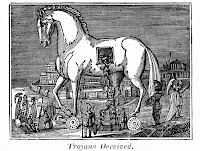
Talk about Trojan horses.

Big corporations cannot be analyzed separately from government.

When the state outsources its spying to corporations, for someone to argue that the state should not limit corporate surveillance because it’s engaged in surveillance itself is confused, at best, and downright misleading, at worst.

Especially when it comes from seasoned politicians like the Pauls.

Parts of the government are scrutinizing the private sector. Often they’re right to.

Other parts of government are much worse than the private sector when it comes to privacy violation.

Those parts of the government are often most incestuously allied with corporations. This is the corporate-state or intel-industrial complex that produces programs like Echelon.

So it’s quite bizarre for the Pauls to claim that Microsoft (or Google or Apple) are pure private-sector entities, when they gain market share directly because of concrete government actions on their behalf and because of endemic and pervasive state-created judicial/legal/financial corruption.

One more thing.  Microsoft wasn’t prescient at all about the net, as the Pauls claim in their new manifesto.

It was way behind. Gates himself admitted it.

There is, finally, another reason why the Pauls may have turned their attention to protecting Big Data,

It looks like Big Data is bankrolling him.

Here’s Reason’s Brian Doherty, making the point:

“With Peter Thiel, founder of the controversial “big data” company Panantir, having made a $2.6 million investment in the (somewhat feckless in the end) superPAC “Endorse Liberty” during campaign season, perhaps the Paul machine sees this as a cause that can energize both grassroots and big money.”

And that’s all  I want to say now about this turn of events until I learn a bit more what is really going on.

But, if you were waiting to see Ron Paul libertarianism implode, it happened this week.

Rajat Gupta: Did Goldman Frame Gupta To Save Its Skin?

We know that Rajat Gupta was a big Obama supporter.

We know that Goldman Sachs switched its loyalties to Mitt Romney earlier this year, mainly out of animosity to Dodd-Frank, which they claim is crushing the banks.

As early as last year  ThirdPoint LLC, said to be part of a Michael Milken-related market racketeering network, attacked Obama.

[Third Point is a leading hedge-fund that’s  credibly alleged to have colluded with Goldman Sachs in collusive raids on rivals. Documents accidentally released in a lawsuit against Goldman Sachs by Patrick Byrne of Overstock now show that Goldman did in fact pass on non-public information of its clients to select hedge-funds .

ThirdPoint has since cut stakes in Goldman Sachs in March this year, probably sensing that the firm is due for a huge beating.]

GS’s troubles are ongoing.

In March 2012, Greg Smith, a senior manager, trashed the firm, specifically Lloyd Blankfein and Gary Cohn, for corrupting the culture…..as if that were possible.

Two other Goldman executives are under investigation for tipping caught on wire-taps, Henry King and David Loeb.

[This is the evidence that Judge Jed Rakoff wouldn’t let the jury hear. It was the core of the defense’s argument that, not Gupta, but the other proven tipsters at Goldman has passed on the Buffett tip. The jury, confused by hearsay that was wrongly included of Gupta talking about non-public non-material information to Galleon, hung the Galleon case on him and convicted on this insubstantial evidence.]

Last year,  after the SEC first began administrative proceedings against Rajat Gupta (March 2011) we heard that Lloyd Blankfein had hired a big-shot DC criminal attorney (August 23, 2011).

Then, in Feb 2012,  sources close to Goldman reported to the NY Post that the nine month long investigation would likely not lead to criminal charges.

Why not?

How did they become so sure that Blankfein wouldn’t be facing charges?

Did they fix the deal around that time?

Only a month later, March 2012, the defense reluctantly began sending particulars of its charges to Gupta.

Yet it had been investigating Big Raj for a decade, and had been on the Galleon case since 2007.

What took so long? Was there any pressure from Goldman?

Was the fix in by then, and is that why Goldman insiders were so sure that Blankfein would be off the hook?

After all. Gupta is a RETIRED director at Goldman, and his main professional association is with McKinsey, not with Goldman.

He had nothing to do with the trading culture of Goldman that was the source of its problems.

He just sat on a board, which probably met a few times a year. The public, angry at Goldman, wouldn’t know that they’d been fed Gupta, to protect the core of Goldman itself.

Did Blankfein figure out that throwing overboard a South Asian patsy, albeit a powerful one, one associated with the loss of jobs to Americans, would save his skin in the media, dominated, rightly, by anger over the financial crisis?  Did it help that Gupta was also an Obama donor?

That Blankfein had an eye on PR at this time is clear because around the same time that he  made some other interesting moves, as I noted earlier.

1. He announced his support for Romney (January 2012)

2. He told the press that Goldman was in the clear (February 2012)

(This was around the time the defense was asking for particulars of the charges to be sent)

3. Bharara starts sharing Brady material (Feb 2012)

In March 2012, a month later, Bharara was finally forced to disclose what specifically he had on Rajat Gupta.

4. Blankfein was hired as a public spokesman for gay marriage by Human Rights Campaign  (February, 2012).

The timing of all these events is surely extremely suggestive…

Blankfein’s attorney, Reid Weingarten, represented WorldCom CEO, Bernie Ebbers, who was convicted in 2005 of fraudulent accounting, in the largest such scandal in US history until the Bernie Madoff ponzi.

Charles Gasparino at The New York Post:

“Goldman Sachs will not support Obama,” the firm’s CEO, Lloyd Blankfein, muttered at a recent dinner.

It was a meeting with the CEO of Blackrock, Larry Fink, himself another of Wall Street’s top Obama boosters back in 2008. But “Larry is looking for someone to support this time,” a friend of Fink told me.

Blankfein has apparently found his pick. According to people who know him, Blankfein’s bet is that Romney will win the Republican nomination fairly early, putting him in a decent position to win the presidency — and in office does his best to water down some of the more insane aspects of the Dodd-Frank financial-reform law.

Some caveats: Romney barely won the Iowa caucuses and still faces much conservative skepticism about his various flirtations with big government as Massachusetts governor. Goldman still has many committed Democrats, and Wall Street support can be fickle. Blankfein might well reverse his bet if Obama takes a commanding lead in the polls.

But with the polls fairly even, the firm so far seems to be betting big that the GOP base will conclude that Romney has the best chance of winning over independents and beating the president in November. That would allow a reversal of Obama’s most leftist policies — including financial reform, which threatens to strangle Goldman and all the big banks while doing little to address the core problems that led to the 2008 collapse.

What makes Goldman’s move to the right so striking is just how far to the left it was in 2008. The Goldman community gave more than a $1 million to the 2008 Obama campaign, bested only by donors tied to the ultraliberal University of California. But the latest contribution records (through the end of September) show that Goldman-linked givers barely crack the top 20 of Obama donors, with a little more than $50,000 toward his 2012 re-election effort.

By contrast, Goldman-linked donors are Romney’s leading source of corporate campaign cash, spending $367,200 on his 2012 effort so far. That’s nearly $127,000 more than the firm put up for 2008 GOP nominee John McCain.

Not that Goldman has suddenly become a hotbed of Tea Party conservatism. Its beef with Obama is focused almost entirely on Dodd-Frank’s impact on its bottom line.”

Doing Well By Doing Good: Corporate Brand Teaching

In the old days, people who did things for love of their community, for idealism, or for a cause they believed in, were in it just for that. They deserved the respect they got. Today, volunteer work has been festooned with all kinds of goodies, and, not unnaturally, it’s drawing people more interested in the goodies than the good. And not unexpectedly, the king of “doing well by doing good” –  Goldman Sachs – is in the thick of it. Continue reading →

Steve Cohen To Leave Trading, Says Vanity Fair

Well, well, well. It looks like Patrick Byrne, Judd Bagley, Mark Mitchell and the rest of the estimable team at Deep Capture are having more than some effect.

Not only have the Germans and Austrians banned naked short- selling, Vanity Fair, our least favorite low-class, high-gloss magazine of the DC twitterati, tells us that Steve Cohen is closing up shop as a trader. Sith Lord Cohen doesn’t like the spotlight, it seems.  Maybe he remembers all too well what he was up to in the 1980s……even if Reuters wants to keep it buried.

Vanity Fair:

In the July issue of Vanity Fair, legendary hedge-fund billionaire Steve Cohen tells special correspondent Bryan Burrough that he might be ready to walk away from active trading. How big would that be? Well, says Burrough, it’s “a little like saying that God is ready to walk away from Earth.” In this video, Burrough takes the measure of Cohen’s controversial careeer—and offers his theory on why the reclusive banker granted the second in-depth interview of his 30-year career to Vanity Fair.

The Daily Bell Gets It….

The Daily Bell on why the show trial of Goldman (albeit a worthy target, in my opinion) is most likely to be just another ruse of the powers that be:

“The progressive press, in our estimation, tries to blame individuals or certain corporations (Enron comes to mind, and now Goldman) to distract from the larger issue, which is the corruption of civil society itself by this horrid, pernicious mercantilism. Continue reading →

John Paulson: Market Fraud, Not Market God

John Paulson – more crooked than clever, says The Big Money:

“What emerges from the SEC’s charges against Goldman Sachs (which, it should be noted, the investment bank is strenuously denying) isn’t a story of Paulson seeing a crisis coming when others are still happily buying up housing derivatives. No, it’s a story of reluctant buyers manipulated into buying more collateralized debt obligations when it was already clear that the market was falling apart.”

SEC Brings Action Against Goldman Sachs

Update 1(April 17)

Glad to see that Simon Johnson is making the same point I make here, that charges should also be brought against John Paulson, or the system is broken beyond repair.

Market Watch:

“SAN FRANCISCO (MarketWatch) — The Securities and Exchange Commission on Friday charged Goldman Sachs & Co. and one of its vice presidents for defrauding investors by misstating and omitting key facts about a financial product related to subprime mortgages.

The SEC alleged in a lawsuit that Goldman /quotes/comstock/13*!gs/quotes/nls/gs (GS 158.38, -25.89, -14.05%) structured and marketed a collateralized debt obligation that hinged on the performance of subprime residential mortgage-backed securities. However, it failed to disclose the role that a major hedge fund, Paulson & Co., played in the portfolio selection process as well as the fact that the hedge fund had taken a short position against the CDO.”

This hit the FTSE, which fell 100 points, and the DJIA, 120 points and caused a tumble in GS’s share value, down by about (GS 165.40) 18% this morning. Investment banks and brokerages are down 7.6%.

This is likely to start a sell-off in the financial sector as a whole (down 3.1%) and possibly the much waited next leg down of the great correction that began in 2007-08.

Michael Roston points out the obvious. The amount in question in the Abacus deal is $15 million bucks, which is chump change.

Point two. No one’s saying anything about John Paulson, who made $1 billion out of it.

[Or, to take another instance, what about the Greek government, which is also getting bailed out….by tax-payers of another country? No culpability for the governments who get into these kinds of deals?]

You’ll also notice, as I blogged earlier, that George Soros, another speculator, has also called for the IB’s to be broken up (using the same argument, “too big to fail means too big to exist” – something also pushed by David Einhorn and the left-liberals). Now, I can see the sense in the “too big to fail, too big to exist” mantra, especially, if it had been used against the banks before they helped themselves to tax-payer money. But I wonder why it’s being repeated now, after the fact….and not then..

I didn’t hear these same critics of size pipe up at that crucial time.

Why?

Daily Bell Interview of GATA’s Bill Murphy

The Daily Bell interviews Bill Murphy of GATA (Gold Anti-Trust Action Committee):

“It’s something like out of a James Bond movie. What are the odds that my testimony gets blotted out from live coverage and then our whistleblower and wife get hit by a car the next day? … The gold scandal story is larger than life to begin with. Now throw this spooky stuff on top of it. Veteran Cafe (Le Metropole Cafe, Murphy’s website) members will recall that in the early part of this century what happened to me during a six week period …

My car was stolen and then found on a nearby highway one day after the insurance company paid me off. There was no damage to the car, money left in the console, and a cashmere sweater in the back seat.

My web site was hacked and somebody sent out a very goofy email supposedly from me, but it was not me.

Coming out of a restaurant/night spot less than two blocks from where I live, somebody jumped out from behind a wall and sucker-punched me with brass knuckles. I was out cold and thought my jaw was broken.

Nothing like this has happened before or since.

Daily Bell: Do you think, this time, that the CFTC must take all this seriously.

Bill Murphy: Outside of Bart, it appears none of them want to go there. GATA is like their worst nightmare because they are like everyone else … kowtowing to the rich and powerful. However, a firestorm is growing about what GATA has to say, partially ignited by the Andrew Maguire revelations. I suspect we are finally going to receive some mainstream press in the months ahead, which will be like shining a light on Dracula.

Daily Bell: Why hasn’t it already?

Bill Murphy: The relationship between a government agency like the SEC and the CFTC is insidious. Nobody wants to rock the boat. Heck a number of these people at these agencies end up working on Wall Street, or interact business-wise in some other manner. The Chairman of the CFTC is a Goldman Sachs alumni. That about says it all.”

My Comment:

To follow..

Soros To Buy Stake In Bombay Stock Exchange, Goldman Seeks Commercial Banking License in India

Palak Shah at the Business Standard :

“US micro hedge fund legend George Soros and the world’s third biggest philanthropist George Kaiser are in the race to acquire close to 4 per cent in the Bombay Stock Exchange (BSE), Asia’s oldest stock exchange.

Soros has bid for the BSE stake, held by the embattled Dubai Financial Group LLC, through Soros Fund Management LLC, and Kaiser has done so through private equity fund, Argonaut.

Other investors who have bid for BSE stake include New York-based private equity majors J C Flowers and Caldwell Investment, promoted by Toronto investment broker Thomas Caldwell. Caldwell is a specialist investor in stock exchanges and bought 4.3 million shares of the New York Stock Exchange in 2006. Sources added that a private equity fund has bid Rs 370 for each share, valuing BSE at over Rs 3,800 crore. Avendus Capital is advisor to the deal.

Dubai Financial, part of sovereign fund Dubai Holding, holds 3.92 per cent stake in BSE, which it bought when the exchange was demutualised in 2007. BSE was then valued at Rs 3,780 crore. While BSE and Avendus could not be reached for comment, sources familiar with the developments said Dubai Financial felt the exchange deserved a higher valuation in the current situation.

In the recent past, the valuation of the exchange saw a sudden spurt after a new management team took over in 2009.

While some stock brokers sold BSE shares at around Rs 180 a piece some six months ago, a bank auctioned 0.27 million shares at Rs 320 a couple of months ago.

Under the new management, BSE changed its derivative trading cycle to compete with the National Stock Exchange, launched a mutual fund trading platform and is upgrading its technology platform. BSE currently has a near 28 per cent share of the equity spot market in the country and has been making efforts to develop its derivative trading segment, where National Stock Exchange is a monopoly player. BSE will launch currency derivatives in May and is also in the process of increasing its stake in Central Depository Services Ltd to 51 per cent.

Currently, six foreign investors hold 25.65 per cent of BSE and five Indian institutions hold 12 per cent.

A little under 62 per cent of BSE’s shares are widely held. Among the key Indian shareholders are firms such as Bajaj Holdings and Investment, which owns 2.94 per cent, Infosys Technologies CEO and MD S. Gopalakrishnan, who owns 1.04 per cent and media major Bennett, Coleman and Co, which owns 1.04 per cent.

BSE recently announced 12 bonus shares for every share held and the exchange currently has around Rs 2,000 crore of cash reserves, which translates into cash per share of at least Rs 190.

BSE posted a net profit of Rs 55.42 crore on revenue of Rs119.21 crore for the quarter ended December 2009.”

The launching of the mutual fund platform and the upgrading of the technology and expansion of derivative trading is exactly what Goldman Sachs introduced into the New York Stock Exchange in the 1990s. And we saw what happened in the 15 years following. And Goldman is in India, currently seeking a commercial banking license to operate there.

With the same players around (Soros, Goldman Sachs etc. ), there’s no reason to believe that what’s coming up for the Bombay Stock Exchange won’t take the same direction. Before the financial crisis, the Indians had little exposure to the highly levered derivatives and toxic debt that blew up the system elsewhere. Let’s see whether this upcoming round they’ll be as lucky. With economies stagnant elsewhere, Asia and some select African countries are the only places where there’s actual economic growth occurring.

I’m afraid the same handful of corrupt players will game the system there…

More here at The Economic Times:

“His hedge fund Quantum, which was reported to have posted earnings of over 30% last year, went on a buying- spree at a time, when most funds were dumping stocks in a sliding market. On July 4, Quantum Fund bought a 3.8% equity in Jain Irrigation Systems, and close to 1% of the holding of Jai Corp for a value consideration of Rs 167 crore. Since February, the fund has made investments valued at close to Rs 600 crore, or $ 140 million, in various companies, including Indiabulls Financial Services, Indiabulls Real Estate and Kalindee Rail Nirman. Quantum’s selective stock picking comes at a time, when institutional investors have been pulling out a large chunk of money amid concerns over a combination of factors such as weak global markets, soaring global oil prices and spiraling inflation in India. “Hedge funds normally are active, when there is some momentum in the market. Quantum may be trying to do some value-buying, but one has to see how long the fund stays invested, given the prevailing uncertain market conditions,” said a stock-broker..”

Remember Formula K (or, the First Law of Kleptocracy) :

s(B) + s(G) + s(S) v. EE where ‘s’ is always a positive integer

Some (s) of the big banks (B – eg. JP Morgan, Goldman Sachs, Citi etc.)

+

Some parts of government (G – eg. parts of the SEC/Treasury/Fed Reserve Chairman, IMF, World Bank etc.)

+

Some hedge-funds and speculators (S – eg. Soros, Paulson (?), Loeb, Cohen and others reportedly involved in manipulation and collusion with government)

Versus

Every one else (EE)

Hanky-Panky At The Counting House

I thought I’d repost a piece that I wrote in Dissident Voice, way back in 2006. It helps give some background to the JP Morgan manipulation story.

And it also adds some background to the ongoing re-valorization of the once discredited IMF. Along with that re-valorization, is the hyping of anyone supporting even further central regulation, although the financial crisis occurred in all sorts of places that have plenty of it.

All this centralization and global government is supposedly for the welfare of the world – but there is no “welfare of the world” that can be safely accepted as gospel from the mouths of the financial industry and its political and media allies.

Note the date of the piece below – back on June 6, 2006, when, dare I say it, most of the financial talking- heads and blogs now being treated as the only legitimate interpreters of reality were doing…well, they weren’t reading GATA or supporting its work, I’m pretty sure. To have done so then would have made them persona non grata in the very same liberal media that is now embracing this research and that GATA, in turn, seems to be endorsing….for its own reasons..

Check it out for yourself.

Here’s an excerpt from the piece: “Hanky-Panky at the Counting House” (June 6, 2006)

Also, at Dissident Voice, you can find “Was The IMF Involved in Gold Price Manipulation” (June 8, 2006) which was also posted at Daily Reckoning and on one of the gold sites.  I think it’s been taken off Daily Reckoning since.

“The unofficial theory is naturally a lot juicier, although described by even sworn enemies of paper currency as conspiratorial. Still, it’s managed to rear its head in the Wall Street Journal, so it can’t be all wet. Here is what widely respected libertarian Congressman Ron Paul had to say on Feb 14, 2002:

While the Treasury denies it is dealing in gold, the Gold Anti-Trust Action Committee (GATA) has uncovered evidence suggesting that the Federal Reserve and the Treasury, operating through the Exchange-Stabilization Fund and in cooperation with major banks and the International Monetary Fund, have been interfering in the gold market with the goal of lowering the price of gold. The purpose of this policy has been to disguise the true effects of the monetary bubble responsible for the artificial prosperity of the 1990s, and to protect the politically-powerful banks that are heavy invested in gold derivatives. GATA believes federal actions to drive down the price of gold help protect the profits of these banks at the expense of investors, consumers, and taxpayers around the world.

GATA has also produced evidence that American officials are involved in gold transactions. Alan Greenspan himself referred to the federal government’s power to manipulate the price of gold at hearings before the House Banking Committee and the Senate Agricultural Committee in July, 1998: Nor can private counterparts restrict supplies of gold, another commodity whose derivatives are often traded over-the-counter, where central banks stand ready to lease gold in increasing quantities should the price rise. [Emphasis added] (3)

More specifically:

Gold is borrowed by Morgan Chase from the Bank of England at 1 percent interest and then Morgan Chase sells the gold on the open market, then reinvests the proceeds into interest-bearing vehicles at maybe 6 percent.

At some point, though, Morgan Chase must return the borrowed gold to the Bank of England, and if the price of gold were significantly to increase during any point in this process, it would make it prohibitive and potentially ruinous to repay the gold. (4)

In plain English, the strong dollar policy that put the sizzle in the stock market under Clinton was made possible only by manipulating the gold market to keep prices low. The low interest rates which kept the economy on the boil went hand in hand with low gold prices. Investment banks used the low rates to borrow gold from the central banks and sold them short (short selling being the technique of selling assets you don’t actually own in the hope of buying back at a cheaper price because you anticipate a fall in the price). This allowed the banks to make billions from a market rigged to take the risk out of their shorting. And it kept the dollar pumped up. And who was the architect of this strong dollar policy? Why, none other than Robert Rubin of Goldman Sachs — one of the bullion banks most implicated in the gold fixing scenarios.

So, the appearance of another Gold-man at this critical moment is all the proof the gold cartel theorists need that more manipulation is in store to keep the dollar up, gold down, and the bullion banks from losing their . . . er . . .  shorts. (5)

And if this seems conspiratorial, consider what Paul Mylchreest, investment analyst at Cheuvreux, top ranked for its research in Western Europe and part of Credit Agricole, the largest bank in France says today, “Central banks have 10-15,000 tonnes of gold less than their officially reported reserves of 31,000. This gold has been lent to bullion banks and their counterparties and has already been sold for jewellery, etc. Non-gold producers account for most and may be unable to cover shorts without causing a spike in the gold price…” (6)

Or what the Wall Street Journal itself wrote about what took place in the seventies:

Worried the falling dollar was undermining its anti-inflation efforts, the Carter administration announced a multi-part support package on Nov. 1, 1978: The Treasury would use gold sales and foreign borrowing and draw on its reserves with the International Monetary Fund to defend the dollar. At the same time the Federal Reserve raised its discount rate a full point. (7)

And that was in the ’70s, when there was no credible alternative to the dollar, India and China were sleeping giants, Russia was still the Soviet Union, and the United States was not threatening to nuke the Middle East.

How bad is the situation?

[A]s of June 2000, J.P. Morgan reported nearly $30 billion of gold derivatives and Chase Manhattan Corp., although merged with J.P. Morgan, still reported separately in 2000 that it had $35 billion in gold derivatives. Analysts agree that the derivatives have exploded at this bank and that both positions are enormous relative to the capital of the bank and the size of the gold market.

It gets worse. J.P. Morgan’s total derivatives position reportedly now stands at nearly $29 trillion, or three times the U.S. annual gross domestic product. Wall Street insiders speculate that if the gold market were to rise, Morgan Chase could be in serious financial difficulty because of its “short positions” in gold. In other words, if the price of gold were to increase substantially, Morgan Chase and other bullion banks that are highly leveraged in gold would have trouble covering their liabilities. (8)

That was 2000. This is 2006.

So long as gold remains a mere relic . . . a yellow reminder of what used to be money . . . no harm done. Unless something absurd happens, that is. Something absurd like, say, gold doubling to $573 an ounce inside 5 years. If that happened, then the “carry trade” of borrowing gold to invest in paper could become a very expensive way to bankrupt the entire global financial system. (9)

This spring gold hit over $700. And that’s why the hanky-panky is likely to begin in earnest now.

Lila Rajiva is a freelance writer in Baltimore, and the author of the must-read book The Language of Empire: Abu Ghraib and the US Media (Monthly Review Press, 2005) She can be reached at: lrajiva@hotmail.com. Copyright (c) 2006 by Lila Rajiva

NOTES

(1) “Good as Goldman: Bush drafts Hank to bat third,” Daniel Gross, Slate, Tuesday, May 30, 2006.

(2) “Please, Sir, I Want Some More. How Goldman Sachs is carving up its $11 billion money pie,” Duff Mcdonald, New York Metro, Dec 21, 2005.

(3) Speech of Congressman Ron Paul, U.S. House of Representatives, February 14, 2002, www.house.gov/paul

(4) “All That Glitters Is Not Gold,” Kelly Patricia O’Meara, Insight Magazine, March 4, 2000.

(5) According to GATA, the cartel includes J.P. Morgan Chase, Deutsche Bank, Citigroup, Goldman Sachs, Bank for International Settlements (BIS), the U.S. Treasury, and the Federal Reserve

(6) “How Central Banks Have Kept Gold Down,” Adrian Ash, Money Week, February 9, 2006.


(7) “As Dollar Weakens, Hidden Strengths May Stave off Crisis,” Wall Street Journal, January 17 2005.


(8) See Note 4.

(9) See Note 6.

Europe Thumbs Its Nose At G-Sax, Banksters

The Guardian:

“For the first time in five years, no big US investment bank appears among the top nine sovereign bond bookrunners in Europe, according to Dealogic data compiled for the Guardian. Only Morgan Stanley ranks at number 10.

Goldman Sachs doesn’t make the table. Goldman made it to number five last year and in 2006, and number eight in 2007, the data shows. JP Morgan was in the top ten last year and in 2007 and 2006 but doesn’t appear this year.

“Governments do not have the confidence that the excessive risk-taking culture of the big Wall Street banks has changed and they still cannot be trusted to put the stability of the financial system before profit,” said Arlene McCarthy, vice chair of the European parliament’s economic and monetary affairs committee. “It is no surprise therefore that governments are reluctant to do business with banks that have failed to learn the lesson of the crisis. The banks need to acknowledge the mistakes that were made and behave in an ethical way to regain the trust and confidence of governments.”

Goldman Charity Prompted By PR Concerns

RaceTotheBottom, a law blog on corporate regulatory issues, has this on the latest PR move  by Goldman Sachs, one we noted in our previous blog post on Haiti. which mentioned the donations made by the big banks.

“The latest effort by Goldman to ameliorate the criticism is apparently to require top officers and managers to donate a certain percentage of their compensation to charity. As the NYT noted:

* While the details of the latest charity initiative are still under discussion, the firm’s executives have been looking at expanding their current charitable requirements for months and trying to understand whether such gestures would damp public anger over pay, according to a person familiar with the matter who did not want to be identified because of the delicacy of the pay issue.

Apparently Bear Stearns had done something similar in the past, requiring the top 1000 employees to contribute 4% of their compensation to charity.

The specifics have apparently not yet been determined. Nonetheless, unlike the stock bonuses, the approach effectively reduces the amount of compensation paid to each employee.

Goldman could have considered reducing the amounts paid in compensation and contributed the saved amounts directly to charity. The financial institution in fact added an additional $200 million to its charitable foundation. But making direct contributions would have potentially violated state law.

Corporations are obligated to profit maximize. Some portion of the company’s profits can be donated to charity. Companies may do so, however, only if there is a business benefit. See RMBCA § 3.02(15)(permitting “donations, or do any other act, not inconsistent with law, that furthers the business and affairs of the corporation.”). For modest amounts of contributions, the business benefit can be vague, with enhanced reputation in the community enough of a justification.

For more significant amounts, however, there must be a sufficient nexus to the business of the company. Had Goldman chosen to donate 5% of the amount left aside for compensation, an amount that would probably exceed $1 billion, it would have needed to show some type of meaningful connection to its business. Any failure to do so would likely generate lawsuits from shareholders alleging that the board had failed to engage in the required profit maximization.”

My Comment:

Isn’t this exactly why the more laws you have on the books, the more complicated your problems get?

Think about it. Goldman can’t make direct charitable contributions, because companies are obligated to maximize profits. Why are they obligated to maximize profits?

Because that’s what shareholders are due, per company law.

You might ask whether maximizing profits is always in a company’s best interests, versus building long term value or market share or any number of other things that stake-holders in the company might value more than high returns, but those things don’t count, because that’s how a law works – like a blunt instrument.

And then when managers focus on these short-term horizons and start doing legal (or illegal) tricks to show quick gains on their books, then we need another set of laws to curb them, with incentives running in the opposite direction….

The end result is a muddle of misplaced directives and restrictions that distort the market.
And people criticize the free market!

Janet Tavakoli Faces Off With Goldman On AIG CDOs

Janet Tavakoli in Market Watch

“Earlier, Goldman denied it could have known this was a problem, yet acknowledged I had warned about the grave risks at the time. If Goldman wants to stick to its story that it didn’t know the gun was loaded, then it is not in the public interest to rely on Goldman’s opinion about the greater risk it now poses to the global markets.

Goldman excuses its participation by saying its counterparties were sophisticated and had the resources to do their own research. This is a fair point if Goldman were defending itself in a lawsuit with a sophisticated investor trying to recover damages. It is not a valid point when discussing public funds that were used to bail out AIG, Goldman, and Goldman’s “customers.”

Goldman claims the portfolios were fully disclosed to its customers. Yet at the time of the AIG bailout, Goldman did not disclose the nature of its trades with AIG, and Goldman did not disclose these portfolios to the U.S. public. If it had, the public might have balked at the bailout.

The public is an unwilling majority owner in AIG, and public money was funneled directly to Goldman Sachs as a result of suspect activity. The circumstances of AIG’s crisis were extraordinary and without precedent. I maintain that the public is owed reparations, and it would be fair to make all of AIG’s counterparties buy back the CDOs at full price, and they can keep the discounted value themselves.”

Fraud On the Run: Goldman Cop On SEC Beat (ROTFLOL)

In the news, to be filed under – What parallel universe does New York live in?:

“Oct. 16 (Bloomberg) — The U.S. Securities and Exchange Commission named Adam Storch, a 29-year-old from Goldman Sachs Group Inc.’s business intelligence unit, as the enforcement division’s first chief operating officer.

Storch, who joined the SEC Oct. 13, was named to the newly created post of managing executive in the enforcement unit, charged with making the division more efficient, the SEC said today in a statement. At New York-based Goldman Sachs, he had worked since 2004 in a unit at that reviewed contracts and transactions for signs of fraud.”

My Comment:

Personally, I’ve come to nurse a kind of contemptuous respect for, an appalled amusement at Goldman Sachs. It’s the contrarian in me.

In-your-face-corrupt, shameless, self-promoting, out-of-touch, sanctimonious, and bottomlessly greedy –  It’s a firm made for our times…

If Goldman Sachs didn’t exist, we’d have to invent it.

Government Profiting from Bailed-out Banks

In the news, AP reports:

“Critics of the bailout were concerned that the Treasury Department would never see a return on its investment. But the government has already claimed profits from eight of the biggest banks.

The Times cited government profits of $1.4 billion from Goldman Sachs, $1.3 billion from Morgan Stanley and $414 million from American Express. It also listed five other banks — Northern Trust, Bank of New York Mellon, State Street, U.S. Bancorp and BB&T — that each returned profits between $100 million and $334 million.”

The government has also collected about $35 million in profits from 14 smaller banks, the Times reported.