Let me put this as bluntly as possible. A state cannot be “compassionate.” Policies might have well-intentioned goals, but they are policies – that is, legal and administrative enactments, often backed by force, that must be followed by whoever falls under their jurisdiction, regardless of their state of mind.
On the other hand, compassion is a quality of heart and intention. An involuntary A non-voluntary action consequent to a policy cannot be compassionate. Obedience to a legal requirement cannot be compassionate. Compassion can be understood only by the context and the state of mind of an individual.
Libertarianism is not..should not be…and cannot be… compassionate.
Instead, it is the attitude to government policy and law that best allows human beings to act with the compassion each is capable of. To force “compassion” on people who don’t want to be “compassionate” is simply force, just as surely as if you were forcing anything else on them that they didn’t want. What looks like “compassion” to you might, after all, look like “expropriation” to me.
“Compassionate” policies might indeed achieve some immediate goal that makes some group of people more satisfied than they previously were. But it surely makes another group unhappy in order to do so. Now, the trade off might..or might not…be worth it. But the entity making that utilitarian calculation isn’t an individual, it’s at best a committee of hacks, at worst, a mafia of thugs….or worst of all, some economic model cooked up in a Harvard professor’s study.
By transferring “compassion” to the state, “compassionate conservatism” encourages people to become less compassionate personally. People actually become meaner. Why wouldn’t they? They’re already being taxed at a third to half their money, effectively. Even the good lord only asked for ten percent.
(Note: I don’t necessarily agree with Robert Ringer’s other views on defense. I don’t see a necessity for the US to be on a perma-war footing that involves aggressive wars overseas and an extensive network of bases. As a libertarian, I endorse a strong defense but one that’s decentralized and limited to volunteers, not mercenaries. It would be based on universal ownership of and training in firearms and would refrain from interfering in foreign internal affairs. This would go along with a decentralized government, supported by state and citizen militias. Most of all, I endorse economic freedom and prosperity as our greatest defense. The more attractive the US is as a trade partner, the less foreign states are going to hurt their own economic interests by turning hostile.
Far from strengthening the country, anti-market economic policies and a perpetually intrusive foreign policy are draining money, time, and energy from it.
(Nonetheless, I don’t think we can disarm unilaterally “at one fell swoop,” without opening up a can of worms, now that the government has actually created multiple foreign threats by its belligerence).
“I repeat what I said earlier: If anything, I believe the tea-party rally on tax day was far too docile. It once again demonstrated just how intimidating the far left can be. Not only intimidating, but clever.
How so? The BHO oligarchy has managed to change the Big Question from ”Is Obama a socialist?” to ”Is the tea-party movement dangerously immersed in racism, hate speech, and violence-prone affiliations with paramilitary groups?” Never sell the Saul Alinsky crowd short when it comes to turning every negative around and pointing it in the direction of its accusers.
I honestly believe that Der Fuhrbama believes his verbal skills are so powerful that he can embarrass the tea-party people into submission. He may be a lightweight in most respects, but he’s a lightweight with an abundance of (over)confidence. The tea-party people had better take a page from Rules from Radicals and press down twice as hard on the accelerator, lest they lose their momentum long before November 2.
Docile simply doesn’t cut it. Just ask the compassionate conservatives who are now in the process of going down in flames.”
“The Commission approved the Goldman suit in a vote that spit along party lines – a rare occurrence for approvals of enforcement litigation.
—Before the Commission had released its announcement, the New York Times published on its website a story describing the suit.
–Less than half an hour after the Times story’s publication, Organizing for America, the successor organization to Obama for America and now a project of the Democratic National Committee (“DNC”), sent millions of supporters an e-mail message from President Obama urging support for “Wall Street Reform.”
–Within hours, the Democratic National Committee had purchased AdWords advertising from Google, Inc. The DNC’s Google campaign fundraising advertisement, headed “Fight Wall Street Greed,” appeared whenever a user ran a Google search for the phrase “Goldman Sachs SEC.” It read, “Help Pres. Obama Reform Wall Street and Create Jobs. Families First!” and included a link to www.BarackObama.com, the website of Organizing for America.
–Democrats in Congress and the Administration have heralded the Commission’s suit against Goldman as a welcome boost to their case for the legislation.
–Members of the media have already begun to question the timing of the Commission’s suit and the actions of the Democratic National Committee.
As supported by the Commission’s canons of ethics, and as frequently reiterated by you and other Commissioners, the unqualified independence of financial regulators is crucial to the health of the financial system and the U.S. economy. For this reason, doubts about whether the Commission has scrupulously guarded its independence from the Administration’s partisan political agenda and concerted efforts to manipulate Congressional action are very serious, and should be addressed with full transparency.”
[NoteI: I mentioned Engdahl’s piece about Soros and Rothschild earlier, with the disclaimer that EIR is a Larouche outfit often labeled conspiracist and anti-Semitic, but nonetheless acknowledged to have produced good research. This piece, as I found it on the net, is not extensively sourced, which is why I’ve not previously linked it. However, having recently found old newspaper articles substantiating at least a part of the material, I’m going ahead and posting it.
Note II: Soros has a variety of interesting business associations. He has ties with Jim Rogers, through the Quantum Fund, which Rogers left to form his own group; with Rees-Mogg, the British journalist and Agora associate/writer; and with James Goldsmith, the Anglo-French financier, who was at one time Rees-Mogg’s primary financial backer. But, Goldsmith, a speculator and corporate raider in the 1980s, was vehemently opposed to GATT and the drive to globalize in teh 1990s, which seems to rather complicate the economic hit-man narrative. Rogers’ pronouncements, as much as I’ve followed them, often directly contradict Soros’ public statements.
Thus, in my opinion, while there could well be collusion at work among some (or even all) of these entities, from the record, at least, the situation is much muddier. For instance, if you look at what Goldsmith has to say about globalization in the 1990s, he is anti-agribusiness, anti-nuclear power, and anti-GATT. That diverges sharply from Engdahl’s general premise, which is best exemplified in the shock-doctrine advocated by Soros in Russia, via economist Jeffrey Sachs (the best account of which is by journalist Ann Williamson, who testified on the matter to Congress).
The truth is, many people advocate many kinds of things from ideology. That ideology is often shared by their business associates, since people with shared ideologies usually end up working in the same place. That doesn’t automatically mean they are all working hand-in-glove, or even know each other more than superficially. Even the joint ownership of a fund or corporation, unless it is over a long period of time, does not have to imply that the owners are all in agreement with each other’s financial goals. That said, there are suggestive connections noted in this piece that are relevant both to the debt crisis in Europe and to the ongoing manipulation of the markets, which is why I want to link the piece, despite the problems with it that I’ve noted.
Here’s an excerpt relevant to the situation in Poland:
“Poland: In late 1989, Soros organized a secret meeting between the “reform” communist government of Prime Minister Mieczyslaw Rakowski and the leaders of the then-illegal Solidarnosc trade union organization. According to well-informed Polish sources, at that 1989 meeting, Soros unveiled his “plan” for Poland: The communists must let Solidarnosc take over the government, so as to gain the confidence of the population. Then, said Soros, the state must act to bankrupt its own industrial and agricultural enterprises, using astronomical interest rates, withholding state credits, and burdening firms with unpayable debt. Once this were done, Soros promised that he would encourage his wealthy international business friends to come into Poland, as prospective buyers of the privatized state enterprises. A recent example of this privatization plan is the case of the large steel facility Huta Warsawa. According to steel experts, this modern complex would cost $3-4 billion for a western company to build new. Several months ago, the Polish government agreed to assume the debts of Huta Warsawa, and to sell the debt-free enterprise to a Milan company, Lucchini, for $30 million!.
Soros recruited his friend, Harvard University economist Jeffery Sachs, who had previously advised the Bolivian government in economic policy, leading to the takeover of that nation’s economy by the cocaine trade. To further his plan in Poland, Soros set up one of his numerous foundations, the Stefan Batory Foundation, the official sponsor of Sach’s work in Poland in 1989-90.
Soros boasts, “I established close personal contact with Walesa’s chief adviser, Bronislaw Geremek. I was also received by [President Gen Wojciech] Jaruzelski, the head of State, to obtain his blessing for my foundation.” He worked closely with the eminence gris of Polish shock therapy, Witold Trzeciakowski, a shadow adviser to Finance Minister Leszek Balcerowicz. Soros also cultivated relations with Balcerowicz, the man who would first impose Sach’s shock therapy on Poland. Soros says when Walesa was elected President, that “largely because of western pressure, Walesa retained Balcerowicz as minister.” Balcerowicz imposed a freeze on wages while industry was to be bankrupted by a cutoff of state credits. Industrial output fell by more than 30% over two years.
Soros admits he knew in advance that his shock therapy would cause huge unemployment, closing of factories, and social unrest. For this reason, he insisted that Solidarnosc be brought into the government, to help deal with the unrest. Through the Batory Foundation, Soros coopted key media opinion makers such as Adam Michnik, and through cooperation with the U.S. Embassy in Warsaw, imposed a media censorship favorable to Soros’s shock therapy, and hostile to all critics.
Russia and the Community of Independent States (CIS): Soros headed a delegation to Russia, where he had worked together with Raisa Gorbachova since the late 1980s, to establish the Cultural Initiative Foundation. As with his other “charitable foundations,” this was a tax-free vehicle for Soros and his influential Western friends to enter the top policymaking levels of the country, and for tiny sums of scarce hard currency, buy up important political and intellectual figures. After a false start under Mikhail Gorbachov in 1988-91, Soros shifted to the new Yeltsin circle. It was Soros who introduced Jeffery Sachs and shock therapy into Russia, in late 1991. Soros describes his effort: “I started mobilizing a group of economists to take to the Soviet Union (July 1990). Professor Jeffery Sachs, with whom I had worked in Poland, was ready and eager to participate. He suggested a number of other participants: Romano Prodi from Italy; David Finch, a retired official from the IMF [International Monetary Fund]. I wanted to include Stanley Fischer and Jacob Frenkel, heads of research of the World Bank and IMF, respectively; Larry Summers from Harvard and Michael Bruno of the Central Bank of Israel.”
Since Jan. 2, 1992, shock therapy has introduced chaos and hyperinflation into Russia. Irreplaceable groups from advanced scientific research institutes have fled in pursuit of jobs in the West. Yegor Gaidar and the Yeltsin government imposed draconian cuts in state spending to industry and agriculture, even though the entire economy was state-owned. A goal of a zero deficit budget within three months was announced. Credit to industry was ended, and enterprises piled up astronomical debts, as inflation of the ruble went out of control.
The friends of Soros lost no time in capitalizing on this situation. Marc Rich began buying Russian aluminum at absurdly cheap prices, with his hard currency. Rich then dumped the aluminum onto western industrial markets last year, causing a 30% collapse in the price of the metal, as western industry had no way to compete. There was such an outflow of aluminum last year from Russia, that there were shortages of aluminum for Russian fish canneries. At the same time, Rich reportedly moved in to secure export control over the supply of most West Siberian crude oil to western markets. Rich’s companies have been under investigation for fraud in Russia, according to a report in the Wall Street Journal of May 13, 1993.
Another Soros silent partner who has moved in to exploit the chaos in the former Soviet Union, is Shaul Eisenberg. Eisenberg, reportedly with a letter of introduction from then-European Bank chief Jacques Attali, managed to secure an exclusive concession for textiles and other trade in Uzbekistan. When Uzbek officials confirmed defrauding of the government by Eisenberg, his concessions were summarily abrogated. The incident has reportedly caused a major loss for Israeli Mossad strategic interests throughout the Central Asian republics.
Soros has extensive influence in Hungary. When nationalist opposition parliamentarian Istvan Csurka tried to protest what was being done to ruin the Hungarian economy, under the policies of Soros and friends, Csurka was labeled an “anti-Semite,” and in June 1993, he was forced out of the governing Democratic Forum, as a result of pressure from Soros-linked circles in Hungary and abroad, including Soros’s close friend, U.S. Rep. Tom Lantos.”
Did I mention that 19th-century America was not only the most prosperous nation in history but also the most charitable nation in history? In a land with no income tax and no welfare state, it was voluntary contributions that built the churches, opera houses, museums, and so much more. Continue reading →
“And he said also to the people, When ye see a cloud rise out of the west, straightway ye say, There cometh a shower; and so it is. And when ye see the south wind blow, ye say, There will be heat; and it cometh to pass. Ye hypocrites, ye can discern the face of the sky and of the earth; but how is it that ye do not discern this time?”
My Comment
The notion that you could look at nature and “read” it is part of the so-called “hermetic” tradition of the West and very much a part of eastern religion (Buddhism, Hinduism) as well, from where they might have been derived partially. In the hermetic tradition, the world was conceived of as a complex fractal system in which each part reflected the whole in a succession of patterns that extended from the stars in the sky down to star fish in the ocean. This way of looking at nature holistically in symbolic terms is not necessarily diametrically opposed to the scientific method, a truth that is evident from the fact that leading scientists from the Renaissance to the twentieth century have managed to pursue impeccably empirical research, while holding beliefs that the intellectual class today would call obscurantist.
“When they were first introduced during the early days of the New Deal, farm subsidies were intended to stabilize prices in order to offset the extraordinary low prices brought on by over-production and by the Great Depression; to keep farmers on their farms and in their homes.
Today, it would be fair to say that farm subsidies, like Wall Street bailouts, flow to those who need them the least.
In Thieves in High Places, Jim Hightower provides the classic example — billionaire stockbroker Charles R. Schwab; the proud owner of Casa de Patos, “1,500 acres of picturesque wetlands in Northern California.” Schwab grows rice on the land, not for harvesting purposes but because the rice attracts ducks. Schwab is one of those rich folks who likes to invite friends and clients to go duck hunting. (Careful you don’t invite Dick Cheney, Mr. Schwab.)
So Schwab has no intent to harvest the rice, but that doesn’t prevent this man with an estimated $4.7 billion net worth from collecting $500,000/year in federal farm subsidies because he does not market the rice.
Hightower laments, “Sadly, it’s legal, and it’s a fine upstanding example of what George [W. Bush] and his base like to call ‘entrepreneurship.'”
Update: Antiwar has a good piece about Dr. Lani Kass, Senior Special Assistant to the Chief of Staff to the US Air Force General Norton A. Schwartz, who reached the rank of Major in the Israeli Defense Force (IDF) before rising to her present highly sensitive position at the Pentagon. Dr. Kass is also rumored to be an unofficial adviser to Admiral Mike Mullen, Chair of the Joint Chiefs of Staff, on Middle East Policy.
“There are indications that Dr. Kass is a major player in shaping US security policy. She has been described as a “key participant” in the development of the national strategy for combating terrorism, as well as the national military strategic plan for the Global War on Terrorism. In September 2007, The Times of London reported that she was a leading participant in “Project CHECKMATE, a “highly confidential strategic planning group tasked with ‘fighting the next war’ as tensions rise with Iran” that was “quietly established” by the US Air Force in June 2007 as a “successor to the group that planned the 1991 Gulf War’s air campaign.”
Also per The Times, CHECKMATE “consists of 20-30 top air force officers and defense and cyberspace experts with ready access to the White House, the CIA and other intelligence agencies.” Its director Brigadier-General Lawrence A. Stutzriem and Kass reported directly to General Michael Moseley, at the time chief of staff of the Air Force. The Times cited Defense sources saying, “detailed contingency planning for a possible attack on Iran has been carried out for more than two years.” Regarding Iran operations, Kass was quoted as saying “We can defeat Iran, but are Americans willing to pay the price?”
“Leaving aside the legal issues involved, one does wonder at America’s insistence that Iran remain nuke-free. Back in the 1950s, America participated in a regime change in Iran and there is considerable evidence that America might have destabilized Iran again in the late 1970s. And despite mistranslations, Iran has never directly threatened Israel with nuclear weapons – even if it had them. Israel on the other hand is said to have up to 400 nuclear missiles or more, though Israel has never confirmed their existence.
States, in fact, usually do not commit suicide. The idea that a nuclear Iran would suddenly start lobbing nukes at Israel strikes us as preposterous. Even if Israel did not strike back, the US has enough firepower to turn all of Iran into molten slag. The regime would not survive the first missile. But none of this seems to matter. The US is the de facto policeman of the new global “Power Elite” order. It is harrying nations around the world into falling in line with the US position that so long as there is any hint of a possibility that Iran is pursuing nuclear weapons, Iran ought to be severely boycotted, its economy squeezed and its businesses barred.
It is a serious situation. Boycotts are not inevitably a prelude to war, but they are often destabilizing and can well be a cynical prelude to action. In this case, we believe that certain US leaders seem to want to ratchet up the pressure on Iran to a point that is positively dangerous. Why would the US put world peace at risk over an atomic program that has not yet been proven to exist?”
Why?
Here is one answer: “The Zionist Power Configuration” (James Petras). (Note: The tone of this is shriller than necessary, but because it is a systematic and superbly documented critique that I can’t really find any where else, and because of Lieberman’s new, extremely dangerous call for war in Iran at a time of maximum global fragility (and with the very suspicious downing of the Polish plane in the background), I am going to post it anyway.
And here is more on the IL:
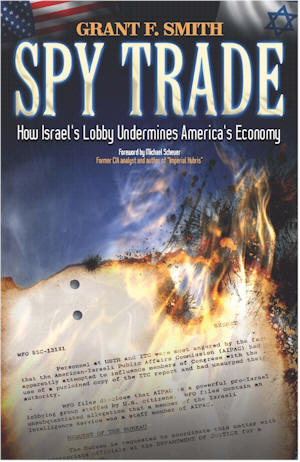
PY TRADE: How Israel’s Lobby Undermines America’s Economy by Grant F. Smith
Foreword by Michael Scheuer, former chief, CIA Bin Laden unit Large Cover Image
Buy now at:
Praise for Spy Trade:
“This terrific historical expose ought to be required background reading for those FBI agents assigned to investigate foreign espionage and public corruption matters. For many reasons, such cases are amongst the most challenging to investigate and prosecute, but are made even harder when undue political pressures enter into the picture. FBI officials responsible for setting investigative priorities and allocating resources would also do well therefore to read Spy Trade so they are aware of the historical linkage between Israel’s ‘Uzi diplomacy’ arms dealing, the Iran-Contra scandal, and the Jonathan Pollard spy incident with AIPAC’s nefarious ‘lobbying’ activities.” Coleen Rowley, former FBI agent and 2002 Time Magazine “Person of the Year.”
“Grant F. Smith’s excellent, deeply disturbing book..is a welcome addition to a growing scholarly literature.” Michael Scheuer, former senior CIA analyst and author of “Imperial Hubris”
“Like political parties, lobbies are groups of citizens with shared interests, an important part of a functioning democracy. When they have enormous power, however, and especially if their activities remain almost completely hidden, lobbies can be dangerous.
Meticulously detailed in this riveting addition to his earlier exposes, Grant Smith reveals yet another facet of the extent to which the pro-Israel Lobby is beyond dangerous, and has become a serious threat to a broad range of American ideals, objectives and interests abroad, as well as here at home. This book contains many highly disturbing, documented revelations. Read it.” Ambassador Edward L. Peck, former Chief of Mission in Iraq and Former Deputy Director, Cabinet Task Force on Terrorism, Reagan White House
“This book presents formidable and dangerous new evidence of spying by Israel and the corrosive long term influence of its lobby on US governance.” Paul Findley, member of Congress from 1961 to 1983 and author of three books on the US-Israeli relationship, including the Washington Post bestseller They Dare to Speak Out: People and Institutions Confront Israel’s Lobby
“Grant F. Smith is without peer as an archival scholar of the history of the Zionist power configuration operating in tandem inside and outside of the US government. His meticulous research on the long-term operations of AIPAC in shaping US Middle East policy provides the best contemporary framework for understanding our involvement in Middle East wars. He shows how American foreign policy in the Middle East follows Israel’s agenda and documents the enormous cost to our Treasury and economy as well as the loss of American lives. This is a book that should be read by all citizens who are concerned about the aggressive manipulation of our media and political institutions to enhance Israel’s power and further its privileged position in the Middle East.”James Petras, Bartle Professor (Emeritus) of Sociology at Binghamton University, New York
About the Book
Israel and its American lobby have committed audacious but generally unknown crimes against the United States. Government secrecy across the CIA, FBI, Department of Justice and Pentagon long kept files about Israeli espionage, weapons smuggling and covert operations on American soil classified…until now.
Spy Trade begins on the trail of a vast smuggler network funneling stolen and illegally purchased surplus WWII arms to Jewish fighters in Palestine. When the FBI threatened to crack down—a clandestine summit meeting yielded minor convictions for small time operators—but not the financial masterminds behind the scheme. This germ of immunity soon flowered into a full scale assault on American industry, the electoral system, national defense secrets and rule of law itself.
Spy Trade probes Israel lobby smuggling operations diverting uranium from the US to Israel’s Dimona nuclear weapons facility. The US Department Justice battled mightily to regulate two key enablers—the Jewish Agency and American Zionist Council—as Israeli foreign agents in the 1960s. But when the effort failed it generated a massive counterstrike.
Israel lobby campaign finance violations unleashed a network of coordinated stealth political action committees that intimidated American politicians and made a “pro-Israel” outlook and voting record requirements for staying in government. A new legal battle to regulate the American Israel Public Affairs Committee (AIPAC) as a political action committee—this time launched by concerned citizens—began two decades ago but has not yet been resolved.
Spy Trade alsoreveals the long term impact of a newly declassified “third scandal” that began in the 1980s. In the midst of both the Iran-Contra affair and Jonathan Pollard espionage incident AIPAC and the Israeli embassy conducted a spectacular clandestine operation against American industries and workers. It has so far cost the US economy $71 billion and a hundred thousand jobs each year by shutting down or diverting US exports. Trade privileges obtained by Israel under the treaty not only permit financing illegal settlement construction with proceeds from diamonds sold in the US. The US pharmaceutical industry faces an unrelenting onslaught against its capacity to innovate and protect its intellectual property.
Spy Trade is much more than a groundbreaking dissection of the tactics Israel and its American lobby repeatedly use to evade justice. The book also provides stunningly simple strategies for ending criminal immunity and subversion of law enforcement that may someday restore American governance.
The Polish genius took the slow, flowing folk-dance and turned it into the swaggering form that perfectly expressed his own fervent nationalism, the heroism of his people, and the mystic nationalism of Chopin’s literary counterpart, the activist and poet, Adam Mickiewicz. Moved by the dismemberment of Poland, the devoutly Catholic Mickiewicz adopted the doctrine of Messianism. The mystic Andrzej Towiaski led him to embrace the belief that Poland was a Christ among nations, like Israel, and that the Kingdom of God would come about in the middle of the nineteenth century, through the Jews, the Poles, and the French.
It’s fitting music for the burial of former Polish president Lech Kaczynski at Wawal Cathedral in Krakow.
A massive bell inside a thousand-year-old cathedral was tolling as the bodies of Poland’s president and first lady arrived for burial. Some 150,000 Poles in Krakow paid their last respects to Polish President Lech Kaczynski (lekh kah-CHIN’-skee) and his wife, Maria. The funeral was long on tradition but short on world leaders. Many of their travel plans were wrecked by the enormous plume of volcanic ash that blanketed Europe.
Financial commentator Joel Bowmanlooks at the Dharavi slum in Mumbai from a different angle:
“In an editorial pre-incarnation, your wayfaring author once found himself roaming the hot, sweaty crucible of economic chaos on the Indian Subcontinent in search of story and adventure. Mumbai squirms and pulses under the weight of three times the population density of New York City. It is both the commercial and entertainment centre of India, generating 5% of the country’s GDP and accounting for 25% of industrial output, 40% of maritime trade, and 70% of the nation’s capital transactions. Mumbai, sometimes still referred to as “Bombay,” is also a land of arresting dichotomy. For one, it is home to the world’s largest movie production industry…but just a short, bumpy ride from the glitz of Bollywood lays Dharavi, the largest slum in all of Asia. The latter area is a heaving mass of one million souls crammed into less than one square mile of unimaginable filth and grinding poverty. Needless to say, our visit to Mumbai’s underbelly was one of the most inspiring days of the whole trip.
The slum actually boasts an annual GDP of $660 million,” we wrote, awestruck after our short visit there, in The Rude Awakening. “The area, nestled between two railroad tracks, is bisected by an open-air sewage drain; commercial district on one side; residential on the other.
“On the commercial side, factories buzz around the clock, recycling the mass of waste spewed forth from around greater Mumbai. By day, ‘rag-pickers’ from the slum troll the city, collecting plastics, metals, bottles and all manner of other reusable matter. These materials are then melted down or repurposed in Dharavi before being sold back to metropolises all over India and, in some cases, across the region. Incredibly, all the machines are made on site. The men and women work 12 hours per day and each shift cooks a welcome meal for the incoming workers.
“Bound by the common oppression of multi-generational poverty, the people of Dharavi live and toil side by side, breaking their backs in the slum’s commercial district. Muslim people carve household Hindu temples, which then sell in the city’s markets, while the religious rift between the two groups rages on in the ‘outside world.’ Christian women watch over Muslim children, youngsters from different castes play together in the yards and Indian boys and girls learn in the slum’s schools alongside their classmates from all over Asia.”
“Experts have analysed the pensions of a number of former directors of British banks, many of which were only saved from collapse by state bailouts. The biggest beneficiary is former Royal Bank of Scotland director Larry Fish, who has a pension pot of £18m, paying out £1.5m a year. Unlike the former RBS chief executive Sir Fred Goodwin, he has managed to maintain a low profile up to now, as he used to run the bank’s American operations.
Other bankers with pension pots of more than £1m include: Richard Banks, Richard Pym and Chris Rhodes (Alliance & Leicester); Steve Crawshaw and Chris Rodrigues (Bradford & Bingley); Peter Cummings, Colin Matthew and Phil Hodkinson (HBOS); David Baker, Robert Bennett, Keith Currie, David Jones and Andy Kuipers (Northern Rock); and Johnny Cameron and Mark Fisher (RBS).
The analysis also established that the true value of Sir Fred Goodwin’s pension pot could be, in fact, almost double the previously stated figure of £16m. According to pensions expert John Ralfe: “The official numbers that Royal Bank of Scotland has come out with is that his total pension pot from the age of 51 to the expected death is about £16.9m. I think that is a gross understatement. If I wanted to go along to a third-party pension provider and get the sort of pension that Fred Goodwin is on – £700,000 and that goes up in line with inflation, of course, each year – I would have to pay something in the order of £28m.”
The contrast with the pensions given to rank-and-file banking staff could not be greater. Dennis Grainger, who worked at Northern Rock for a decade, is entitled to only £700 a year. “I’m so disgusted with this I’ve turned it down,” said Mr Grainger.
Vince Cable, the Liberal Democrat Treasury spokesman, has attacked the scale of the rewards: “What makes people really, really angry is that these people were exceptionally well paid, got enormous pension pots and other payments, despite the fact that they have failed and they have failed their shareholders, failed their employees and failed the taxpayer, and they are walking away with their millions.”
The large payments are not limited to pensions. Bank bosses have seen their average salaries rise from £800,000 in 2006 to more than £1m in 2008 – 20 per cent more than the average pay packet of chief executives in other sectors. They now earn £255,000 a year more than their FTSE-100 counterparts. Fees paid to non-executive directors of banks have also risen. In the case of the RBS, non-executive directors have seen their fees almost treble in less than a decade, from £25,000 a year in 2000 to £73,000 a year in 2008.
Mr Cable has denounced bankers’ pay and perks as “the kind of things you would associate with absolute monarchies in the days of the Bourbons in France”.
Sir Fred Goodwin
Even after cashing in £2.7m of his pension, he gets £550,000
Sir James Crosby
Will start reaping rewards of £10.4m pension pot in 2011 £572,000
Lawrence Fish
£18m pension fund yields over a million every year £1.5m
Adam Applegarth
In 2022 he will be able to claim his full yearly pension £305,000
Andy Hornby
The former HBOS chief can take his pension at 50 £240,000
Michael Fairey
Opted to take his entire £7m pension pot as a lump sum £280,000″
Six of the Salé-imprisoned ‘Casablanca 7’ began their hunger strikes from 18 March 2010 in protest of their indefinite imprisonment and lack of clear charges. These are Ali Salem Tamek, Brahim Dahane, Yehdih Ettarrouzi, Ahmed Naciri, Saleh Labaihi and Rachid Sghayer.
The hunger strikers issued this statement on 18 March:
‘Our detention has been condemned by governments and parliaments around the world as well as human rights organisations, trade unions and civil society groups. We are being persecuted for exercising our right to express political opinion and engage in legitimate activities to protect the human the rights of our people. In protest at our detention we are today beginning an open hunger strike in order to expedite our claim to a fair trial and our release without condition. We call on democratic forces in the world to support our fight for our release and that of all Saharawi political prisoners held in Moroccan jails.’
Another 19 hunger strikers are in Tiznit prison and their hungerstrikes started from 20 March. These are Moustapha Abd-Dayem, Hreish Hassan, Mohamed Berkaoui, Bachir Isamïli, Mohamed Taghioullah Fekallah, Brahim Khalil Meghimiah, Khalihenna Abouhassan, Moulay Ali Bouamoud, Fadli Binhau, Mahmud Aboughassem, Sheiahu Hamza, Fathi Sid Ahmed, Daihani Abdallah, Mohamed Salami, Sawakh Djamal, Mahdjub Ailal, Hassan Mohamed Lehassen, Nourdinne Taher, Lehmam Salama.
And there are a further 3 hunger strikers in Boulmharez prison in Marrakech (El Waaban Said, Brahim Bariaz, Ali Salem Ablag), 3 in Layouune prison4 (Bachri Bentaleb, Ameidan Chej and Mohamed Berkan), 2 in Taroudant prison (Louali Amaidan and Jalad Hasan), 2 in Kenitra prison (Laaseiri Salec and Amaidan Saleh) and 1 in Bensliman prison (Hasan Abdelahi).5
Detailed medical information from the hunger strike monitoring groups draw attention to the dangerous symptoms the prisoners are experiencing at this stage of 29 days. These are listed variously among the prisoners as loss of consciousness, fatigue, migraines, asthma, acute cardiac and intestinal pain, asthma, vomiting and diarrhoea. Blood pressure and sugar levels are reported as decreasing alarmingly, with growing kidney, liver and gallbladder complications.6
The Saharawi Lawyers Association has also reported cases of neglect by Moroccan prison administrations, lack of proper medical assistance from prison clinics and staff, and Saharawi prisoner Hassan Abdullah in Bin Sliman is said to have been severely beaten by Moroccan prisoners at the incitement of prison staff.”
John Paulson – more crooked than clever, says The Big Money:
“What emerges from the SEC’s charges against Goldman Sachs (which, it should be noted, the investment bank is strenuously denying) isn’t a story of Paulson seeing a crisis coming when others are still happily buying up housing derivatives. No, it’s a story of reluctant buyers manipulated into buying more collateralized debt obligations when it was already clear that the market was falling apart.”
With a command of several disciplines, from finance and mathematics to poetry and philosophy, Taleb knows how to state an interesting concept in clear and engaging terms.
I’m not a fan of Nouriel Roubini. But after reading this, I figured if Taleb thinks the guy is “robust,” there must be more to him…or maybe they just hang out together at Davos.
(I have recently warmed up to NR for admitting that gold could fall below $1000).
“Eliot Spitzer was not robust because a single sex scandal derailed his career.
Nouriel Roubini is robust because he has vulva castings on the wall of his apartment, and it doesn’t derail him at all.
[Actually, Taleb has it wrong here. Spitzer fell because he went after Hank Greenberg and Henry Paulson, when Paulson had the power of the Treasury behind him and Greenberg is central to the whole AIG-Goldman business, even though the MSM will tell you otherwise. Roubini, on the other hand, never said anything that got in the way of anyone powerful…..in fact, his pronouncements have served them well].
Understand this dichotomy, and you’ll begin to understand Nassim Taleb’s conception of a robust society where we wouldn’t have financial crises like the one we just came through.
Still don’t get the significance of the Spitzer and Roubini examples?
Ok, let’s use a financial example.
When Jerome Kerveil lost billions for SocGen, it wasn’t because his trades specifically cost the firm billions. It was because, in the process of liquidating $50 billion or so of assets, the bank depressed the market to such an extent that they lost billions.
Had SocGen and Kerveil been a tenth of its size, that same liquidation wouldn’t have cost the bank much at all.
Thus SocGen was not robust, but a similar firm 1/10th as big would have been.
[Lila: Is this back-handed support for “too big to fail”?]
All of the above are examples given to us by The Black Swan author during a recent night out in Manhattan.
More than anything else, Taleb is obsessed with robustness, a topic he returned to several times during our night out.
It’s something he first started hitting on in The Black Swan, and as the Spitzer, Roubini, and SocGen examples demonstrate, it’s a very broad concept.
Norman Mailer, says Taleb, was robust, because “he had six mistresses” and nobody cared. The chairman of a large bank worth $100 million is not robust, because a blackmailer who has knowledge of some infidelities could extort him for $75 million.
[Norman Mailer’s milieu was different from the banker’s….So could we say that “robustness” is adaptability to one’s environment?]
Our conversation, over 3 plates of oysters, two servings of shrimp, and a few drinks* ranged from fitness (we both share an interest in evolutionary fitness and the teachings of fitness guru/economist Art De Vany), finance, global warming, and who is a danger to society.
One of the biggest dangers to society.
There were two names he insisted I include: Paul Krugman and Thomas Friedman.
“Paul Krugman is a danger to society!“
“He uses the wrong mathematics, that’s how I knew he was a fluke.“
Why? It’s because Krugman is pushing to create a society that is less robust. Taleb, who characterizes himself as a libertarian, even goes one step further:
“The definition of a robust society: where Paul Krugman could exist without harming others.“
Even worse though is Krugman’s fellow NYT pundit, Thomas Friedman, who with his book about globalization, “is the biggest danger.”
I challenged Taleb on his anti-expert mentality, and told him my contention that much of the appeal of someone slamming these luminaries is that it makes normal people feel good about themselves.
He kind of sidestepped the question, saying that there are plenty of experts who he doesn’t slam, like, say, dentists, because their knowledge, and their arrogance isn’t dangerous. What’s dangerous is the arrogance of someone with the power to influence policy.
After dinner, we talked fitness, and he asked me how I became familiar with Art de Vany. I told him it was through the blogger and econ prof Tyler Cowen, which immediately set Taleb off.
“That guy’s a bullshitter,” noting that Cowen admits to writing about books he only reads parts of.
“How can you write a review of a book you haven’t read?” presumably referring to this Slate review.
His advice to Cowen: “Read much fewer books, read them slowly, turn off your internet connection, and then come back.”
[Lila: Ah, but Cowen has flourished academically and he might even end up in a government position, all without reading the books he writes about…how much more robust can you get than that?]
Correction: Apologies to Prof. Cowen for aspersing him unintentionally. I meant, Taleb says he doesn’t read the books he writes about, which is quite a different thing…. Taleb was apparently referring to a Salon review by Cowen of “Black Swan” that ticked off Taleb….
As the night ended, Taleb gave me a brief ride in his White Lexus Hybrid towards a better place to pick up a cab. As we left the parking garage, a couple walked in the direction of the car, and he made a comment about not wanting to run them over.
Unless the guy was an economist, in which case, that would be a “benefit to society.”
See below for the real thing. Note also the references to “masses”. The people appealing to the masses aren’t the Randy Weavers of the world who are lone wolves who see themselves ranged against the blind masses. The people appealing to the masses are the bland bureaucrats and apparatchiks of the government, our corpocrats and kleptocrats, and the charismatic politicians who front for them, who never met a public need they couldn’t massage. “Homeland,” perpetual war, forced labor camps are all things the militias are afraid of.
“Few cars in the history of auto manufacturing can match the sentimentality and nostalgia felt for the Volkswagen Beetle. But years before we’d come to associate our beloved Bug with the emblem of the peace sign, Volkswagen’s long strange trip began with a swastika. The iconic, quirky little car often dubbed the “hippie-mobile” was originally, quite literally, the Hitler-mobile.
The brainchild of the Führer himself, the car was masterminded as a gift to the German common man. Translated as the “people’s car,” Volkswagen would provide a cheap, fast, and fuel-efficient means of travel to a country where only a wealthy few owned cars. According to the Vintage Volkswagen Club of America, Hitler opened the 1934 Berlin Auto Show proclaiming, “A car for the people, an affordable Volkswagen, would bring great joy to the masses and the problems of building such a car must be faced with courage.”
In 1937, the Nazi Party, allied with auto engineer and Beetle designer Ferdinand Porsche, formed the state-owned Volkswagen company. A year later, Hitler presided over the tightly controlled, propaganda-heavy groundbreaking ceremony for the new Volkswagen plant before a crowd of 70,000 “Heil!”-chanting faithful. Production on the Beetle, then called the KdF-Wagen or “strength through joy” car, was ill-timed to begin in September of 1939. Only a few cars made it out of the factory before World War II forced Porsche to halt production and turn the Volkswagen plant into a war armaments labor camp. Hitler never lived to see his pet project come to fruition since the Beetle wouldn’t be mass produced until after the Nazi surrender.
In the 1980s, Volkswagen, in the spirit of candor about its Nazi past, commissioned a 10-year $2 million investigation led by historian Hans Mommsen into the extent of its role in the use of wartime slave labor. Titled “Volkswagen and Its Workers During the Third Reich,” the mea culpa reveals Ferdinand Porsche was a willing, “morally indifferent” participant in Hitler’s regime. Volkswagen hired some 20,000 forced laborers, prisoners of war, and concentration camp inmates from Auschwitz, Dachau, and Bergen-Belsen. Kept behind barbed wire in horrible living conditions, they worked for Volkswagen to manufacture grenades, land mines, military vehicles, warplanes, and V-1 flying bombs. They were subjected to malnutrition and savagely beaten for trying to feed themselves from food scraps off the floor.
Volkswagen wasn’t the only automaker with war blood on its hands. One of the most profitable companies to emerge from World War II was SS aider and abetter Daimler Benz whose production skyrocketed thanks to arms contracts, tax breaks, and tens of thousands of slave laborers. BMW similarly exploited 25,000-30,000 forced workers to repair airplane engines for the Nazi war machine.
If the unseemly pasts of these automakers has you ready to boycott German cars and pledge your consumer allegiance to the American auto industry, well don’t wrap yourself in Old Glory just yet.
A car enthusiast first and murdering psychopath second, Hitler drew inspiration — both technically and ideologically — from Ford Motor Company (F) founder and fellow anti-Semite Henry Ford. As creator of the mass produced and inexpensive Model T and publisher of a four-volume conspiracy manifesto titled The International Jew, the bigoted automaker paved the road and Hitler vowed to follow in his muddy tire tracks. In fact, Hitler so reveredFord, the Chancellor hung a life-size portrait of him in his Munich office, gave him a personal shout-out in Mein Kampf, and awarded him the Third Reich’s highest decoration for foreigners, the Grand Cross of the German Eagle. For his part, Ford served as leader of the America First Committee, the foremost interest group opposing American entry into the war, and authored Ford’s overseas subsidiaries to produce Nazi war materials.
Not to be outdone, General Motors rendered its Nazi salute if only to protect its $100 million investment in Germany. GM not only resisted Roosevelt’s call to military production duty in its US factories but assisted the Axis arms effort instead. James Mooney, senior executive for General Motors, was rewarded for his loyalty to Hitler when he was also bestowed with a medal for his “distinguished service to the Reich.”
“President Clinton weighed in that “legitimate” comparisons can be drawn between today’s grass-roots anger and resentment toward the government and the right-wing extremism 15 years ago.”
Actually, I think the Clinton statement was a pretty fair one, all in all. It didn’t equate “right-wing extremism” with tea-party goers and anti-government activists (as the SPLC did) and it did give room for people to voice their opinions, without having to “be nice.” It cautioned, correctly, that people should stop short of advocating violence.
Any discussion of the Confederacy, said the ex-Prez, should always include a mention of slavery, which doesn’t sound like an onerous requirement to me. So too any discussion of “Islamicism” should also include a complete list of US interventions in the said Islamicist state, right?
In short, more balance and less polemics. I hope I’ve always tried to do that on this blog.
The only thing is, can we hope the government will live up to this standard and stop short of advocating violence, say, in Iran, or in Michigan…or anywhere else?
ORIGINAL POST
Thanks to David Kramer at LRC blog, for this slimy listing by the Southern Poverty Law Center (SPLC) of Ron Paul among the “enablers’ of the “Patriot” movement, which, if you didn’t know by now is code to our dear leaders and their cohorts for “Nazi right-wing (definitely Christian) loons-who-share-milk-shakes-‘n-training-manuals- with- OsamaJohnPatrickBedellDavidKoreshRandyWeaver-bin Laden” :
1. Michele Bachmann 2. Glenn Beck 3. Paul Broun 4. Andrew Napolitano 5. Ron Paul
On the page following, you can see what a smear this is. There’s a list of incidents making up a “Patriot” timeline (love those quotation marks) that starts with President Bush’s “New World Order” remark. (He said it, didn’t he?) and is dotted with references to anti-Semitism, white supremacy and violent acts.
Note that when “cultists” or militia members are murdered, the word used is “killed” or “left dead.” When a federal agent is killed, the term is “murdered.”
“The cops raided an Independent Anarchist Media Collective space at 13 Thames Art Space in Brooklyn and arrested two group members Tuesday.
According to the “I AM Collective” statement, the NYPD entered the Bushwick based art and performance space without a warrant.
“Two plainclothes detectives entered first, followed quickly by a Lieutenant and vans full of blue shirt officers,” the statement reads. “After corralling everyone present in the back room, they searched the space and detained two members of the collective.”
Anarchist News.org describes the event that was slated to run today, April 16:
“The I AM collective was preparing for the NYC Anarchist Film Festival, a showcase of resistance movements and insurrectionary events from around the world presented from an anarchist and anti-authoritarian perspective.”
Update: I thought back to the climate-gate e-mails, which, I’d momentarily forgotten, were uploaded to wikileaks. If wikileaks were a Soros-funded disinformation operation, I wonder if it would be uploading emails that damage the AGW theory. That tends to make me wonder about the reason the left-liberals might not like wikileaks.
Update III: Here’s Justin Raimondo on the subject. Raimondo thinks the only people who criticize wikileaks are limousine liberals and tin-foil hat conspiracists…for now, I’ll let him have the last word:
“A child could understand this, but it’s way beyond the executive director of the Reporters Committee for the Freedom of the Press, and also far beyond the comprehension of the “liberal” Mother Jones magazine, which ought to change its name to Encounter. Kushner “reports” this nonsense uncritically, and even cites the loony John Young, of Cryptome.org, who rants:
“’WikiLeaks is a fraud,’ [Young] wrote to Assange’s list, hinting that the new site was a CIA data mining operation. ‘Fuck your cute hustle and disinformation campaign against legitimate dissent. Same old shit, working for the enemy.’”
Kushner has all bases covered: the white-wine-and-brie liberals who would rather look the other way while their hero Obama slaughters children on the streets of Baghdad, and the tinfoil hat crowd who can be convinced Wikileaks is a “false flag” operation.”
Update II: I should reiterate, I don’t endorse the WM piece. I merely present it…
Update I: I should also add that it doesn’t mean the documents they unearth might not be very important or useful. That’s not what I think this report is suggesting. A front always has a legitimate purpose, which gives it its credibility. How to differentiate disinformation from honest error? Well, evidence of someone/some outfit being funded by intelligence or government agencies; obvious lies or distortions repeated even when evidence contradicts the distortion; giving credence to very few sources or setting up some voices as totally credible and not listening to the range of voices; character assassination rather than rational debate, stigmatization; lack of self-criticism; unwillingness to rethink ideas when faced with new facts.
From The Wayne Madson Report via Alex Constantine:
“In January 2007, John Young, who runs cryptome.org, a site that publishes a wealth of sensitive and classified information, left Wikileaks, claiming the operation was a CIA front. Young also published some 150 email messages sent by Wikileaks activists on cryptome. They include a disparaging comment about this editor [Alex Constantine] by Wikileaks co-founder Dr. Julian Assange of Australia. Assange lists as one of his professions “hacker.” His German co-founder of Wikileaks uses a pseudonym, “Daniel Schmitt.”
Wikileaks claims it is “a multi-jurisdictional organization to protect internal dissidents, whistleblowers, journalists and bloggers who face legal or other threats related to publishing” [whose] primary interest is in exposing oppressive regimes in Asia, the former Soviet bloc, Sub-Saharan Africa and the Middle East, but we are of assistance to people of all nations who wish to reveal unethical behavior in their governments and corporations. We aim for maximum political impact. We have received over 1.2 million documents so far from dissident communities and anonymous sources.”
In China, Wikileaks is suspected of having Mossad connections. It is pointed out that its first “leak” was from an Al Shabbab “insider” in Somalia. Al Shabbab is the Muslim insurgent group that the neocons have linked to “Al Qaeda.”
Asian intelligence sources also point out that Assange’s “PhD” is from Moffett University, an on-line diploma mill and that while he is said to hail from Nairobi, Kenya, he actually is from Australia where his exploits have included computer hacking and software piracy.
WMR has confirmed Young’s contention that Wikileaks is a CIA front operation. Wikileaks is intimately involved in a $20 million CIA operation that U.S.-based Chinese dissidents that hack into computers in China. Some of the Chinese hackers route special hacking program through Chinese computers that then target U.S. government and military computer systems. After this hacking is accomplished, the U.S. government announces through friendly media outlets that U.S. computers have been subjected to a Chinese cyber-attack. The “threat” increases an already-bloated cyber-defense and offense budget and plays into the fears of the American public and businesses that heavily rely on information technology.”
My Comment:
Julian Assange was always sending me emails and requests to join wikileaks a couple of years ago. I thought the outfit was interesting, but I don’t really deal in “secret” documents or cloak-and-dagger stuff, because something founded on distrust is bound to founder on distrust.
Even media activism has the same result. You start wondering if everything you’re reading is disinformation. At a certain point, you have to ask, so what if it is? Can’t I still arrive at the right conclusions by operating from strict rules of reason and ethics?
It seems to me that you can figure out what is going on without going under cover or hacking or stealing classified information because propaganda has a very distinctive flavor you get to recognize after some time. I’ll leave the exciting spy v spy stuff to more adventurous sorts. I can’t confirm anything in this piece, but since it’s something I’ve wondered about myself and since it looks like there’s at least one other person (besides Alex Constantine) who’s wondering as well, Assange’s co-worker, it becomes blog-worthy. I remain agnostic.-to-mildly skeptic about wikileaks….
“EJ: Who wins the political battle shaping up here between the PIIGS and their creditors? Within the structure of the euro?
MH: I guess whoever has the most guns politically. The Greeks are out on the streets. The French are out on the streets. They’re not like Americans. They’re really protesting and the class war is back in business over there. Same thing in Ireland.
EJ: My French friends will tell me they’re barbarians over there. We’re very civilized here in the United States.
MH: That’s our problem, as Freud said in “Civilization and its Discontents.”
EJ: I remember reading that book in college. He explained the conflict between the demands of society for individuals to stifle the animalistic behavioral foundations of human nature. Is there a way to diffuse the conflict? A muddle-through option? The IMF has been in and out of the Greek rescue.
Debtor versus creditor nations split the EU
MH: The IMF cannot be part of the solution. It’s part of the problem. The EU basically is part of the problem because it’s pro-financial. So the whole way in which the European Union is structured, basically in a centralized way to be run by the financial lobbyists, obviously isn’t working. The EU isn’t really like the United States. It doesn’t really have it’s own parliament and systematic taxes. The Germans are saying today that in the old days, a century ago, if a problem like this came up in, say, Latin America, the United States would send in the marines. They’d occupy the custom’s houses and as these governments made most of their money on charging customs on imports and exports the marines would collect it and pay the creditors.
But now what are the creditors going to do today? Are, let’s say, the Germans going to take over in Greece? Who will act as the equivalent of the Internal Revenue Service to collect the money? The Germans would have to promote not a military dictatorship as the colonel powers did in the old days but a popular government that would tax the rich and the Germans aren’t going to do that. The European Union, the creditors, because they support the right wing not the left wing, are preventing these governments from collecting taxes progressively to balance the budget and pay the debts. That’s the problem: it’s a right-wing versus left-wing problem. Unfortunately, there isn’t really a left wing in Europe to make this case very well. The social democrats have more or less abandoned what used to be an economic policy at the outset. They are now concerned more with political and social issues than economic issues. So there isn’t really a party in Europe that is taking the side of progressive economic policies. They’ve left economics and finance, and debt and credit policy, to the right wing to discuss among each other rather than making it a left-wing topic like it used to be a hundred years ago.
EJ: Isn’t that something of a global phenomenon?
MH: Yes.
EJ: I don’t see it as being terribly different here in the US.
MH: Or in Australia. The Labor Parties all over the world. The most right-wing parties that you can see are the labor parties of Australia and New Zealand where they were leading the privatization sell-offs and leading the tax shift favoring the financial sector. And they didn’t even realize it! They’ve somehow “decoupled” financial analysis from the social analysis that characterizes social democratic and labor parties from their outset a hundred years ago.”
My Comment:
Hudson is always interesting to read, as long as you keep in mind his basic Marxist orientation. So he gets the details right, and then he goes on about the old demon “right-wing” in rhetoric that doesn’t make sense to me, and that even his own writing betrays.
“So Old Europe is quite culpable for having promoted a kind of neo-liberalism that was so right-wing as never to have been able to get a foothold at all either in Western Europe or in the United States. In Latvia there is a flat tax on labor of over 50% and less than a 1% tax on property.”
But right-wingers are the ones arguing the hardest to abolish taxes, especially in this country….
So, with the acknowledgment that I’m an alert student of economics who’s been reading/researching the economic crisis for a few years, but whose main training is in history and politics, let me note the puzzling discrepancies I find in the writing of a man whose knowledge and industry experience are said to be impeccable by even people who don’t agree with him:
1. Why does MH blame “right wingers,” when it was Austrians and right-wingers who were vehemently opposed to the bail-out and to TARP that saddled the country with the banks’ debts? Since when are social-democrats right-wingers?
2. Monetarism and monetary intervention are uniformly advocated by all economists, from the so-called left to the so-called right. Indeed, it’s only the extreme right (to the right of the statist Chicago school) that criticizes all monetary intervention.
3. Why does Hudson argue against deflation? Deflation is the one thing that will ultimately put the economy back on track. All those overpriced houses would fall in price to within reach of the average citizen. Deflation might reduce wages but it will save pensioners and support savers (who have taken the brunt of the damage done by the boom).
4. A default by Greece would have helped the Euro, ultimately.
5. Why does Hudson think that inflating away a country’s debt is good for the working man or for pensioners or for small business? Inflation will whittle away at the currency, at savings, and at real income. None of which is good for ordinary people.
6. Hudson is right that Social Security and Medicare in the US are not entitlements, since people have all contributed to them. One solution to funding them is to dismantle the war machine. Convert all bases to peaceful uses. That requires no extra funding. Why is it that Hudson doesn’t raise that as an option?
7. Hudson claims that Latvian taxes are of a kind no Western nation would levy (50%) on labor. Really? Adding up all income taxes and sales taxes, taxes in the northern European countries are surely that high, and taxes in the US and UK are well on their way there.
8. Despite talking about “social culture” Hudson says nothing about whether the Eastern European countries have the same kind of business and social culture that have made the northern countries creditor countries. What are the rates of savings, of corruption, of business creation? What are the laws regarding property rights? What are the incentives, or lack thereof, for business?
“The soldier does not wish to appear a coward, disloyal, or un-American. The situation has been so defined that he can see himself as patriotic, courageous, and manly only through compliance.”
“SAN FRANCISCO (MarketWatch) — The Securities and Exchange Commission on Friday charged Goldman Sachs & Co. and one of its vice presidents for defrauding investors by misstating and omitting key facts about a financial product related to subprime mortgages.
The SEC alleged in a lawsuit that Goldman /quotes/comstock/13*!gs/quotes/nls/gs (GS158.38, -25.89, -14.05%) structured and marketed a collateralized debt obligation that hinged on the performance of subprime residential mortgage-backed securities. However, it failed to disclose the role that a major hedge fund, Paulson & Co., played in the portfolio selection process as well as the fact that the hedge fund had taken a short position against the CDO.”
This is likely to start a sell-off in the financial sector as a whole (down 3.1%) and possibly the much waited next leg down of the great correction that began in 2007-08.
Michael Roston points out the obvious. The amount in question in the Abacus deal is $15 million bucks, which is chump change.
Point two. No one’s saying anything about John Paulson, who made $1 billion out of it.
[Or, to take another instance, what about the Greek government, which is also getting bailed out….by tax-payers of another country? No culpability for the governments who get into these kinds of deals?]
You’ll also notice, as I blogged earlier, that George Soros, another speculator, has also called for the IB’s to be broken up (using the same argument, “too big to fail means too big to exist” – something also pushed by David Einhorn and the left-liberals). Now, I can see the sense in the “too big to fail, too big to exist” mantra, especially, if it had been used against the banks before they helped themselves to tax-payer money. But I wonder why it’s being repeated now, after the fact….and not then..
I didn’t hear these same critics of size pipe up at that crucial time.
“Wall Street’s most powerful firm is being drawn into the government’s sprawling insider-trading investigation.
Prosecutors are examining whether a Goldman Sachs Group Inc. board member gave inside information about the Wall Street firm to Galleon hedge-fund founder Raj Rajaratnam during the height of the financial crisis, people close to the situation told The Wall Street Journal.”
1) A neutron star with an intense magnetic field, capable of emitting toxic radiation across galaxies 2) A hedge fund, the single market player most responsible for the severity of the 2008 financial crisis, through the toxic instruments it createdContinue reading →
Thus it is not surprising that the U.S. Government, following the lead of the CIA, has over the years become a protector of drug traffickers against criminal prosecution in this country. For example both the FBI and CIA intervened in 1981 to block the indictment (on stolen car charges) of the drug-trafficking Mexican intelligence czar Miguel Nazar Haro, claiming that Nazar was “an essential repeat essential contact for CIA station in Mexico City,” on matters of “terrorism, intelligence, and counterintelligence.” When Associate Attorney General Lowell Jensen refused to proceed with Nazar’s indictment, the San Diego U.S. Attorney, William Kennedy, publicly exposed his intervention. For this he was promptly fired.Continue reading →
“In forwarding Starr’s email to the SEC, former Lehman General Auditor Beth Rudofker wrote: “I phoned you earlier to review and pass on some recent rumor activity and information that is concerning to us.”
In June, Rudofker sent another email to lawyers at the SEC, pointing out additional “rumors” about Lehman that she said “continue to be destructive.” In her long email to the SEC, she said: “We have been able to prevent 3 stories containing these specific rumors that were set to run.”
Also included in the documents is a back-and-forth email exchange between Einhorn and Callan, in which Callan accused him of being “very disingenuous.” Callan said she would not have talked to Einhorn if she knew he was going to make a speech criticizing the firm’s finances.
“I can only feel that you set me up and you will now cherry pick what you like out of the conversation to your thesis,” she wrote in an May 19, 2008 email.
Einhorn defended himself in a lengthy response, saying that Callan knew Greenlight was “short” the stock when she reached out to talk to him.
“You had no reason to expect that our discussion was confidential in any way,” Einhorn wrote in response. “In fact, you knew that I do not want to be restricted in trading the stock and I did not request any information that you would not provide to any other investor who asked.”
A few days later, Einhorn gave another speech blasting the email exchange.
A spokesman for Einhorn declined to comment on Wednesday evening.
For his part, Starr now says, “obviously I was wrong” about Lehman. But he isn’t backing down on his criticism of Einhorn.
“I still stand by those words,” said Starr, who noted that his fund has $50 million under management. “I think that manipulating the market and running a high publicity business is just not appropriate behavior and disruptive to free and open markets.”
My Comment:
Goldstein is the excellent Reuters reporter whose story on Steven Cohen was reportedly spiked…
From Lew Rockwell exciting news from Brazil…and also from Sweden:
“The young Brazilian financial and ideological entrepreneur, Helio Beltrão, has done something great for the Austro-libertarian movement and the cause of liberty, for his country and the whole world: establish the Instituto Ludwig von Mises Brasil, and make it flourish. The website is already significant, and this month, MisesBrasil sponsored the first Austrian Economics conference in the country’s history. Continue reading →
Airline prices are set to rise this summer, says an industry spokesman:
“Airline capacity and routes flown are still down compared to recent years,” said Mark Koehler, Priceline’s senior vice president, Air. in a statement.
“We haven’t experienced the widespread, aggressive airfare sales seen a year ago. In general, travelers will find that summer airfares could be as much as 25% more expensive than last year, on average, and that’s before factoring in extra fees for baggage, pillows, food and such. Travelers who want to save on air travel will need to plan ahead, be flexible and try different approaches to booking their trips,” he said.
Airlines have started to see increased traffic as travelers returned after cutting back during the recession. The International Air Transport Association recently cut its full-year loss forecast for the airline industry by half to $2.8 billion.
Shares of airlines stocks jumped this morning.”
So, for anyone planning to become a stateless globe-trotter – and we’re all for it if your wallet can take it – here’s another monkey-wrench tossed into your plans.
Not only are fees and security at airports increasing, as I’ve blogged before, but prices and services on airlines are going up too. They even have a lavatory fee coming up at budget airline Ryanair. And they’re thinking of reducing the number of lavatories to make room for more seats.
Personally, I don’t think budget airlines – unless you fly often – are much of a saver. I’d rather pay $100 more and feel free to carry as much luggage as I want, get fed regularly with something other than $5 bags of pretzels, and have wait-staff paid enough not to glower at you.
Not long before you’ll be asked to bring your own seats or stand all the way….
“According to US data, the OCTG tradecase is the largest in US history against China imports valued at more than $2.6 billion in 2008 and about $1 billion last year.”
“China has imposed anti-dumping and anti-subsidy duties on a U.S. specialty steel product, and also hit Russia with anti-dumping duties in the same case, its customs administration said.
U.S. producers will be assessed anti-dumping duties of up to 64.8 percent and anti-subsidy, or “countervailing,” duties of up to 44.6 percent on the grain-oriented electrical steel, it said on its website on Monday.
Grain-oriented electrical steel, also known as grain-oriented silicon steel, is used for the cores of high-efficiency transformers, electric motors and generators.
The state-backed China Chamber of Commerce of Metals, Minerals and Chemicals Importers and Exporters hailed the Ministry of Commerce’s April 10 ruling, which the Ministry has not yet publicly announced, state news agency Xinhua said.
“During the investigation the Ministry found that U.S. producers had received subsidies by the U.S. government, and their unfair competition hurt Chinese producers,” Xinhua said, quoting an unnamed person at the chamber of commerce.”
“According to the statistics from the General Administration of Customs, China’s exports were valued at US $112.11 billion in March, up by 24.3 percent year on year, while the imports were up by 66 percent to US $119.35 billion, trade deficit were US $ 7.24 billion. This is the first monthly trade deficit for China since May of 2004.”
What’s interesting is that this trade row with the US isn’t necessarily a sign of rising protectionism in China, as the media often reports. It seems to signal a move toward more trade with emerging markets in Asia and elsewhere. Thus at the recently concluded Boao Forum for Asia, (the Chinese Davos), the Chinese Vice-President called for open markets and not protectionism. Of course, this isn’t free trade, by any means, but state-driven mercantilism. It remains to be seen whether that is any better than state-driven protectionism.
As Russia has hardened its position and moved closer to the European and US stance, the Chinese move has become crucial for Iran. Iran continues to be the fifth largest exporter of crude in the world, but US sanctions have meant that its refineries have suffered from lack of foreign investment and it now relies on the world market for its gasoline needs.
We are looking forward to the day when a defendant’s every legal filing also becomes the subject of such prompt attention. I’ve italicized the federal government designation of the “crime” that Isikoff has adopted as established fact:
“A former U.S. Marine rifle expert and veteran of the 1991 Persian Gulf War supplied the extremist Christian “Hutaree” militia with a “hit list” of federal judges and elected officials and served as the group’s “heavy gunner” who was responsible for providing a “significant volume of firepower” against designated law-enforcement targets, according to a court document released by federal prosecutors.
In a new court filing, federal prosecutors for the first time portray the former Marine, Michael David Meeks, 40, as a key figure in the Michigan-based Hutaree’s alleged conspiracy to trigger an “uprising” against the U.S. government by plotting to assassinate law-enforcement officers with improvised explosive devices.
Meeks, the prosecutors allege, used his four years of U.S. military training to become a member of the Hutaree’s “inner circle” and participated in “military-style training exercises ” with the group on a dozen occasions between October 2008 and February of this year.”
As far as I can tell from this, the only thing the federal government has got on them so far is hearsay and some combat-style exercises.
Obama’s nuclear security summit has pursuaded some 47 countries to sign onto an informal pact to keep nuclear material out of the hands of terrorists within four years. One focus of the summit is Iran, but the background is the recent signing of an arms reduction treaty between the US and Russia.
Meanwhile, some clarification of the much-abused term “rogue,” often applied to countries that joined the nuclear club later than the US or Russia, like India, Pakistan, and Israel.
1. The numbers below, from the Bulletin of the Atomic Scientists, speak for themselves, even though they too understate the case. The US and Russia are astronomically more “nuclear” than any other states. So long as they are, every other state not only has the right but the duty to arm themselves with nuclear weapons or suffer Iraq’s fate.
2. India and Pakistan were NON-signatories to the NPT. They were responding to this massive power asymmetry. Non-signatories to a treaty cannot be “rogue” states flouting the treaty, as the propaganda goes.
Iran is a signatory, but ought never to have signed in the circumstances. (Nor, as long as this imbalance stays, should any prudent state).
3. Israel, which as has never admitted to its program, is a signatory to the NPT, so if any state is to be labeled “rogue” (a term I consider inflammatory) it’s Israel, as much as Iran, whatever the alleged level of Iran’s incipient nuclearization.
From what we’ve learned from whistle-blowers like Mordechai Vanunu, Israel continues to operate what is widely regarded as a far bigger program than what’s listed below. It’s probably now the world’s 3rd or 4th largest nuclear power.
Note: I support Israel’s right to have nuclear weapons, as well as Iran’s, as well as any other country’s. Disarmament for all, or disarmament for none.
Talking about Iran’s feeble efforts at nuclear self-defense without mentioning the weapons held by Israel, Europe, and Russia, all around Iran, is dangerous and reads like hypocrisy to the rest of the world.
All numbers are estimates from the Natural Resources Defense Council, published in the Bulletin of the Atomic Scientists, unless other references are given. The latest update was on April 6, 2010. If differences between active and total stockpile are known, they are given as two figures separated by a forward slash. If specifics are not available (n.a.), only one figure is given. Stockpile number may not contain all intact warheads if a substantial amount of warheads are scheduled for but have not yet gone through dismantlement; not all “active” warheads are deployed at any given time. When a range of weapons is given (e.g., 0–10), it generally indicates that the estimate is being made on the amount of fissile material that has likely been produced, and the amount of fissile material needed per warhead depends on estimates of a country’s proficiency at nuclear weapon design.
Sir James Michael Goldsmith, Anglo-French financier and corporate raider of the 1980s, is most infamous for taking over Goodyear Tires and restructuring it, thereby putting its many employees out of work.
In this deeply prophetic interview with Charlie Rose in 1994 he discusses his book about globalization, The Trap, and displays a more humane side of his complex intelligence.
In the earlier part of the interview (not shown here), Goldsmith gets into a heated debate with Clinton economic honcho Laura Tyson over the benefits of NAFTA and GATT in which Tyson comes off as both naive and uninformed.
In another part,Goldsmith calls Indian physicist and environmental activist Vandana Shiva “remarkable” and asks why it is that global “free” trade, supposedly so beneficial to developing countries, was protested widely and vigorously by huge numbers of people in India.
Take away points from the interview:
*This (globalization) is the establishment against the rest of society
*I am for big business until it devours society
*Big business loves total access to unlimited give-away labor
*In every developing nation you have a handful of people who control everything, the oligarchs
*This (globalization) is the poor in rich countries subsidizing the rich in the poor countries (Lila: I’d add that the poor in poor countries are also subsidizing the rich in rich countries)
*Free trade within homogeneous regions is to be preferred to global trade
(Lila: This coincides with something I’ve advocated for a while, on the principle of subsidiarity)
*The European parliament is a force for pseudo-democratic institutions
*It’s already fixed by the two main parties, the Christian Democrats and the Socialists
*The people have a right to vote on the single most important economic decision of their life times
*Here in the USA we’ve had no debate on it (GATT) while we’ve had a huge debate about NAFTA which was a pimple
*GATT is going through because business wants it
*It’s a fix here (the US), as it is in Europe
*We’ve allowed instruments that are supposed to serve us to become our masters
*GATT is an example of how an economic doctrine is going to destabilize our society
*Nuclear is another example. Here in Europe, we’ve not been allowed to discuss this disastrous form of energy, disastrous in terms both of economics and in terms of security
*Corporate agriculture is a third example of how we are destroying our societies
*The ruling machinery of government power in Europe is imposing this (GATT) without a debate
Note: My comments are at the end under the heading, “My Comment”; the article is in light gray text; the quotes from the Bible have been underlined; the Bible commentary by Scofield and Hagee that the article cites are in italics, as are titles of books and reports; the quotes from all other authors, including Sizer, Adelman, and various newspapers, as well as subheadings, are bolded] :
“Central to Christian Zionist belief is Scofield’s commentary on Genesis 12:3. For the sake of clarity, Scofield’s notes have been italicized in the following passage:
“‘I will bless them that bless thee.’ [Bible]
In fulfilment closely related to the next clause [Scofield]
‘And curse him that curseth thee”[Bible]
Wonderfully fulfilled in the history of the dispersion. It has invariably fared ill with the people who have persecuted the Jew — well with those who have protected him. The future will still more remarkably prove this principle.” [Scofield]
Drawing on Scofield’s speculative interpretation, John Hagee claims,
“The man or nation that lifts a voice or hand against Israel invites the wrath of God.”[Hagee]
However, as Stephen Sizer points out, in his definitive critique,“Christian Zionism: Road-map to Armageddon?”,
“The promise, when referring to Abraham’s descendants speaks of God blessing them,not of entire nations ‘blessing’ the Hebrew nation, still less the contemporary and secular State of Israel.” [Sizer]
Apparently unaware of this more orthodox reading, The New Scofield Study Bible, published by Oxford University Press in 1984,enhanced Scofield’s interpretation, by adding,
“For a nation to commit the sin of anti-Semitism brings inevitable judgment.”[Bible]
Reading such tendentious comments, a bible-believing Christian could easily assume, for example, that God will punish the 114 countries which endorsed the Goldstone Report.
Stephen Sizer writes,
“Sustained by a dubious exegesis of selective biblical texts, Christian Zionism’s particular reading of history and contemporary events . . . sets Israel and the Jewish people apart from other peoples in the Middle East . . . it justifies the endemic racism intrinsic to Zionism, exacerbates tensions between Jews and Palestinians and undermines attempts to find a peaceful resolution of the Palestinian-Israeli conflict, all because ‘the Bible tells them so.’” [Sizer]
[Lila: I am not sure if I agree entirely with the statement that “racism is inherent to Zionism.” I have made a similar argument in “The Language of Empire,” (2005) but would like to qualify it, because of the special circumstances of the Jewish people in relation to European Christianity, as well as their relatively small numbers compared to the ethnic populations around them. However, those small numbers must be balanced against the enormous power wielded by Israel and its support by the US and UK government, as well as the corporate economic structure.
In sum, without demonizing Israel, it’s necessary to ask if its exceptionalist religious narrative – in which Zionism is inextricably intertwined – isn’t ripe for modification, the same modification that state Christianity underwent during the enlightenment (and thereafter), and that Islamicism is, rightfully, being asked to undergo today].
The incredible Scofield
In his 2008 book, The Rise of Israel: A History of a Revolutionary State, Jonathan R. Adelman describes the crucial support Israel receives from Christian fundamentalists as “totally fortuitous.” The incredible career of the man who wrote “the Bible of Fundamentalism,” however, casts considerable doubt on that assertion.
Two years after Scofield’s reported conversion to Christianity in 1879, the Atchison Patriot was less than impressed. Describing the former Atchison resident as the “late lawyer, politician and shyster generally,” the article went on to recount a few of Scofield’s “many malicious acts.” These included a series of forgeries in St. Louis, for which he was sentenced to six months in jail.
Being a “born again” preacher, however, did not preclude Scofield from becoming a member of an exclusive New York men’s club in 1901. In his devastating biography, “The Incredible Scofield and His Book,” Joseph M. Canfield comments,
“The admission of Scofield to the Lotos Club, which could not have been sought by Scofield, strengthens the suspicion that has cropped up before, that someone was directing the career of C. I. Scofield.” [Canfield]
That someone, Canfield suspects, was associated with one of the club’s committee members, theWall Street lawyer Samuel Untermeyer.As Canfield intimates,Scofield’s theology was
“most helpful in getting Fundamentalist Christians to back the international interest in one of Untermeyer’s pet projects – the Zionist Movement.” [Canfield]
Others, however, have been more explicit about the nature of Scofield’s service to the Zionist agenda. In “Unjust War Theory: Christian Zionism and the Road to Jerusalem,” Prof. David W. Lutz claims,
“Untermeyer used Scofield, a Kansas city lawyer with no formal training in theology, to inject Zionist ideas into American Protestantism. Untermeyer and other wealthy and influential Zionists whom he introduced to Scofield promoted and funded the latter’s career, including travel in Europe.”[Lutz]
Absent such powerful connections, it is hard to imagine “this peer among scalawags” ever getting a contract with Oxford University Press to publish his bible. Nevertheless, it remains a mystery why OUP chose to endorse such a sectarian work.
Atonement
If there had been no Scofield Bible, American presidents influenced by Christian Zionism, such as Truman, Johnson, Reagan and George W. Bush, would most likely have been less sympathetic to Israeli demands, and consequently more attentive to U.S. interests. Moreover, the American people might have been spared the well-publicized pro-Israeli rants of John Hagee, Pat Robertson and the late Jerry Falwell,not to mention the lucrative End Times “prophecy” peddled by Hal Lindsey and Tim LaHaye.
But it is the people of the Middle East who have suffered most at the hands of an expansionist Israel, emboldened by the unswerving allegiance of America’s Christian Zionists, who were led to believe that Scofield’s words were God’s will.
Although much needless suffering has already been caused by the Scofield Bible, perhaps it’s not too late for Oxford University Press to publicly disavow its harmful book. Among its many victims are 3.5 million Palestinian refugees whose right to return is fervently opposed by Christian Zionists, who believe that the land belongs exclusively to “God’s chosen people.” At the very least, OUP could demonstrate remorse for its role in promoting ethnic cleansing by compensating those refugees with the considerable profits accrued over the past century from sales of its Zionist bible.”
My Comment
Not many people know about the role of the Scofield Bible in fostering one relatively marginal interpretation of the Scriptures, the dispensationalist views of John Darby, a 19th century minister of the Plymouth Brethren.
Dispensationalism went onto become so influential among American Protestants that it changed the political dynamics of the country. However, while the article cited above demonstrates how financial interests actively promoted the Scofield Bible, it wouldn’t have become so influential if the culture into which it was introduced wasn’t already receptive to it at many levels.
This is the argument I make in “Language of Empire” (MR Press, 2005), in which I analyzed the influence of Christian Zionism on the practice of torture as well as on the rhetoric that justified the war on terror.
You can find the core of the argument in “Christian Zionism: An Ideological Tower of Babel” (Counterpunch, January 15, 16, 2005), finished a year before the book actually came out. The main point I make is that while Christian Zionism is important to the justification of American empire and of Israel’s role in it, it isn’t the only source of justification. There are broader streams in American religious and intellectual history with which Christian Zionism coincides. Those streams are identified below in the Counterpunch piece, which forms a concluding chapter in the book. Note, I’ve defined them below each part of the excerpt):
“Both secular and religious exceptionalists also share a unique relationship to the law that suggests that law and legal institutions are themselves implicated in the policies of Abu Ghraib and clarifies why it may not be possible to look to them alone for salvation.
[Legalism – the tendency to turn every moral/political/social debate into a courtroom drama over technical legality]
Both groups share the heritage of covenant theology which reads holy scripture as the record oflegal contracts between God and man, a heritage which both privileges the law while simultaneously also promoting a sense of not being subject to it. The written contract binds us, but the interpretation of that contract remains with the state whose favored status has been granted by the law.”
[Voluntarism – the belief that the essence of divinity is not rationality, but will, and that God’s acts are beyond or even contradictory to reason]
“Dispensationalists read the final book of the Bible, Revelations, as a literal account of a post-war progression to a world-consuming conflagration, Armageddon. In doing so, they discount the importance of reason, learning, or social consensus in their interpretations in favor of what they see as a literal reading of the Biblical text. Parallel to this is their reading of the unfolding of human history as also a literal record where that text transparently reveals itself.”
[Dispensationalism – the belief that Biblical prophesies can be seen unfolding in history today and that God’s promises in the Bible relate to the political state of Israel]
“Just as fundamentalism disdains mediation, an anti-intellectual culture might find an oral tradition based on a continuing interpretative dialogue between past and present actually less attractive than the fixed guidelines of a written contract, whether made between one nation and another or between nations and God.”
[Literalism, Anti-intellectualism – the acceptance of the literal meaning of texts, the devaluation of interpretation, and a dislike for intellectual theories and intellectuals]
“From Biblical righteousness, the Promethean sense of the state as virtue incarnate; fromChristian dominionism, the impetus to expand; from apocalyptic ruminations, the Promethean obsession with terror. And through all of these runs an unexamined sense of supreme moral satisfaction, a Puritan certainty about the nature and precise physical location of evil in the other that is translated not simply in the messianic language of Americanism but even in the shibboleths of liberalism. Evil is outside, out there in the world, radically disordered, deserving of eradication.”
[Dominionism, Puritanism, Apocalyptic Millenarianism — the belief that society should be ordered by the Christian religion working through the state; the belief in the essential depravity of human beings and the need for salvation by grace that is unearned and not universal; a belief in the return of Christ as prophesied in Revelations, accompanied by a world-wide confrontation with the forces of evil, followed by a golden age of a 1000 years]
How these beliefs impact policy-making in the west can be seen most clearly and stunningly in the Declaration of the first Jerusalem Summit (October 12-14, 2003) which reads in part thus:
“ISRAEL AS THE KEY TO THE HARMONY OF CIVILIZATIONS
Billions of people believe that Jerusalem’s spiritual and historical importance endows it with a special authority to become a center of world’s unity.
Israel’s unique geographic and historic position at the crossroads of civilizations enables it to reconcile their conflicts. Israel’s unique spiritual experience enables it to find a golden mean between the fault lines dividing civilizations: between tradition and modernity, religion and science, authority and democracy.
We call upon all nations to choose Jerusalem, the eternal and indivisible capital of Israel, as a center for this evolving new unity. We believe that one of the objectives of Israel’s divinely-inspired rebirth is to make it the center of the new unity of the nations, which will lead to an era of peace and prosperity, foretold by the Prophets.”
Note: Many religions and nations have exceptionalist narrratives.
The unique problem at work here is in the lack of self-awareness of this innate chauvinism and the role it plays in the political positions taken by the US, UK, and Israel (the Anglo-sphere), as well as by their allied and client states.
This unique problem becomes a global one when the chauvinists, disguised as universalists, possess extraordinary nuclear arsenals and corporate power, and when the “deep capture” of the media and of legal and academic institutions has reached the point when there is no internal check whatever to its pretensions. The threat posed then is no longer simply to immediate victims of specific policies (say, Iraq) but to the entire world (the global financial crisis), and, indeed, the future of humanity (control of the gene pool, food and water and the dangers posed by bio-weapons and nuclear contamination).
May 8. Vancouver, BC, Canada. Libertarian seminar.
his is an all day extravaganza, starting at 8:30 am, with opening remarks from seminar host, Jayant Bhandari, and featuring:
9 to 11am: Character & a Free Society” by Lawrence W. Reed, President, Foundation for Economic Education, USA. As a journalist, Lawrence visited 69 countries; spent time with Contra rebels in Nicaragua; lived with Mozambique rebel forces; travelled with freedom activists in Poland 11 to 11:15am: Coffee 11:15 to 1:15pm: “Defending the Undefendable” by Walter Block, Harold E. Wirth Eminent Scholar Chair in Economics and Professor of Economics at Loyola University New Orleans and Senior Fellow with the Ludwig von Mises Institute, 1:15 to 2:15pm: Lunch
“How Capitalism Tames The Vices,” Lila Rajiva, author of “The Language of Empire,” (MR Press, 2005) and “Mobs, Messiahs and Markets,” (with W R Bonner, Wiley, 2007).
(Lila: My invitation was withdrawn by the seminar hosts from fear that Canadian authorities/other seminar participants might object to opinions I’ve expressed on Israel-Palestine on my blog (I don’t believe they would have). My apologies to any readers who signed up anticipating my speaking there, but now you’ll get more time with Walter Block, Paul Geddes, and Larry Reed. Have fun!)
4 to 4:15pm: Coffee 4:15 to 4:45pm: Closing remarks by Paul Geddes, Vice-President, West Coast Libertarian Foundation, Canada
Event Rooms 1300-1500, Segal Graduate School of Business 500 Granville Street
Vancouver, BC, Canada V6C 1W6
For further information, Contact: Jayant Bhandari: contact@jayantbhandari.com;
“The mass-man is one who has neither the force of intellect to apprehend the principles issuing in what we know as the humane life, nor the force of character to adhere to those principles steadily and strictly as laws of conduct; and because such people make up the great and overwhelming majority of mankind, they are called collectively the masses.”
— Albert J. Nock
[I had this down before as Alfred J., sorry…
For patient readers of this blog, no, I do not have dyslexia or ADD, as you might think from the strange ways I mangle names. I’m simply a recovering word-associationist. From years of writing poetry and playing music, I’m far more aural than visual. I posted something from Four Quartets a while back, and I think “Alfred J. Prufrock” was playing somewhere in the back of my mind]
Malaysia has been promoted as a good destination for international travelers, retirees, and job seekers in Asia. But it’s also had serious and persistent problems with discrimination, not only in housing, education and work, but in working conditions for immigrants. This seems to be an endemic problem with Malaysia’s foreign manual laborers, who suffer conditions similar to those experienced by Asian workers (skilled and unskilled) in Dubai and other Middle Eastern countries:
“A report released by Amnesty International on Wednesday urged Malaysia to end migrant abuse and reform labour laws in order to better protect foreigners working in the country. The rights group said that many migrant workers are being forced to work long hours in harsh conditions and are subject to rape, abuse and unpaid labour. The rights group says these conditions amount to little short of ‘bonded labour’, adding that laws that allow employers to hold workers’ passports prevented them from leaving abusive workplaces for fear of arrest.
The report entitled ‘Trapped: The Exploitation of Migrant Workers in Malaysia’ accuses the Malaysian authorities of extortion, exploitation, arbitrary arrest and facilitating human trafficking of migrant workers through ‘loose regulation of recruitment agents and through laws and policies that fail to protect workers.’ More than 200 migrant workers, both legal and illegal, were interviewed for the compilation of the report. Amnesty has called on the Malaysian government to investigate abuses in the workplace and by police. Migrant workers constitute more than a fifth of the Malaysia’s work force.”
At a 10,000 man protest in 2007 by Hindu Malays over discrimination in favor of native-born Muslim Malays (bhumiputras), a Hindraf (Hindu rights action force) spokesman said:
“They [Malaysian Indians] are frustrated and have no job opportunities in the government or the private sector. They are not given business licenses or places in university.” (Reuters, November 25, 2007)
The Indians were also incensed by demolitions of Hindu temples at the time.
Last year (Sept, 2009), the government decided to ban the use of English in teaching math and physics to students, a practice introduced by former Prime Minister Mahathir in 2003 as essential to Malaysia’s competitiveness as a destination for foreign businesses. The reason given for the ban, which will take effect in 2012, is the poor performance of the students in those subjects and the deterioration in English language skills, but some consider the real reason to be intense lobbying against English by Malay nationalists.
Native Malays continue to be Muslim by force. Take the famous case of Azlina Jailani who at 26 converted to Christianity and changed her name to Lina Joy. Under Malay law she’s still a Muslim, since Malay Muslims are forbidden from converting. She’s been fighting in the courts since 1999 to become a Christian legally.
“Every Malaysian citizen over the age of 12 must carry an identification card, called a MyKad, which states the bearer’s religion. In 1999, Joy, a sales assistant, succeeded in getting officials to change her name on the card. Although she said she had been baptized in 1998, she was not able to have the word Islam removed from the card. Her fight to do that is what got her to Federal Court.
It is not possible to be an ethnic Malay in Malaysia without being a Muslim. Apostasy or conversion is a punishable offence in most states in Malaysia, either with a fine, a jail sentence or both.Muslims, most of them ethnic Malays, make up 60 percent of Malaysia’s population and dominate public institutions in an uneasy balance that has remained touchy since anti-Chinese race riots in 1969 that are presumed to have killed hundreds on either side of the ethnic divide. Some 25 percent of Malaysians are ethnic Chinese, followed by Indians with about 11 percent. Indigenous peoples and non-citizens make up the rest.”
And meanwhile, statists in the Anglophone world continue to labor under the delusion that a national ID card is somehow in the interests of the citizenry and intended to protect them from harm.
As the case of Malaysia shows, ID cards are always about control of the population.
An excerpt from “Zionism’s un-Christian Bible,” at Online Journal explains how one of the defining political doctrines of our time was fostered by the selective promotion of one heretical interpretation of the Bible:
“Central to Christian Zionist belief is Scofield’s commentary on Genesis 12:3. For the sake of clarity, Scofield’s notes have been italicized in the following passage:
“‘I will bless them that bless thee.’ In fulfilment closely related to the next clause, ‘And curse him that curseth thee.’
Wonderfully fulfilled in the history of the dispersion. It has invariably fared ill with the people who have persecuted the Jew — well with those who have protected him. The future will still more remarkably prove this principle.”
Drawing on Scofield’s speculative interpretation, John Hagee claims, “The man or nation that lifts a voice or hand against Israel invites the wrath of God.”
However, as Stephen Sizer points out, in his definitive critique, Christian Zionism: Road-map to Armageddon?
“The promise, when referring to Abraham’s descendants speaks of God blessing them, not of entire nations ‘blessing’ the Hebrew nation, still less the contemporary and secular State of Israel.”
Apparently unaware of this more orthodox reading, The New Scofield Study Bible, published by Oxford University Press in 1984,enhanced Scofield’s interpretation, by adding,
“For a nation to commit the sin of anti-Semitism brings inevitable judgment.”
Reading such tendentious comments, a bible-believing Christian could easily assume, for example, that God will punish the 114 countries which endorsed the Goldstone Report.
Stephen Sizer writes,
—————————————————————————–
“Sustained by a dubious exegesis of selective biblical texts, Christian Zionism’s particular reading of history and contemporary events . . . sets Israel and the Jewish people apart from other peoples in the Middle East . . . it justifies the endemic racism intrinsic to Zionism, exacerbates tensions between Jews and Palestinians and undermines attempts to find a peaceful resolution of the Palestinian-Israeli conflict, all because ‘the Bible tells them so.’”
—————————————————————————
The incredible Scofield
In his 2008 book, The Rise of Israel: A History of a Revolutionary State, Jonathan R. Adelman describes the crucial support Israel receives from Christian fundamentalists as “totally fortuitous.” The incredible career of the man who wrote “the Bible of Fundamentalism,” however, casts considerable doubt on that assertion.
Two years after Scofield’s reported conversion to Christianity in 1879, the Atchison Patriot was less than impressed. Describing the former Atchison resident as the “late lawyer, politician and shyster generally,” the article went on to recount a few of Scofield’s “many malicious acts.” These included a series of forgeries in St. Louis, for which he was sentenced to six months in jail.
Being a “born again” preacher, however, did not preclude Scofield from becoming a member of an exclusive New York men’s club in 1901. In his devastating biography, The Incredible Scofield and His Book, Joseph M. Canfield comments,
————————————————————————
“The admission of Scofield to the Lotos Club, which could not have been sought by Scofield, strengthens the suspicion that has cropped up before, that someone was directing the career of C. I. Scofield.”
————————————————————————
That someone, Canfield suspects, was associated with one of the club’s committee members, the Wall Street lawyer Samuel Untermeyer.As Canfield intimates,Scofield’s theology was
————————————————————————-
“most helpful in getting Fundamentalist Christians to back the international interest in one of Untermeyer’s pet projects – the Zionist Movement.”
—————————————————————————-
Others, however, have been more explicit about the nature of Scofield’s service to the Zionist agenda. In “Unjust War Theory: Christian Zionism and the Road to Jerusalem,” Prof. David W. Lutz claims,
—————————————————————————–
“Untermeyer used Scofield, a Kansas city lawyer with no formal training in theology, to inject Zionist ideas into American Protestantism. Untermeyer and other wealthy and influential Zionists whom he introduced to Scofield promoted and funded the latter’s career, including travel in Europe.”
—————————————————————————-
Absent such powerful connections, it is hard to imagine “this peer among scalawags” ever getting a contract with Oxford University Press to publish his bible. Nevertheless, it remains a mystery why OUP chose to endorse such a sectarian work.
Atonement
If there had been no Scofield Bible, American presidents influenced by Christian Zionism, such as Truman, Johnson, Reagan and George W. Bush, would most likely have been less sympathetic to Israeli demands, and consequently more attentive to U.S. interests. Moreover, the American people might have been spared the well-publicized pro-Israeli rants of John Hagee, Pat Robertson and the late Jerry Falwell,not to mention the lucrative End Times “prophecy” peddled by Hal Lindsey and Tim LaHaye.
But it is the people of the Middle East who have suffered most at the hands of an expansionist Israel, emboldened by the unswerving allegiance of America’s Christian Zionists, who were led to believe that Scofield’s words were God’s will.
Although much needless suffering has already been caused by the Scofield Bible, perhaps it’s not too late for Oxford University Press to publicly disavow its harmful book. Among its many victims are 3.5 million Palestinian refugees whose right to return is fervently opposed by Christian Zionists, who believe that the land belongs exclusively to “God’s chosen people.” At the very least, OUP could demonstrate remorse for its role in promoting ethnic cleansing by compensating those refugees with the considerable profits accrued over the past century from sales of its Zionist bible.”
My Comment
Not many people know about the role of the Scofield Bible in fostering one marginal interpretation of the Scriptures, the dispensationalist views of John Derby, a 19th century minister of the Plymouth Brethren.
Dispensationalism went onto become so influential among American Protestants that it changed the political dynamics of the country. However, while the article demonstrates how financial interests actively promoted the Scofield Bible, it wouldn’t have become so influential if the culture into which it was introduced wasn’t already receptive to it at many levels.
This is the argument I make in “Language of Empire” (MR Press, 2005), in which I analyzed the influence of Christian Zionism on the practice of torture as well as on the rhetoric that justified the war on terror.
[Because my publisher had actually set a limit to the number of pages and characters I could use, I had to prune each sentence so the writing ended up a lot denser than it might have been].
You can find the core of the argument in “Christian Zionism: An Ideological Tower of Babel” (Counterpunch, January 15, 16, 2005), finished a year before the book actually came out. While Christian Zionism is important to the justification of American empire and of Israel’s role in it, it isn’t the only source of justification. There are broader streams in American religious and intellectual history with which Christian Zionism coincides. Those streams are identified below in the Counterpunch piece, which forms a concluding chapter in the book:
“Both secular and religious exceptionalists also share a unique relationship to the law that suggests that law and legal institutions are themselves implicated in the policies of Abu Ghraib and clarifies why it may not be possible to look to them alone for salvation.
[Legalism – the tendency to turn every moral/political/social debate into a courtroom drama over technical legality]
Both groups share the heritage of covenant theology which reads holy scripture as the record of legal contracts between God and man, a heritage which both privileges the law while simultaneously also promoting a sense of not being subject to it. The written contract binds us, but the interpretation of that contract remains with the state whose favored status has been granted by the law.”
[Voluntarism – the belief that the essence of divinity is not rationality, but will, and that God’s acts are beyond or even contradictory to reason]
“Dispensationalists read the final book of the Bible, Revelations, as a literal account of a post-war progression to a world-consuming conflagration, Armageddon. In doing so, they discount the importance of reason, learning, or social consensus in their interpretations in favor of what they see as a literal reading of the Biblical text. Parallel to this is their reading of the unfolding of human history as also a literal record where that text transparently reveals itself.”
[Dispensationalism – the belief that Biblical prophesies can be seen unfolding in history today and that God’s promises in the Bible relate to the political state of Israel]
“Just as fundamentalism disdains mediation, an anti-intellectual culture might find an oral tradition based on a continuing interpretative dialogue between past and present actually less attractive than the fixed guidelines of a written contract, whether made between one nation and another or between nations and God.”
[Literalism, Anti-intellectualism – the acceptance of the literal meaning of texts, the devaluation of interpretation, and a dislike for intellectual theories and intellectuals]
“From Biblical righteousness,the Promethean sense of the state as virtue incarnate; from Christian dominionism, the impetus to expand; from apocalyptic ruminations, the Promethean obsession with terror. And through all of these runs an unexamined sense of supreme moral satisfaction, a Puritan certainty about the nature and precise physical location of evil in the other that is translated not simply in the messianic language of Americanism but even in the shibboleths of liberalism. Evil is outside, out there in the world, radically disordered, deserving of eradication.”
[Dominionism, Puritanism, Apocalyptic Millenarianism — the belief that society should be ordered by the Christian religion working through the state; the belief in the essential depravity of human beings and the need for salvation by grace, that is unearned and not universal; a belief in the return of Christ as prophesied in Revelations, accompanied by a world-wide confrontation with the forces of evil, followed by a golden age of a 1000 years]
How these beliefs impact policy-making in the west can be seen most clearly and stunningly in the Declaration of the first Jerusalem Summit (October 12-14, 2003) which reads in part thus:
“ISRAEL AS THE KEY TO THE HARMONY OF CIVILIZATIONS
Billions of people believe that Jerusalem’s spiritual and historical importance endows it with a special authority to become a center of world’s unity.
Israel’s unique geographic and historic position at the crossroads of civilizations enables it to reconcile their conflicts. Israel’s unique spiritual experience enables it to find a golden mean between the fault lines dividing civilizations: between tradition and modernity, religion and science, authority and democracy.
We call upon all nations to choose Jerusalem, the eternal and indivisible capital of Israel, as a center for this evolving new unity. We believe that one of the objectives of Israel’s divinely-inspired rebirth is to make it the center of the new unity of the nations, which will lead to an era of peace and prosperity, foretold by the Prophets.”
“The government forced through the controversial digital economy bill with the aid of the Conservative party last night, attaining a crucial third reading – which means it will get royal assent and become law – after just two hours of debate in the Commons.
However it was forced to drop clause 43 of the bill, a proposal on orphan works which had been opposed by photographers. They welcomed the news: “The UK government wanted to introduce a law to allow anyone to use your photographs commercially, or in ways you might not like, without asking you first. They have failed,” said the site set up to oppose the proposals.
But despite opposition from the Liberal Democrats and a number of Labour MPs who spoke up against measures contained in the bill and put down a number of proposed amendments, the government easily won two votes to determine the content of the bill and its passage through the committee stage without making any changes it had not already agreed.
Tom Watson, the former Cabinet Office minister who resigned in mid-2009, voted against the government for the first time in the final vote to take the bill to a third reading. However the vote was overwhelmingly in the government’s favour, which it won by 189 votes to 47.
Earlier the government removed its proposed clause 18, which could have given it sweeping powers to block sites, but replaced it with an amendment to clause 8 of the bill. The new clause allows the secretary of state for business to order the blocking of “a location on the internetwhich the court is satisfied has been, is being or is likely to be used for or in connection with an activity that infringes copyright”.
The Liberal Democrat MP John Hemming protested that this could mean the blocking of the whistleblower site Wikileaks, which carries only copyrighted work. Stephen Timms for the government said that it would not want to see the clause used to restrict freedom of speech – but gave no assurance that sites like Wikileaks would not be blocked.
Don Foster, the Liberal Democrats’ spokesman for culture, media and sport, protested that the clause was too wide-ranging: “it could apply to Google,” he complained, adding that its inclusion of the phrase about “likely to be used” meant that a site could be blocked on its assumed intentions rather than its actions.
The Lib Dem opposition to that amendment prompted the first vote – known as a division – on the bill, but the Labour and Conservative whips pushed it through, winning it by 197 votes to 40. The next 42 clauses of the bill were then considered in five minutes.
Numerous MPs complained that the bill was too important and its ramifications too great for it to be pushed through in this “wash-up” period in which bills are not given the usual detailed examination.
However the government declined to yield – although it had already done a deal with the Torieswhich meant that a number of its provisions, including clause 43 and the creation of independent local news consortia, would not be part of the bill.”
I didn’t have time to complete this post from a week ago, but with the really bizarre story of the Polish plane, I thought I should revisit it, as is:
At the end of March, Haaretz (March 31) reported that the British Foreign Office issued a travel advisory last week to citizens traveling to Israel and Palestine, “hours” after it decided to expel an Israeli diplomat.
“The risk applies in particular to passports without biometric security features,” the warning on the [UK foreign office] Web site said. “We recommend that you only hand your passport over to third parties including Israeli officials when absolutely necessary.”
This follows confirmation last week that killers of a Hamas operative in Dubai used forged passports from multiple countries, including the UK, Australia, France, Ireland, and Germany.
An editor at the Guardian notes that this is the lowest point in Anglo-Israeli relations since 1988, when an Israeli diplomat was expelled for being an agent of the Mossad.
Current relations with Israel are already strained, because senior Israeli officials visiting the UK have been threatened with arrest for alleged war crimes.
[Note:
The Hamas operative Mahmoud al-Mabhouh was killed in January in a hit that Dubai police have said they are 99 percent certain was the work of Israel’s spy service, Mossad. Israel has neither confirmed nor denied this.
Dubai has named 27 alleged conspirators in the pursuit and killing of the Palestinian, and has claimed that they used fraudulent British, Irish, French, German and Australian passports to enter and depart from Dubai. More than half of the people identified share the names of foreign-born Israeli nationals].
Earlier, UK foreign secretary David Miliband had said there were “compelling reasons” to believe Israel was responsible and had called the use of 12 forged British passports “intolerable,” according to an earlier report by the BBC (March 23).
Meanwhile, Israel’s ambassador to Britain, Ron Prosor, confirmed there would be no diplomatic retaliation, but expressed disappointment at Miliband’s decision. Israel has previously said there is no proof it was behind the killing at a Dubai hotel.
Israel claims the Australians are also going to follow suit, says this report:
“Official Israeli sources told The Australian newspaper that there is a high chance that Australia will follow Britain’s lead and also expel a high ranking Israeli diplomat. “It appears that Israeli officials have received indications in Canberra that Australia is preparing to expel a diplomat,” it said in the newspaper.”
Meanwhile, according to The Australian (March 31) ECAJ president Robert Goot told The Australian: “I think it would be an extreme reaction or possibly an overreaction (to expel an Israeli diplomat). The Jewish community would hope the Australian government might adopt a more nuanced position, depending on the outcome of the (Australian Federal Police) investigation.”
That’s not likely, now that former Mossad case officer Victor Ostrovsky has told ABC Radio that the spy agency had used Australian passports for previous operations before last month’s hit on a top Hamas commander in Dubai that has been blamed on Israel. (see the Sydney Morning Herald (Feb 26, 2010)
Israel has previously dismissed claims from Ostrovsky, who has detailed various accusations against the country in his books. He said Mossad prefers to use “false flag” passports, as Israeli papers frequently invoke suspicion in the Middle East.
“They need passports because you can’t go around with an Israeli passport, not even a forged one, and get away or get involved with people from the Arab world,” he said.
“So most of these (Mossad) operations are carried out on what’s called false flag, which means you pretend to be of another country which is less belligerent to those countries that you’re trying to recruit from.”
Ostrovsky said Mossad had a “very, very expensive research department” dedicated to manufacturing the fake documents which simulates different types of paper and ink.
The Australian newspaper also said Ali Kazak, a former Palestinian representative to Australia, had warned in 2004 that a Mossad agent in Sydney had obtained 25 false Australian passports.
According to The Age (Feb 26, 2010), in Dec 2004, a second secretary in the Israeli embassy in Canberra was recalled because he was suspected of ties to passport fraud in New Zealand, where in March 2004 two suspected Mossad agents were convicted for fraudulently trying to get local passports. The New Zealand case eventually led to the downgrading of diplomatic ties and the canceling of Israeli PM Moshe Katsav’s visit.
The same report notes that Mossad used forged Canadian passports in 1997 in a bungled plot to assassinate Hamas leader Khaled Meshal.
Then, as now, the Israeli prime minister, who has to approve all assassination attempts, was Benjamin Netanyahu.
Note: I don’t know who Aguilar is, have never heard of him, don’t endorse any of his views, since I don’t know them, and only post this because he seems to echo a recent fear of mine about the promotion of Zarlenga and Zarlenga-esque ideas in all sorts of venues, including what I always thought of as the libertarian Daily Bell.
Infrastructure repair would provide quality employment throughout the nation. There is a pretense that government must either borrow or tax to get the money for such projects. But it is a well enough known, that the government can directly create the money needed and spend it into circulation for such projects, without inflationary results.
First, incorporate the Federal Reserve System into the U.S. Treasury.
Second, halt the banks privilege to create money by ending the fractional reserve system.
Third, spend new money into circulation on infrastructure, including education and healthcare.
Ron Paul (2009, pp. 204-205) writes:
While a gold standard would be a wonderful thing, we shouldn’t wait for one before we end the Fed… An end to the money-creating power and a transfer of remaining oversight authority from the Fed to the Treasury would be marvelous steps in the right direction.
Aguilar:
So we see that Ron Paul’s proposal is essentially the same as that of Stephen Zarlenga and his man in Congress, Dennis Kucinich. Like Paul, Zarlenga also believes that a gold standard is a wonderful thing, provided that it does not have to actually be implemented. Since Paul has no concrete plans for implementing a gold standard, he and Zarlenga are united in their desire to incorporate the Federal Reserve System into the U.S. Treasury as quickly as possible.
The only difference is that, once the Federal Reserve System is incorporated into the U.S. Treasury, Paul vaguely hopes that Timothy Geithner will freeze the money stock while Zarlenga hopes that Geithner will spend new money into circulation on infrastructure. If I had to guess, I would say that Geithner, once given this enormous power, is more likely to spend the money, though not necessarily on infrastructure, than to freeze the money stock.
Ron Paul (2009, 203) writes,
“In an ideal world, the Fed would be abolished forthwith and the money stock frozen in place.”
Aguilar:
Idyllic is the right word. There is no reason for Paul to think that Geithner will do this for him. The Secretary of the Treasury is appointed by the President and the President panders to the voters. And they certainly do not want the stock of money frozen. If infrastructure is the new word for pork, then they want nothing more than to get some.
“If there’s anything worse than a secret Federal Reserve, it’s Congress controlling it,” says Sen. Jim DeMint, Republican of South Carolina. I agree. I dislike the United States having a central bank (I advocate free banking) but, given the existence of the Fed, I certainly would not put it in the hands of a bunch of squirrelly politicians.
I worked with Steve [Zarlenga] on his first draft of the American Monetary Act. The time came when Steve and I began to meet with Congressman Dennis Kucinich, briefing him and others in Washington on monetary ideas.
So much has happened since then. So many more people have become aware of the evils of the debt-based monetary system. We have seen Congressman Ron Paul ignite a national wave of revulsion against the Federal Reserve System. There is now even hope that the American Monetary Act might be introduced on the floor of Congress.”
Aguilar:
As for eliminating the Fed and giving the Treasury Department free rein to print money, I have already examined Zarlenga’s proposal in my 2008 paper and I specifically spoke of Cook here. There is no need to duplicate that material here just because Ron Paul has joined them….”
My Comment:
What this tells me is that there can be collaborations with the left on civil liberties and foreign policy, but not on economic freedom, which, for me, actually precedes political freedom.
My money represents my work and my time…and my work and my time represent my life. Through them my engagement in the world unfolds. They are how I come to understand the world in the most real way.
Not in the superficial and arrogant way that one “understands” the world only to meddle in it, as someone from the political class would. To them, the world is a black-box they engineer.
Hands off my world. Hand off my money. Hands off my work. Hands off my life.
I support Ron Paul, because I believe him to stand for these things and to fight for these things. If, ultimately ,for some reason can’t…. then for me at least there is no need to endorse any one else’s platform. It would be better to forget politics, since obviously there’s no one else who’s even broaching these issues. It’s that simple.
If Aguilar turns out to be right about this, then, regretfully, I’ll have to become a “mere” libertarian. With a small ‘l’. I’d sooner look to an alliance of counter-parties to the US government to teach the banking mafia the hard lesson they need in economics and justice than follow even libertarians blindly down a dead-end.
[Note: The video is from Russia Today, which some claim contains Russian disinformation].
Update: Russian investigators say that there was nothing wrong with the landing instruments on the plane and that it was pilot error that caused the crash. Also, it seems that the number of bodies found is 96.
Update 8:
At Asia Times, M. K. Bhadrakumar notes that as the so-called “color” revolutions in Central Asia (Ukraine, Georgia and Kyrgyzstan) have all gradually become undone, Kyrgyzstan has become destabilized, leaving the whole region from Af-Pak to Kyrgyzstan, on the very borders of China, volatile.
Point two. Like it or not, the US needs cooperation with Russia to help it out here before the excursion in Afghanistan is concluded, say, in 2011. It also needs help, as NATO expands into Central Asia, to contain both China and India, and (possibly) play them off against each other.
A strongly anti-Russian, reactionary Pole, like Kaczynski, might have been a very disturbing factor, a thorn also in the side of the much more tractable Polish PM, Donald Tusk.
Point three.
Tusk is on more amicable terms both with the Obama administration and with Russian PM Putin, with whom he met separately at Katyn last week. Tusk is also more Euro-friendly.
Point four. With Iran cementing natural gas deals not only with Pakistan, but with China and India (over US objections), and with a Euroskeptic Polish president (Kaczynski) making unexpected overtures to Russia, America’s power/leverage vis-a-vis Russia might suddenly seem less certain on both fronts, eastern and western, especially with the Russian natural gas pipeline in the Baltic, an initiative that tends to increase Russian influence in Europe.
Point five. The recent discovery of huge reserves of natural gas in Poland has foreign corporations scrambling for drilling rights there. That makes Poland a much bigger player in the region, especially in its ability to help or hurt a European recovery. Take that into account along with the recent devaluation of the Zloty, which is regarded as helpful to Polish exporters and the economy, but bad for Europe..
Update 7:
On April 8 Obama signed a new arms reduction treaty with Dmitri Medvedev (President of Russia) and met with East European heads of state, including Donald Tusk (Polish PM) to discuss the future of NATO and to allay fears Eastern Europe might have over the US-Russia deal.
The more I think about it, the more this crash looks odd to me.
Digging for more information, I find the following:
Donald Tusk, the PM, was much less antagonistic to Russia and much more supportive of free market policies and integration of the country into the EU than Kaczynski.
From wiki:
“After being elected prime minister, relations between Tusk and President Lech Kaczynski were often acrimonious due to different political ideologies and the constitutional role of the
presidency. Using presidential veto powers, Kaczynski blocked legislation drafted by the Tusk government, including pension reform, agricultural and urban zoning plans, and restructuring state television.[16]
Tusk and Kaczynski repeatedly sparred over issues ranging from European integration, homosexuality, foreign policy, to constitutional issues, with Tusk taking more socially liberal opinions than the conservative Kaczynski.
In his premiership, Tusk has proposed various reforms to the Polish constitution. In 2009, Tusk proposed changes to the power of the presidency, by abolishing the presidential veto”
It’s wholly plausible that as the second and worse leg of the economic crisis unfolds, and as sovereign default threatens several countries in Europe, a less prickly person as president of Poland might have seemed an attractive option to NATO.
Of course, at this point, all this is no more than speculation…
‘That speculation [that it was sabotage and not an accident] will influence the elections,’ he said, predicting some Poles would see an analogy to the 1943 plane-crash death of Wladyslaw Sikorski, Poland’s premier-in-exile. Some believe that Sikorski’s plane was deliberately brought down.
“A witness named himself Roman said he was washing his car in the village near the airport, when he saw a plane crashed down in the woods. “It was foggy here at that time, I couldn’t see it very clearly. I didn’t hear any explosion, but saw a lot of smoke. The plane flew forward a distance after one of the wings had been knocked off by the trees. Then the other wing also broke down, and the plane crashed in the woods 300 to 400 meters away from the airport, ” Roman recalled. A Xinhua reporter at the site saw pieces of the plane wreckage scattering in the sealed-off woods, where four rescuers were carrying out a body from the wreckage.”
One police officer pointed at a topless white birch tree about 300 meter away and told Xinhua that it was the first tree hit by the plane. Behind it, a number of treetops were cut off straight in the accident.”
“Without consulting the Poles, Mr. Schroder (former German chancellor) had supported a major Russian-German gas pipeline, called Nord Stream, now being built under the Baltic Sea. For the first time, Russia could send gas directly to Western Europe, reducing its dependence on Poland, Belarus and the Baltic States as transit countries for sending Russian gas to its lucrative European markets.When the deal was struck between Mr. Schroder and then-President Vladmir Putin in September 2005, some Polish politicians said it was the beginning of a new Russian-German alliance.” (Lila: This would bring back to many Poles the history of German-Russian collusion at Gdansk to divide Poland)
“American technology to produce shale gas is unleashing a scramble for drilling rights in Poland, where experts believe vast reserves of unconventional gas exist that could help to weaken Russia’s grip on Europe’s energy supplies.
ConocoPhillips is poised to launch Poland’s first shale gas drilling programme next month near Gdansk on the Baltic coast. Two other American oil groups — Exxon-Mobil and Marathon — and Talisman Energy, of Canada, are set to follow. The technology has transformed America’s energy industry and driven gas prices to their lowest level in years.”
“In one of those rare moments of unity, the National Bank of Poland and the Polish government agreed on the need to weaken the Polish zloty, which over recent weeks has rebounded close to its pre-crisis strength. The currency’s strength is now seen a possible threat to economic recovery. After several verbal interventions over the past few days, the central bank intervened with real money Friday, for the first time in more than a decade.”
Update 1 (the following is paraphrased from a Polish newspaper that I translated with Google translator):
Smolensk’s Severny airport was, until October 15, the 103rd airport Military Transport Aviation Regiment. And, half an hour before the presidential plane landed, a military plane, Ilyushin Il-76, from Moscow, which was carrying a branch of the Federal Protection Service officers (the equivalent of BOR-u), tried to land. The pilot, originally from Smolensk was thoroughly familiar with local conditions and tried to land twice, before returning to Moscow. A Pole living in a hotel near the site says that the left wing hit a tree and the plane fell to the ground and disintegrated, immediately catching fire. Emergency services on the spot appeared after several minutes.
[Lila: Now this part sounds a bit odd to me, although it could just be confusion at the scene of an accident].
The Russians stated that it made no sense to send ambulances to the site, since everyone was dead. The crash occurred in the forest, and the Russian services couldn’t enter the disaster area because of the mud at the site.
[Lila: How could they be so sure everyone was dead, especially, when many more bodies were recovered than were on the flight list (132 bodies versus 89 on the list)?]
ORIGINAL BLOG POST
Accident, Sabotage, or False Flag?
MSNBC reports that Polish President (from 2005-2010) Lech Kaczynski (1949-2010) and top Polish military and civilian leaders, historians, and activists were killed when the presidential plane crashed on landing in thick fog in Smolensk in western Russia on Saturday, killing 130, according to this report.
(Other reports have placed the death toll at 96, 9788 (the number on the passenger list according to the Poles), 132, and 135).
Pravda.ru says the plane came down at 11 AM local time about 1.5 km from the airport and 225 km from Moscow.
The Governor of Smolensk told official media there were no survivors of the crash and that the plane had clipped the top of the trees, crashed, and then broken into pieces.
Preliminary data collected show that the plane hit the treetops while approaching the airport in bad visibility, says an official with the Russian general prosecutor’s office, according to ITAR-Tass news agency, (reported by CBS).
BBC reported that Russian PM Putin visited the scene of the crash and said he would personally supervise the investigation. He also said the investigation would be a joint Polish-Russian investigation. The Russian emergency ministers said both of the plane’s information recorders (black boxes) had been found and would be examined.
The Polish group was on its way to the 70th anniversary of the massacre at Katyn forest near Smolensk, when thousands of Polish officers (including some who were also Jewish) were killed by the Soviet secret police, the NKVD, in 1940.
My Comment 2:
The significance of Katyn was that it was blamed on the Nazis by the Soviets, and, that despite this betrayal of its own ally, Poland, the US continued to treat the Soviets preferentially and cover-up for it.
Furthermore, at the end of WW II, the western powers again betrayed Poland – over whom the war was supposed to have been fought – by allowing it remain under the Soviet sphere of influence.
So, Katyn is not simply about Poland and Russia, as nation states, it’s also, equally, about Poland’s betrayal by the US and the Allies.
And it’s about the Polish Catholic suspicion of the atheistic Bolsheviks who primarily carried out the massacres ….
Religion, ethnicity, and nationalism all converge in this profound national trauma.
It’s important to remember that President Roosevelt officially rejected the conclusion of his own research team, and stated he was convinced that the Nazis were culpable. That is, he sided with Stalin against the Poles. And he actually ordered that the report that he himself had commissioned be suppressed. It was only more recently that the true history of the massacre of the flower of Poland by the Soviet NKVD has become common knowledge. This secret history is vital to understanding the symbolism involved in this crash.
This is not just about Poland and Russia. It is about the anti-Communist and anti-Nazi feelings of Catholics in Poland and their betrayal by the West.
According to the Aviation Safety Network, there have been 66 crashes involving Tu-154 in the last 40 years, 6 in the last 5 years alone, and Aeroflot has withdrawn its Tu-154 fleet from service, although the TU-154 used to be the workhorse of the Soviets and the eastern bloc in the 1970s and 1980s. The Polish government had been thinking of replacing the planes for flights carrying government officials, but didn’t have the money for it.
Another aviation expert also told Al-Jazeera that the TU-154 can operate in extreme weather conditions and can land on an unpaved airstrip. He believes the crash was a “fluke”.
2. How is it that the information that the president’s wife had an uncle who was killed at Katyn was so widely and uniformly known that it appeared in a majority of global reports about the crash?
(Katyn is a national symbol of WW II and the anti-Communist struggle and stirs deep nationalistic feelings in Poland).
Another oddity in the media reports was the varying numbers given for the dead, when according to early reports, the Russians were able to collect all the bodies, and had verified that all on board had died. In that case, why such different numbers?
Also, how is it that the original flight list was for only 89 people (one didn’t show up)? How did some 30 plus extra passengers apparently fly…or is this a reference to something else?
3. What a bizarre coincidence that several people whose death would be calculated to arouse nationalist remembrance of the past (Katyn, communist crimes, Solidarity), should all die on a trip to Katyn, along with significant members of the political and military establishment? The people who died were all people significant to Poland’s anti-communist history. Kaczynski and his twin brother, Soviet era child actors, both played important roles in Polish politics.
“The twins (Kaczynski and his brother) pushed unashamedly for conservative values and a righting of historical wrongs with 20th century foes Russia and Germany in ways that ruffled feathers and often seemed out of step with the times,” says the WSJ.
The BBC noted that Kaczynski was a right-wing Catholic, who opposed rapid free-market reforms and favored retaining social welfare programs:
“He had advocated a right-wing Catholic agenda, opposed rapid free-market reforms and favoured retaining social welfare programmes.”
“At home, Kaczynzki, who was mayor of Warsaw before becoming president, sought to expose former communists and cleanse what he and his brother regarded as pervasive liberalism. He took a hard line against homosexuality and often assailed the media over salacious magazines and TV shows. His critics regarded him as a politically dangerous mix of Polish nationalism and religious conservatism.”
“The president was a conservative and a lifelong skeptic of Russia with many detractors at home and abroad.”
Consider also this piece of symbolism, among many other coincidences:
“Rossiya-24 showed footage from the crash site, with pieces of the plane scattered widely amid leafless trees and small fires burning in woods shrouded with fog. A tail fin with the red and white national colors of Poland stuck up from the debris.”(BBC)
4. In case this proves not to be an accident, Poles might be tempted look to the FSB (and Putin) as the possible culprit, since the plane was recently overhauled in Russia. Yet, Russia is unlikely to have downed a Polish plane with top military and civilian commanders on its own territory. That would be a political and military blunder almost unthinkable.
Poland is a staunch ally of the US in other areas as well, thus provoking some dislike in Russia:
“The European Union member nation of 38 million people sent troops to the U.S.-led war in Iraq and recently boosted its contingent in Afghanistan to some 2,600 soldiers.
U.S. Patriot missiles are expected to be deployed in Poland this year. That was a Polish condition for a 2008 deal — backed by both Kaczynski and Tusk — to host long-range missile defense interceptors. The deal, which was struck by the Bush administration, angered Russia and was later reconfigured under President Barack Obama’s administration. Under the Obama plan, Poland would host a different type of missile defense interceptors as part of a more mobile system and at a later date, probably not until 2018.”(CNN)
Russians also distrusted his advocacy of NATO membership for the former Soviet states of Ukraine and Georgia and his support of Georgian President Mikhael Saakashvili during the 2008 Russo-Georgian war (CS Monitor).
6. However, in recent times, relations with Russia had thawed:
“Polish-Russian relations had been improving of late after being poisoned for decades over the Katyn massacre of some 22,000 Polish officers.”(Stanford Advocate, April 10, 2010).
Last year in September, Russian PM Putin met Kaczynski in Gdansk (Danzig) on the anniversary of the Hitler’s invasion of Poland and had made partial amends for the USSR’s role in breaking up Poland under the Molotov-Ribbentrop Pact (the Non-Aggression Treaty between Germany and the Soviet Union in 1939).
and this:
“Russia never has formally apologized for the murders but Putin’s decision to attend a memorial ceremony earlier this week in the forest was seen as a gesture of goodwill toward reconciliation. Kaczynski wasn’t invited to that event because Putin, as prime minister, had invited his Polish counterpart, Tusk.” (CBS) http://wcco.com/national/polish.Kaczynski.dead.2.1623978.html)
6. Exploring this from another angle, could this tragedy have anything to do with the another strange incident in Eastern Europe a few weeks ago?
Two Gulf Stream V type jets equipped with sophisticated intelligence equipment violated Hungarian laws by flying low into Hungary without landing and then flew 1300 miles over Turkey, Hungary and Romania and disappeared, all around the same time a Syrian-Hungarian man implicated in money-laundering was mysteriously killed in Budapest, in what some have suggested was a Mossad hit. That incidence should be read in light of the recent expulsion of the Israeli ambassador from the UK, and the threat of diplomatic sanctions against Israel in Australia, following the revelation that the Mossad had forged multiple passports from different countries in carrying out the killing of a Hamas operative in Dubai, earlier this year.
But Kaczynski was on very good terms with the Jewish community in Poland, once almost wiped out by the Holocaust. In 2008, he became the first head of state to attend service at a synagogue in Poland, and before that, as mayor of Warsaw, he donated land for a projected museum on Jewish history. Israel and the Jewish community expressed deep shock at the deaths and called Kaczynski a great leader.
That would seem to make him an unlikely target for an Israeli false-flag operation.
Update: AP has a list of the top officials and political significant people who died in the crash. Here are some of them:
Lech Kaczynski (President), Maria Kaczynska (his wife), Andrzej Kremer (deputy foreign minister and chief of staff), General Franciszek Gagor (army chief of staff since 2006, Polish rep at NATO, 2004-06), General Andrzej Blasik (head of airforce, trained in Montgomery, Alabama in 2005), (Vice-Admiral Andrzej Karweta, Navy Chief since 2009, served as Supreme Allied Command Atlantic, Norfolk, Virginia, 2002-05), Gen. Tadeusz Buk (land forces commander, 2009, commander of Polish troop in Iraq since 2007), Slawomir Skrzypek (president of the National Bank since 2007, close friend of the president), Alexander Szczyglo, head of National Security Office, former defense minister, Jerzy Szmajdzinski (opposition candidate for president, deputy parliamentary speaker, defense minister during Iraq war), Ryszard Kaczorowski (last president in exile, who passed on presidency to first democratic president Lech Walesa), Janusz Kurtyka (head of the state-run National Remembrance Institute, commemorating communist crimes), Anna Walentynowicz (Solidarity activist whose firing sparked the movement which led to Polish freedom), Piotr Nurowski (head of Poland’s Olympic Committee), Krystyna Bochenek (deputy parliamentary speaker)
“One day the platoon approached a town and a sniper fired at them. “Light’em up” said the lieutenant, who hated the locals. Ten minutes later thirty-seven villagers were dead and the reporter who had been there got pictures of it all. They appeared around the world. The platoon didn’t know why they were being picked on. If villagers didn’t want to get shot, they shouldn’t let heavily armed insurgents come into their village. At a thousand legion halls, members said war is war, people get hurt. You gotta expect it. The press are wimps, comsymps, unrealistic idealists. We need to unleash the troops, let them win.
Officers, knowing that reporters were the most dangerous of their enemies, said that it hadn’t happened, that the enemy had really done it, that it was an isolated incident, and that there would be an investigation. The commanding general in what interestingly was called “the theater” had presidential aspirations, and so sacrificed the lieutenant, who eventually received three months house arrest.
The soldier from the county almost made it. He was approaching PCOD, Pussy Cut-off Date, determined by the germination time of gonorrhea, when his truck hit the mine. Nothing new here. Men in agony, exposed bone, crushed lungs, and the dying crying out for the trinity of the badly wounded, mother wife, and water. This time the soldier from the county was half gutted.
It was a grand adventure, though.
On the ward where they removed a length of his intestines, he saw many things. He saw the soldier with his jaw shot away who fed through a tube in his nose. He watched a high-school girl of seventeen from Tennessee as she saw her betrothed, stone blind, his face a hideous porridge that would gag a maggot.
Johnny…Johnny…oh Johnny.
He left the hospital with a colostomy bag and instructions never to eat anything he liked. Women do not like colostomy bags, so he had time on his hands. He read. He thought. He came to hate, to hate with a shuddering intensity that unnerved his friends, who learned not to talk about the war. Like soldiers since before time existed, he learned that the war was not about the noble things it was supposed to be about, God and country and democracy, but about money, power, contracts, and the egos of the men who, on the principle that shit floats, always rise to the top. For the rest of his life, he would really, truly, want to kill.
He had come a long way from the county. It had been a grand adventure.”
TUNE IN TO THE WEB’S MOST POPULAR POLITICAL COMMENTATOR:LEW ROCKWELL
Saturday, April 10th, 2010 at 1PM CT
** LEW ROCKWELL ** – An Exclusive Interview and Wide Ranging Conversation. Lew is the Founder and Chairman of the Ludwig von Mises Institute (www.mises.org) and Editor of LewRockwell.com– two websites having among the highest Internet Traffic in the entire world. We will the Disastrous Effects of Government Intervention on Jobs, Businesses and How to Quickly Cure Unemployment.
LEW, THE THINKER-ACTIVIST
Lew was, in the 1960’s, an editor for the books of Ludwig von Mises and he was Ron Paul’s Chief of Staff in the 1970’s.
We will talk about The Future of Liberty in America and The Practical Steps Each Person Can Take To End the Spread of Tyranny. We are very honored to have Lew on our show and know that everyone will find him an extraordinary teacher from whom to learn.
Hosted by Michael McKay along with Special Commentator, Ms. Zoe Russell.
Kaj Grussner, a tax-adviser in Finland, has a piece at the Mises blog that responds to Stephen Zarlenga. Zarlenga is the director of the American Monetary Institute and the author of “The Lost Science of Money.” He had previously criticized the Austrian position at Gnostic Media.
The critique is important because Zarlenga’s ideas have been adopted by Dennis Kucinichand they may very well bear fruit in policies (the American Monetary Act) that could make things worse (if you can imagine that). Here’s Grussner:
“Zarlenga criticizes economists for many things. One of these is that economists have taken morality out of the science of economics. He also says that economists have tried to hide this exclusion of morality, because if people were told about this atrocity they would be outraged.
Of course, morality has no place in the science of economics.
[Lila: I see where Grussner is coming from, but actually he’s mistaken, mainly because economics isn’t a science, but also for other reasons].
Science is, by its very nature, value-free.
[Lila: Actually, this too isn’t quite right. Science has a different set of values, but I take his point].
When you try to explain why action A had consequence B, you should examine theory and fact. It is only when you start too advocate certain actions or programs, such as the 100-percent-reserve solution, that morality comes into play. Let us therefore examine the moral aspects of Zarlenga’s monetary reform.
From the very outset, printing dollars out of thin air, declaring them legal tender, and purchasing goods and services with them is tantamount to theft. The printer acquires property without giving anything of real value in return. After all, the money is merely ink on paper with no value of its own except what it derives from the violent force of the government.
In addition, it is always those who get the new money first who benefit the most. In this instance, it would be the government. But those who are second in line will benefit too, while the new money still has most of its value. The recipients of the new money can turn around and again acquire something for nothing. The amount that can be acquired diminishes over time, so those who get the money last are the ones who pay for the early recipients’ gains.
Zarlenga explicitly mentions healthcare and education as being areas of government spending, as this would benefit the masses, who otherwise couldn’t afford such services. What he fails to understand is that it isn’t the students and patients who benefit, but the hospitals and universities. It is the medical professionals and academics who are the true recipients of the money. It is to them that the money is paid for the services they provide, and the constant influx of new money into these sectors will of course raise prices significantly over time.
[Lila: All this is true, and, in addition, cheapening will actually strengthen big business, because it is big business that takes on the most debt. This is an act that will win the approval of the underclass that doesn’t pay taxes; debtors, who get to see their debts diluted; the governing class and all its clients, who live on public money; and the corporate class that pays taxes, but extracts much more back from the government in the form of subsidies and the use of infrastructure].
Every bout of new money will draw value from the existing amount of money, which means that after the initial theft of property by the government and its preferred interest groups, the debasement of the currency will continue at an ever-increasing rate; the more devalued the dollar gets every year, the more dollars must be printed every year to pay for the same things. For people far away from the printing press, this means that the value of their savings and income is transferred to the money printers and first recipients of the new money, much as it is today.
Another obvious problem with having the government print money is that it creates rent-seeking behavior. With fresh supplies of money coming from the government at an increasing rate, it becomes more and more reasonable for private corporations to lobby for a part of the public-spending cake than to appeal to consumers. In the long run, this means that an ever-increasing part of the private sector will become dependent on the influx of new government money.
From a moral point of view, it makes no difference who counterfeits the money and acquires property for nothing. It is still fraud and theft.
Conclusion
There is no point in making the Austrian case for commodity money here. There are many easily read books that do that. The purpose of this article is to explain that no matter how bad a system is, it can always get worse. Not all reforms are improvements. As we have seen, the 100-percent-reserve solution is ripe with unintended consequences.
When this economic crisis evolves into a currency crisis, which it most probably will, reform will become inevitable. The question then is what ideas for reform are lying around for the people and the politicians to choose from.
The reform advocated by Zarlenga and introduced to the Congress by Dennis Kucinich may very well appeal to politicians and bureaucrats. Also, the increasing animosity toward both the Fed and the banking establishment as a whole will likely encourage ordinary Americans to support Zarlenga and Kucinich’s initiative. On the face of it, the solution sounds rather reasonable and has the support of a very popular congressman.
Just think about it. It would strip the banks of their privileges and put the money power back into the hands of the people through their elected representatives; it would break the bankers’ secretive monopoly racket, which enables them to pay out billions in bonuses while ordinary people suffer. Doesn’t that sound familiar? Isn’t that how the Federal Reserve system was sold to the American public following the Panic of 1907?
For Austrians, it is easy to dismiss Zarlenga as a crank, which, based on the ridiculous claims he makes, he undoubtedly is. So why should we pay attention to someone like him? Because if we don’t, we increase the risk of him being successful in making the American Monetary Act become law. After all, similar monetary systems have been tried before.
This is why Austrians need to expose the real dangers of such a system. It would be a mistake to simply assume that that everyone will recognize its inherent problems and reject it. If the government can pass a constitutional amendment to sign the Federal Reserve Act into law and thus create a private central bank, they can certainly do this too.
So in addition to making the case for the free-market solution in money and banking, Austrians need to take up the debate with all their intellectual opponents. Zarlenga is one of them, and he should not be taken lightly.”
I can’t say I was impressed by Zarlenga’s original criticism of the Austrians or the response to Grussner. The monetarists seem completely mistaken on fundamental economic principles, and I’m appalled that they are being taken so seriously.
In the first place, Zarlenga does not seem to understand that both money and debt represent claims to real goods. But while debt is a claim to real goods not yet produced,money is a claim to those goods in the present. That is, money represents production.
If a bank (either private or public) issues money without sufficient real goods to back that, the money is essentially “funny money” and it represents a theft from people who have savings based on real production. That’s what’s happened already. Savers have lost the high interest rate they ought to have received for the past two decades, and have subsidized an orgy of debt and spending by other people. Now the “other people” are using the force of the law (the gun, really) to make the savers give up more, so that the debtors can walk away from their debts. If the debts were fraudulently contracted, the defrauders should pay, not innocent savers who had nothing to do with the fraud. And if the debts were fairly contracted, the debtors should pay up.
Invoking imaginary golden ages where “the people” simply gave themselves whatever they wanted doesn’t cut it. Ain’t no such thing. Proof? Look at countries where there is “public” money. Inflation runs even higher in India than in the US. Corruption is rampant. A resource-laden, skilled and manpower-rich country has a per capita income no better than some of the poorest countries in sub-Saharan Africa.
The banking mafia is a symptom, not the root cause of our problems. The root cause is the state, and the philosophy that allows the state to set aside natural law because it is “the lawgiver.”
“We Americans also must be honest with ourselves and recognize that we have been living beyond our means and that our lifestyle has been largely financed by austerity in China.”
And here, Peter Gorenstein (who, amazingly, seems to approve) states the obvious – the Fed wants to inflate away debt because it believes it will grow the economy (I kid you not):
“The Fed can’t admit that one reason it wants high inflation is to reduce the real burden of our debt, but you can bet that that’s one of its objectives. What’s more, says Nobel-winning economist Paul Krugman, inflation should be one of the Fed’s objectives. Because that’s how we’ve gotten out from under debt burdens in the past.
So how did the U.S. government manage to pay off its [World War 2] wartime debt? Actually, it didn’t. At the end of 1946, the federal government owed $271 billion; by the end of 1956 that figure had risen slightly, to $274 billion. The ratio of debt to G.D.P. fell not because debt went down, but because G.D.P. went up, roughly doubling in dollar terms over the course of a decade.
In other words, after World War 2, we didn’t “pay down” our debt. We grew into it.
And, importantly, this growth came from a combination of real growth AND inflation:
The rise in G.D.P. in dollar terms was almost equally the result of economic growth and inflation, with both real G.D.P. and the overall level of prices rising about 40 percent from 1946 to 1956.
So inflation is an important tool in getting us out of this mess. It’s painful and unfair–those who have been responsible and saved money will pay the price for those who borrowed money, racked up huge debts, and spent more than they could afford. But it’s what the Fed is (quietly) aiming for.”
Someone might say that the system where I do the borrowing and spending, and you do the saving and working is a version of slavery.
[That isn’t an anti-American statement either. It was made by a rather plain-speaking CEO of an American company…]
Debtors are demanding that savers work for them, through foregoing their own consumption and the market- price of money. Monetarists are demanding that people walk away from the obligations of their government with a slow-motion dilution of the currency. People on fixed income will be destroyed. People dependent on wages in industries where wages are not rising (nearly every industry) will find prices rising beyond them. Responsible workers and savers, here and around the world, will get stiffed. Future borrowing costs will soar. The US will suffer retaliatory treatment from foreign countries. Other countries will default on their debt or renege on their contracts. So will citizens everywhere. Corruption will rise. Gamblers in the stock market will benefit, as their portfolios of cash now get plumped up. That is banana-republicanism.
Update: This comes from Glenn Greenwald. There’s been criticism by the Weekly Standard and others that WikiLeaks released an edited rather than a complete video. Greenwald says Wikileaks released both on the same site and the mistake arises from an erroneous statement in a NY Times piece on the subject.
WikiLeaks has released both the original 38 minutes video and a shorter version with an initial analysis. Subtitles have been added to both versions from the radio transmissions.
This is Bumiller’s fault for misleadingly suggesting that WikiLeaks failed to release the full video. I know she’s been notified by at least one NYT reader of her misleading sentences but has thus far failed to respond. Establishment media outlets can’t stand that WikiLeaks is breaking major stories and are trying — consciously or otherwise — to imply that they’re not as reliable as Real Media Outlets (hence, the “WikiLeaks edited the video to 17 minutes” without indicating that they released the full video). But this is exactly how clear falsehoods are manufactured and then spread.”
Update (Thanks to AD Niven):
The blog post below (April 6, 2010; see also the April 8, 2010 post) says the Wikileaks video was edited to make the event look less defensible.
(Lila: That’s the reason I didn’t post it…….I’ve been through this a number of times with “war footage”)
***********************************
The NY Times, in their story about the incident, spends paragraph after paragraph fretting that we killed a bunch of innocent men standing around doing nothing more than contemplating whether Grotius’ notion of jus ad bellum conflicted with that of Aquinas. Then they hit you with this seemingly important piece of information buried near the end:
“Late Monday, the United States Central Command, which oversees the wars in Iraq and Afghanistan, released the redacted report on the case, which provided some more detail.The report showed pictures of what it said were machine guns and grenades found near the bodies of those killed. It also stated that the Reuters employees “made no effort to visibly display their status as press or media representatives and their familiar behavior with, and close proximity to, the armed insurgents and their furtive attempts to photograph the coalition ground forces made them appear as hostile combatants to the Apaches that engaged them.”
I’d also direct you to Bill Roggio’s post on the subject if my own thoughts didn’t convince you that this was one of the worst smear jobs against our military based on zero evidence in the last decade.
“On Monday, April 5, Wikileaks.org posted video footage from Iraq, taken from a US military Apache helicopter in July 2007 as soldiers aboard it killed 12 people and wounded two children. The dead included two employees of the Reuters news agency: photographer Namir Noor-Eldeen and driver Saeed Chmagh.
The US military confirmed the authenticity of the video.
The footage clearly shows an unprovoked slaughter, and is shocking to watch whilst listening to the casual conversation of the soldiers in the background.
As disturbing as the video is, this type of behavior by US soldiers in Iraq is not uncommon.
Truthout has spoken with several soldiers who shared equally horrific stories of the slaughtering of innocent Iraqis by US occupation forces.
“I remember one woman walking by,” said Jason Washburn, a corporal in the US Marines who served three tours in Iraq. He told the audience at the Winter Soldier hearings that took place March 13-16, 2008, in Silver Spring, Maryland, “She was carrying a huge bag, and she looked like she was heading toward us, so we lit her up with the Mark 19, which is an automatic grenade launcher, and when the dust settled, we realized that the bag was full of groceries. She had been trying to bring us food and we blew her to pieces.”
The hearings provided a platform for veterans from Iraq and Afghanistan to share the reality of their occupation experiences with the media in the US.
Washburn testified on a panel that discussed the rules of engagement (ROE) in Iraq, and how lax they were, to the point of being virtually nonexistent.
“During the course of my three tours, the rules of engagement changed a lot,” Washburn’s testimony continued, “The higher the threat the more viciously we were permitted and expected to respond. Something else we were encouraged to do, almost with a wink and nudge, was to carry ‘drop weapons’, or by my third tour, ‘drop shovels’. We would carry these weapons or shovels with us because if we accidentally shot a civilian, we could just toss the weapon on the body, and make them look like an insurgent.”
Hart Viges, a member of the 82nd Airborne Division of the Army who served one year in Iraq, told of taking orders over the radio.
“One time they said to fire on all taxicabs because the enemy was using them for transportation…. One of the snipers replied back, ‘Excuse me? Did I hear that right? Fire on all taxicabs?’ The lieutenant colonel responded, ‘You heard me, trooper, fire on all taxicabs.’ After that, the town lit up, with all the units firing on cars. This was my first experience with war, and that kind of set the tone for the rest of the deployment….”
Economist and blogger, Atanu Dey, has a bitter and controversial post on the reality behind “India Shining” hype. I don’t agree with a good bit of it, but I can’t say it’s not a credible point of view and provokes some thought:
“India is powerless. The Washington Post reports “two missteps” by the US in relation to India. Misstep is a nice – what’s the word that I am looking for – circumlocution. Or maybe euphemism. Whatever. Misstep is when without intending to, you hurt someone’s toe; a couple of tight slaps on the face is not a misstep. Anyone with half a brain can tell it is calculated and deliberate. India has to silently endure the indignity that the US routinely subjects it to……
..Sometimes, just by the luck of the draw, some states, large or small, get good leaders. The US had great luck when it became independent in 1776. Intellectual giants – Franklin, Jefferson – guided the nation. Singapore, a tiny nation of absolutely no special promise, got Lee Kuan Yew and became a powerful country. Enlightened leadership makes a difference.
India too got an authoritarian dictator at its independence. What was missing was enlightened leadership.
As an Indian, I feel envious of the power that China has and uses ruthlessly. Even when it was just another extremely poor country, it gave India a drubbing in 1962. China had been provoked by the hubris of Indian leaders. Now that it has trillions of dollars in the bank and has the US kowtowing to it, China can severely damage India. Arunachal Pradesh is as good as gone. China is encircling India. Nepal, Bangladesh, Sri Lanka, Pakistan.
What’s depressing is that India could as well have been referred to as one of “the two leading world powers.”
As the American poet John Whittier wrote, “For of all sad words of tongue or pen, The saddest are these: ‘It might have been!’”
India’s leaders are ensuring that it continues to be an irrelevant third-world country by keeping it poor. India suffers indignities, and more can be expected when China overtakes the US as the largest economy in the world in a few years. Poverty is like that – not just injury, it also brings insults in its wake. Those who made India poor did not just condemn hundreds of millions of Indians to lives of extreme deprivation and premature deaths, but they also weakened India externally and internally.
India is so weak externally that even a failed two-bit tinpot Islamic dictatorship can cause immense harm to India. Another failed Islamic state – one which India saved from being butchered further by its Islamic brother and helped it gain independence – routinely sponsors terrorism in India and is engineering a demographic change in India’s eastern states. India responds with weak protests.
India is so weak internally that its citizens die by the hundreds each year from Islamic terrorism and all it can do is to run to the US and complain that Pakistan is being bad to India. India whines and asks the US to declare Pakistan a state that supports terrorism. The US, in response, declares Pakistan to be a frontline ally of the US’s “war on terror.” That’s not a slap on the face of India. That’s a steel-toed military boot shoved deep in the head.
All this need not have been. It could have been different. We all know it but we cannot do anything about it. India has been ruled by the Congress for nearly all of its existence since independence. India has been reduced to a rather pathetic state that its prime minister feels grateful for the little attention that the US administration magnanimously throws his way. He, of all people, should know because the family he serves so loyally is the one that has reduced India to this.
The evil they did lives on. The good is vanishingly small and hence really irrelevant.”
Why do you love the state? That’s one thing I’ve never understood. For the past ten thousand years, the state has wreaked more death and destruction than any other human institution—and yet whenever I go to an anti-war rally, I always find you guys decked out in your Che Guevara t-shirts, distributing your little socialist newspapers. The last time I went to a rally, I had to listen to a couple of you blather on and on about the Soviet Union, explaining how crop failure, and not communism, was the cause of its downfall.
My friends, I can’t take it anymore. We need to talk peaceonomics.
Let me start by asking you a question. Why are you peaceniks anyway? Obviously because you hate war. But why do you hate war? What makes war so bad? No doubt most of you will respond by saying that it’s unjust, that it inflicts violence on innocent people, taking their lives and stealing their property.
Okay, let me now ask you another question. If it’s wrong for the state to use violence against people living overseas, then why don’t you think it’s wrong for it to use violence against those living within its borders? Because, whether you realize it or not, that’s exactly what you believe. You see, violence and theft are the lifeblood of every state, even those with dovish foreign policies.
To see why this is so, consider any one of your beloved social welfare programs. Now on the surface, things like unemployment insurance and Medicaid hardly seem pernicious. After all, if someone falls on hard times, it only seems right to lend them a helping hand.
And, of course, it is right to help those in need—provided that you’re helping them with your own money. If a man decided to withdraw $100 from his savings account and give it to a homeless shelter, then he would obviously be doing a good deed. If, however, someone were to corner an old lady, stick a gun to her head and demand everything in her purse—well then, even if he proceeded to donate this newly acquired money to charity, he would rightly be regarded as a thug and a criminal.
The problem with the state is that it doesn’t have any money of its own. Everything in its possession has been extorted from others. It’s not like the man withdrawing money from his savings account, but like the one sticking a gun up to the old lady’s head…..”