It’s almost worth the Great Depression to learn how little our big men know.”
– Will Rogers
14 Named in Galleon Insider Trading Case
On November 5, 2009, 14 more money managers and lawyers were named in the Galleon Insider Trading case:
1.STEVEN FORTUNA, formerly a Managing Director of S2 Capital LLC (“S2 Capital”), a hedge fund based in Boston, Massachusetts
2. ALI FAR, founder of Spherix Capital LLC (“Spherix”), a hedge fund based in California
3. RICHARD CHOO-BENG LEE, former President of Spherix
4. ROOMY KHAN, a California trader who served at certain times as a paid consultant to a hedge fund based in New York, New York and
5. GAUTHAM SHANKAR, a proprietary trader at Schottenfeld in New York, New York.
6. ZVI GOFFER (pictured here), who formerly worked at The Schottenfeld Group LLC (“Schottenfeld”), a broker dealer in New York, New York, and currently operates a trading firm called Incremental Capital (“Incremental”), in New York, New York
7. ARTHUR CUTILLO, an attorney at the law firm of Ropes & Gray LLP in New York, New York
8. JASON GOLDFARB, an attorney in New York, New York
9. CRAIG DRIMAL, who worked in the offices of the Galleon Group in New York, New York, but is not employed by Galleon
10. EMANUEL GOFFER, who formerly worked at Spectrum Trading LLC, a trading firm in New York, New York, and currently is associated with Incremental in New York, New York
11. MICHAEL KIMELMAN, currently associated with Incremental in New York, New York
12. DAVID PLATE, formerly employed by Schottenfeld, and currently associated with Incremental in New York, New York and
13. ALI HARIRI, a Vice President of Atheros Communications, Inc. (“Atheros”) in California
14. DEEP SHAH, who was formerly employed by Moody’s Investors Service, Inc. (“Moody’s”), in New York, New York, remains at large.
My Comment:
Glee at anyone’s misfortune, however deserved, is unseemly. But can I indulge in a little satisfaction that at least once the high and the mighty didn’t get away with it.
A second note. Khans, Shankars, Shahs. Never let it be said that Asians cannot steal with the best of them. And if this is what’s being dredged up from the capital markets in New York, I’d just love to know what’s going on in Mumbai, Shanghai, and the rest of the globe…
The Collectivist “Private” Sector
From Hell Survivor’s Reality Check:
“Collectivizing investments into Wall Street maximizes fees, involves vast geographical distances, minimizes transparency, operates in an asymmetric knowledge market that always favors the insiders, the sophisticated investors, and maximizes opportunities for corruption.
German emphasis on local and regional investments minimizes these negative elements. Re-injecting the money back into the economy aggravates the already intensely collectivized private sector of the U.S. economy in the form of chain fast food outlets, chain restaurants, chain hotels, chain stores in sharp contrast to the German economy which still maintains highly attractive family owned restaurants and family owned hotels. It is not surprising that Wal-Mart has become, in the last 20 years, the largest corporation. It tried to export its disease to Germany but was rebuffed.
It must be understood that in sharp contrast to popular myths, the private sector of the U.S. economy is, in fact, intensely collectivistic/socialistic. A parasitic cost shifting pulsates intensely throughout the U.S. economy far more than in Germany. It is exemplified in the broadcasting industry and even in free restrooms. Rush Limbaugh’s 50 million annual income causes the products of his corporate sponsors to rise and the cost to be passed on to those not in the market, those who receive no benefit, who had no choice and who have no transparency.”
Trader Psych: Brent Steenbarger: Getting On Tilt
“Tilt” is frustrated, reactive behavior that sends a rush of blood to activate our instinctual behavior – fueling “flight or fight” response (fear/anger). Symptoms of “on tilt” behavior include over-trading, continually increasing position sizes, inability to understand why you made certain trades when you look back. Since we want the logical, rational parts of our mind to be in charge instead, here’s a quick summary of trading psychologist Brent Steenbarger’s remedies for “on tilt” behavior:
1. Focus on breathing slowly and on body movements that center and connect the mind and body (such as moving hands up and down in front of you).
2. Focus on process, not on outcome or expectation. Focus on making each trade a good one and on being a good trader, not on the money.
3. Build up “self-efficacy” (confidence in yourself as a person who can reach your goals) by not reacting to the market, but being proactive
Fort Hood’s Real Hero Overlooked
In the news, myth making at the Fort Hood shootings:
“Though the official version of events won’t be available until the military releases the results of its investigation, Todd told the New York Times in an interview Thursday that it was indeed he who fired the shots that brought down Hasan. He said that he and Munley both pulled up to the scene at the same time and, after receiving fire from Hasan when they ordered him to drop his weapon, each broke in different directions. After aborting an attempt to circle the building, Todd said he headed back to the front of the building where he saw Munley wounded on the ground. He said that he then ordered Hasan to drop his weapon a second time, which again prompted the gunman to fire upon him. It was at this point that Todd told the Times that he “neutralized him and secured him.”
In the aftermath of the week-long confusion over who brought down Hasan, some are not holding back in criticizing the media and the military for their roles in the chaos — the media for not not digging deeper and thus performing their jobs properly, and the military for being too secretive. Some have even questioned whether or not there might have been a racial component involved with crediting a white woman over a black man as the day’s hero.”
My Comment:
“Might have been”?
Ah.
No one usually would intentionally write out the role of a heroic black man to give it to a white woman. Probably not. But unintentionally they often do. That’s a form of unconscious racism that becomes institutional, to use the in-vogue word.
People “just assume” that it wasn’t the black man who did it…..if they even saw him as a subject… and not just background.
This isn’t exaggeration. It’s the way the contributions of most people in the world is appropriated.
We just assume that non-white people do menial things in between tribal wars, and that the heroic, the creative, the original, the value-producing things are done by non-tribal whites.
We assume this not because we’re racists but because empire blinds us.
Having your thumb on the scales to fix the game so that you always come out the winner tends to make you swallow your own mythology and believe that you really are always the winner. Which on its face is absurd, since intelligence and creativity are found much more widely distributed.
Again, it’s not intentional racism. It’s the underlying arrogance of empire. It’s the distortion in morality produced by the distortion in markets. Which is ultimately caused by the state.
Lao Tzu On Libertarian Living
Knowing others is wisdom;
Knowing the self is enlightenment.
Mastering others requires force;
Mastering the self needs strength.
See simplicity in the complicated,
Achieve greatness in little things.
Lao-Tzu
China Beware: Gold Price Skating on Thin Data (Update)
Update (November 14, 2009)
This isn’t an update so much as an additional note on the Van Eeden excerpt below.
*Van Eeden has a good track record, but he’s also a disbeliever in any CB or Fed conspiracy to intervene in the markets. Since that intervention is not conspiracy but fairly well-documented, I’m less confident of his opinion.
*Faber, on the other hand, seems to have his ear much closer to the ground.
For instance, he called the RBI one of the best banks in the world on November 6 (see my blog post).
That was just before the Indian bank’s gold purchase. Now, doesn’t it look as if he knew something was coming up? Either that, or he is doing some clever PR for the IMF.
*Faber’s recently (Nov 11) called $1000 the floor for the gold price and has said that it won’t be breached to the downside again.
[However, just a few days ago, on November 6th, he also said gold could drop to $800. I don’t know how to explain this sudden change. It wasn’t the IMF gold sale to the RBI, because that was completed in mid-October and went public on November 3, before both of Faber’s comments].
*Faber argues for much higher inflation than Van Eeden…who doesn’t believe we have inflation..yet.
Now, Faber’s analysis might be overblown, but his conclusion could still be right. Since he’s based in Asia, he could be privy to information that American money managers might miss.
Conclusion: while Faber’s analysis doesn’t seem as sound to me as Van Eeden’s, Faber might just end up being right because he’s factored in market manipulation.
*In response to a reader comment below:- I know Eric Janszen has also called for very high inflation in the 4th Q, which would indicate a high gold price.
************************
From Paul van Eeden:
“The Chinese Communist Party apparently learned from America that debt financed consumption was not a sustainable economic model. Their solution, it seems, is even more absurd: debt financed production in the absence of demand…..
Earlier we reached the conclusion that interest rates could potentially start increasing and cause the US dollar exchange rate to strengthen, which, in turn, would cause the gold price to fall. We can now add that the massive inflation of China’s money supply can cause the renminbi to collapse and send another currency crises rippling through financial markets. A collapse of the Chinese renminbi could also result in a stronger dollar and lower gold price…….
What would happen if China were the epicenter of an economic collapse? What happens when the gold and commodity bulls realize China cannot continue to consume at an even greater pace than it had been when the world was buying its goods, but, instead, now has to work down the excess inventory it built up? It would be a good bet that the US dollar would rally and the gold price would fall.
Given that the gold price is trading at a 25% premium to its fair value and that we can imagine several scenarios whereby the US dollar could rally and the gold price could fall, it seems to me that betting on a higher gold price right now is merely a bet on the Greater Fool Theory.”
Shock! Hedge-Funds Trading On Insider Info
Bloomberg reports:
“Since the arrests (of Rajaratnam and associates) were announced, the SEC has seen an “uptick” in individuals coming forward with information on misconduct, Khuzami said, adding that people trading on confidential information “should be worried.”
Khuzami, 53, said prosecutors will continue using undercover techniques including informants and front businesses to attract wrongdoing and wiretaps to “ferret out” misconduct. The SEC has endorsed legislation that would let the agency pay whistleblowers for information leading to a case.
Khuzami, a former federal prosecutor who joined the agency in March, is reorganizing the division to add front-line investigators, speed inquiries and create specialized units after the agency was faulted for missing Bernard L. Madoff’s Ponzi scheme. He’s also seeking to bolster his attorneys’ powers by gaining greater access to grand-jury evidence and expanding deal-making and cooperation with informants. “
The SEC is also looking “closely” at laws in the 2002 Sarbanes-Oxley Act, which let the SEC punish executives for misconduct at firms even when they aren’t involved in the wrongdoing, he said last month.”
My Comment:
I’m all for busting the bad guys on Wall Street. And RICO laws are the best way to do that because the scams are so extensive. But given that the corruption goes up to the very top, there’s the real risk that the SEC could simply proceed selectively, targeting political enemies or making examples of relatively small players. Selective justice isn’t justice.
I also don’t care for the way informants are being used. When informants are being rewarded and are able to cut deals, what you get is what you always get when you offer an incentive, more of the activity. We’ll get more informants and more information. How good that information will be is another story.
When incentives were introduced into intelligence gathering (the outsourcing of information gathering and interrogation to private contractors like Titan and Caci), what did we get? Better information? No. We got torture and abuse. I’m afraid that’s what we’re going to get with this, as well. The SEC may end up just settling political scores…
Virginia Tech Connections of Major Hasan
At Lew Rockwell, Michael Gaddy asks the pertinent questions about the Fort Hood shooter Major Hasan:
“We know Hasan graduated from Virginia Tech with a degree in biochemistry from the school’s Center for Applied Behavior Systems, most likely on the taxpayer’s dime. While at Virginia Tech did Hasan have any associations with the Defense Advanced Research Projects Agency (DARPA); was he in any way associated with them since his graduation, if so, in what capacity? DARPA states on its website, “DARPA programs focus on high-risk research that will have payoffs that could provide dramatic advances in military capabilities.” DARPA has been rumored to be associated with the MKULTRA program of mind control and Virginia Tech. Cathy O’Brien stated in her book, Trance-Formation of America that “Virginia Tech is good for two things, engineering and mind control.” and that “most of the east coast M.K. Ultra Mind Control experiments happened in this DARPA facility.”
Another question that deserves an answer is, “Exactly what position did Major Hasan hold in the U.S. Army’s PSYOP community and how did that relate to his dealings with his patients? Also, what was Major Hasan’s position with the US Center for the Study of Traumatic Stress and how did this relate to his duties with the Army’s Warrior Combat Reset Program? Did Major Hasan’s assignment to Ft. Hood have anything to do with a program the Army initiated to “electronically prepare” soldiers for redeployment to Iraq and Afghanistan?”
My Comment
Check out my posts on Virginia Tech from 2007-08 from the category “V-Tech” and also google for subsequent posts. I haven’t revisited the subject and don’t intend to. There’s enough material on the web for the public to enlighten itself and tripping yourself up on irrelevant details doesn’t help that task.
Mass shootings have been rife in American society recently. The same elements recur each time: the disarmament of the victims, the association of the perpetrator with the military/intelligence, association with Virginia Tech (in some cases); paramilitary trappings; prescription drugs of some kind; trauma.
Note: I know nothing about the book, “Trance-formation of America” or its authenticity. But the questions about MKUltra, Darpa and behavioral research are pertinent and need to be looked into.
Feds Seize Four US Mosques Linked to Iran
“In what could prove to be one of the biggest counterterrorism seizures in U.S. history, prosecutors filed a civil complaint in federal court seeking the forfeiture of more than $500 million in assets of the Alavi Foundation and an alleged front company.
The assets include Islamic centers in New York City, Maryland, California and Houston, more than 100 acres in Virginia, and a 36-story office tower in New York.
Seizing the properties would be a sharp blow against Iran, which has been accused by the U.S. government of bankrolling terrorism and seeking a nuclear bomb.
A telephone call and e-mail to Iran’s U.N. Mission seeking comment were not immediately answered.
It is extremely rare for U.S. law enforcement authorities to seize a house of worship, a step fraught with questions about the First Amendment right to freedom of religion.”
The Miscreant’s Ball
An interesting, if incomplete, chart on the relationship between major hedge funds, journalists, and some pols. Please note that the Jim Chanos -Bethany McLean connection (from Enron) isn’t included.
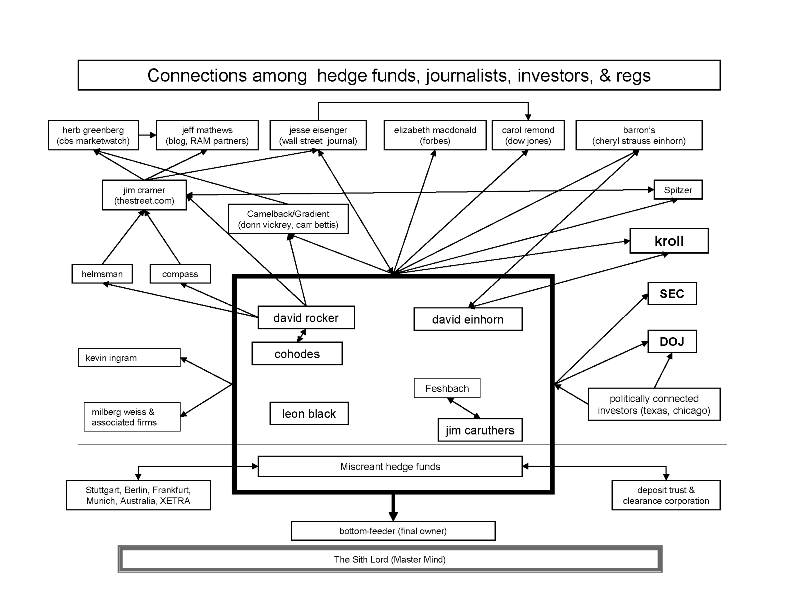
Chanos is the same short-seller who’s recent comments (that China’s growth was exaggerated) seem to have made the risk currencies give back some of their gains and gold take a slight breather…at least for the moment. (At least, that’s my insight into it).
So who’s short and who’s long gold and which journalists are in which pockets? Take your pick because that’s probably got everything to do with the various tidbits of news that get floated in the media and then disappear…
Welcome to the free and independent media of the free and independent, liberty-loving, morally superior, culturally advanced, genetically gifted wonder world of the “international community” of nations, aka, crap-shoot-cum-criminal syndicate.
Shop-lifting On the Rise
The global recession has cut into the retail business another way. World-wide shoplifting is on the rise..by about 6% (versus a normal increase of 1.5%)., says the Global Retail Theft Barometer. That’s putting a $115 billion dent in businesses.
The interesting angle here is that, besides the usual suspects, there’s an upswing in middle-class thieves who simply must have that bottle of wine or the Gucci bag that the economic downturn is denying them.
Here’s how the new crime-spree breaks down globally:
“In terms of total losses, retailers in North America topped the charts at $46 billion, followed by Europe’s $44 billion and $17.9 billion in the Asia-Pacific region. In North America and Latin America, store owners and employees were the leading pilferers; in Europe, Asia and the Middle East, it was customers who were swiping the most loot.”
Now a good part of the theft is still by criminals who resell the stuff. But the middle-class folks who are doing it are not doing it to keep body and soul together. They’re doing it because they think the whole system is rotten from top to bottom and there’s no reason they shouldn’t get their piece of the pie too. Which is the thinking that drove the housing bubble, and before it the tech bubble.
But the more fundamental reason for the crime-wave lies elsewhere. People become de-moral-ized in every sense of the word when the ground on which they stand starts shifting.
“Whatever you wish to keep, you better grab it fast,” said Bob Dylan, little knowing at the time he had nailed the philosophy of the financial industry for the next several decades.
When goal-posts move, when rules are changed post-facto, when it’s clear that cronyism not competence is the way ahead – then, anything goes. This is the subject of “Hyperinflation and Hyperreality”, an excellent piece by Paul Cantor on Thomas Mann’s short story, “Disorder and Early Sorrow.” Its theme is the moral effect of one form of severe economic dislocation – hyperinflation.
Hyperinflation is not our problem now, but it might be wise to think about what it might entail ahead of time.
Marcie Angell on Fixing Health Care
Marcie Angell on how to fix health care simply:
“Recommendation #1: Drop the Medicare eligibility age from 65 to 55. This should be an expansion of traditional Medicare, not a new program. Gradually, over several years, drop the age decade by decade, until everyone is covered by Medicare. Costs: Obviously, this would increase Medicare costs, but it would help decrease costs to the health system as a whole, because Medicare is so much more efficient (overhead of about 3% vs. 20% for private insurance). And it’s a better program, because it ensures that everyone has access to a uniform package of benefits.
Recommendation #2: Increase Medicare fees for primary care doctors and reduce them for procedure-oriented specialists. Specialists such as cardiologists and gastroenterologists are now excessively rewarded for doing tests and procedures, many of which, in the opinion of experts, are not medically indicated. Not surprisingly, we have too many specialists, and they perform too many tests and procedures. Costs: This would greatly reduce costs to Medicare, and the reform would almost certainly be adopted throughout the wider health system.
Recommendation #3: Medicare should monitor doctors’ practice patterns for evidence of excess, and gradually reduce fees of doctors who habitually order significantly more tests and procedures than the average for the specialty. Costs: Again, this would greatly reduce costs, and probably be widely adopted.
Recommendation #4: Provide generous subsidies to medical students entering primary care, with higher subsidies for those who practice in underserved areas of the country for at least two years. Costs: This initial, rather modest investment in ending our shortage of primary care doctors would have long-term benefits, in terms of both costs and quality of care.
Recommendation #5: Repeal the provision of the Medicare drug benefit that prohibits Medicare from negotiating with drug companies for lower prices. (The House bill calls for this.) That prohibition has been a bonanza for the pharmaceutical industry. For negotiations to be meaningful, there must be a list (formulary) of drugs deemed cost-effective. This is how the Veterans Affairs System obtains some of the lowest drug prices of any insurer in the country.
Costs: If Medicare paid the same prices as the Veterans Affairs System, its expenditures on brand-name drugs would be a small fraction of what they are now.”
My Comment
Point one. Some libertarians take the purist position that the simple solution would be to get the government entirely out of health. But I wonder if that isn’t utopian at this point.
Point two. Since the financial crisis has obviously resulted in a huge and criminal wealth transfer, it’s morally untenable to use a libertarian argument, when it wasn’t used to stop the bail-outs of the banks. In other words, now that we’re in the wealth redistribution business, we can’t suddenly become principled when the population demanding the transfer isn’t the financial industry.
Point three. An incremental improvement of the dislocations caused by years of market intervention is the least likely to cause more problems. Angell’s ideas seem like one good place to start.
That said. I still think paying in cash as you go, with small private insurance pools, is the only libertarian solution.
Trauma and Healing
“A psychologist in the field of trauma, Bessle Van der Kert, made an observation several years ago; he noted that survivors heal when they find a greater passion for something other than their trauma. For me, this is my research on Centeotzintli or sacred maiz. It is a many-years story, but it involves the search for origins and migrations. At a certain point, I was told by elders from throughout the continent: “If you want to know who you are, follow the maiz.” That’s what I do now. In the process, I learned that the stories I had been looking for were right in my own home… from my own parents who are 86 and 81… the stories they had told me when I was growing up that became the basis for my dissertation: Centeotzintli: Sacred maize – a 7,000-year ceremonial discourse.
To be beaten is dehumanizing. To be treated as a suspect population and to be told to go back to where you came from is violating. To be denied one’s human rights makes us less than human. To fight for one’s rights is rehumanizing. To find one’s roots – one’s connections to that which is most sacred on this continent – to that which is many thousands of years old and part of one’s daily life – is affirming and it is to find one’s humanity.”
from “Running Past PTSD,” by Roberto Rodriguez
Chanos Bearish on China
“Is China Headed Toward Collapse” asks Politico, relying on legendary short-seller, Jim Chanos, of Enron fame, who is China-bearish.
So are we, as we’ve been hearing the numbers in China are as frothy as souffle. But on the other hand, we’ve also become bearish about hedge-fund managers in bed – ahem, we’re talking metaphors here – with the media, since dipping into the naughty dirt dished up at Deep Capture.
“Chang argues that inconsistencies in Chinese official statistics — like the surging numbers for car sales but flat statistics for gasoline consumption — indicate that the Chinese are simply cooking their books. He speculates that Chinese state-run companies are buying fleets of cars and simply storing them in giant parking lots in order to generate apparent growth.
Another data point cited by the bears: overcapacity. For example, the Chinese already consume more cement than the rest of the world combined, at 1.4 billion tons per year. But they have dramatically ramped up their ability to produce even more in recent years, leading to an estimated spare capacity of about 340 million tons, which, according to a report prepared earlier this year by Pivot Capital Management, is more than the consumption in the U.S., India and Japan combined.”
My Comment
We’re obviously in the middle of info-wars.
First there was “green shoots,” the mother of all rumors. Then there were the rumors about the US government asking embassy officials to use local currency (we heard that one down here in August); then there was the one about the Chinese walking away from oil derivative contracts; then came the Fisk report about the Gulf Arabs (and others) diversifying away from the dollar; next came rumors about China buying gold from the IMF; following on that it was actually India that stepped up and bought half of the IMF’s gold – although since the purchase is against IMF SDRs (Special Drawing Rights) and since the Federal Reserve uses several CBs around the world as depositories, this may be just a book-keeping entry for ought we peasants know.
Mixed in with the financial psyops comes a healthy doze of fear-mongering over swine flu and random shooters….while what we should really be terrified about* slips by under the radar with nary a squawk from the populace.”
*for eg. the approach of biometric IDs, the restriction of free speech, the end of banking secrecy, and the centralization of medical information online
Brazil Blacked Out For Hours…
Half of Brazil was plunged in darkness from 10:15 PM Tuesday for four-six hours, ostensibly because a storm shorted one (or in some reports, three) of five transmission lines at the Itaipu hydroelectic power station that straddles the border between Paraguay and Brazil. The outage affected 50 million people in Brazil. The station also supplies 90% of Paraguay’s power so that Paraguay was blacked out for 15 minutes.
The company in charge, Furnas, which is owned by the Brazilian state, denies that there was any problem in the transmission from Itaipu to the national grid and dismissed the reports as speculative, though they were affirmed by several other officials
More at AP:
“Despite Furnas’s statement, the ministry’s secretary, Marcio Zimmerman, speculated that an unspecified “adverse meteorological condition” set off a “domino effect” through the grid.
Itaipu has an output of 14,000 megawatts, which supplies 20 percent of the energy needs of Brazil, Latin America’s most economically active nation. All of that was off-line overnight.
The blackout occurred two nights after the US television network broadcast a report in which unidentified former US national security officials claimed massive power outages in Brazil in 2005 and 2007 were caused by cyber hackers attacking control systems.”
This is the CBS report mentioned in the AP article. For those concerned this is a cybercrime of some sort, here’s a ranking of countries by their contribution to malware – malicious software that takes over your computer to send out spam or anything else your attacker might fancy (Note this is not a report on cybercrime in general, to which China’s contribution is minimal, but just a ranking of where malware comes from. In cybercrime overall, the US accounts for over 60% – more later..)
1. Americans and other non-British English speakers (more than 30% of world’s total, with the Americans contributing about 23%)
2. China (30 %)
3. Brazil (14.2%)
4. Russia (4.1 %)
Two technologically strong countries that use English, the UK and India, both ranked low, jointly contributing only 1.3%, with most of that from the UK, according to this Forbes report. According to the report, Russian security guru, Eugene Kaspersky, explains this as due to cultural differences. A Businessweek-Symantec report from September 7, 2007 puts India’s contribution at 3%. (the report can be found in a more user friendly format here at engimasoftware).
Selling Survival
Business Insider has a list of 12 places to go if the world goes to hell – i.e., war, massive food/resource shortage, currency collapse.
The number one spot is Chiang Mai in Thailand – where Marc Faber lives.
Hmm. Faber is married to a Thai, runs a long-standing financial advisory service from Hong Kong, and has global ties. In other words, he’s nicely embedded, economically and culturally. I am not sure Joe Citizen who relocates there is going to find things that easy. The dozen cities listed in the article include Rio de Janeiro, Guam, Denver, Kansas, Bern, Capetown – definitely a motley crew.
Being a cynic, I ask myself who’s holding property there that they want to off-load on some scared-witless member of the erstwhile middle-class.
Seriously. The only survival blog that I think is worth much time, Ferfal’s, is dead on when he says unequivocally that survival first of all requires having a network of close friends who can help you if you need it. It means having some fairly stable source of income or means of living. It means knowing the language well enough to be able to keep your ear to the ground and follow nuances of mood. It means being fluent not only in the language, but in the culture, history, economics and politics of the place. At least, fluent enough so that you can spot changes coming ahead of time.
Without any of that, you really are better off staying at home and building up community resources to help with what’s ahead.
Yes, the US government isn’t exactly your friend on a number of things. But the government is no longer a territorial entity. You can be taxed anywhere in the world. You can be located anywhere in the world. You can be dragged home from wherever you hide by a court order….if the country has extradition treaties with the US. Your finances can be found anywhere. Government and police officials can be bought off anywhere. Laws can change in a heart-beat. Banking secrecy isn’t strong anywhere, unless you’re very wealthy. And if you’re very wealthy, you can protect yourself even from the US.
Set up a foreign trust in an off-shore haven, start traveling to remote countries, start googling for information about secrecy and false identities and see how fast you’ll attract the authorities. Trying to save yourself a few thousands in tax dollars – or even tens of thousands – and ending up in prison, broke, sick, injured in a stand-off, or devastated some other way is not what I’d call a good trade-off.
Need for a Retrial of Mumia Abu Jamal
At Counterpunch, Lynn Washington writes:
“One glaring example is photos of the December 1981 crime scene taken by police investigators that do not show a critical element of the prosecution’s case against Abu-Jamal. The eyewitness testimony of cab driver Robert Chobert was a central pillar of the prosecution’s case against Abu-Jamal but police crime scene photos do not show Chobert’s cab behind the slain officer’s patrol car where prosecutors claimed it was parked when Abu-Jamal killed Officer Daniel Faulkner.
Four police photos capturing different angles of the crime scene contained in the trailer for a forthcoming film about Abu-Jamal’s case do not show Chobert’s cab.
There are only two possible scenarios for the missing cab in those crime scene photos: either police tampered with the crime scene by removing the cab or the cab was never there. Either scenario is a major legal violation warranting a new trial.”
My Comment:
It’s interesting to me how much support from the establishment media Roman Polansky got over irregularities in his trial. That support, although mistakenly easy on Polansky’s crime, was correct. But where is the establishment media on an even worse case – that of Mumia Abu Jamal?
As a side-note, Abu Jamal gave my first book, “The Language of Empire,” an unsolicited endorsement. A thumbs up from someone with that much first hand-knowledge of the prison and judicial system, I must say, pleases me more than approval from the powers that be.
I find it amazing how much anger boils over for a Van Jones (Obama’s supposed Green Czar) or for an Abu Jamal. Yet for the real perpetrators of the biggest heist of the last hundred years, for the diseased greed and rapacity of vast numbers of the upper economic and political echelons, for neocolonial policies that have brought not just the USA but most of the globe to the edge of the abyss, for endless and savage wars fomented behind the sham of peace-keeping and policing, for relentless and shameless expropriation of the labor, creativity, and earnings of ordinary people all over the world, for the sordid complicity of the media in all this, where is the shame? Where is the outrage? Where is the hectoring?
President Obama was in Africa telling governments there to shape up. Well and good. They should. But perhaps he should address his moral sermons to those closer at hand…say, in the White House, and the Pentagon, and Treasury, and the SEC, and the Federal Reserve – which hide fish of a rather larger size.
Support the Goldstone Report
Jewish Appeal to Support the Goldstone Report
The primary author of the recently released UN Report on Gaza, the internationally respected jurist Richard Goldstone, has been attacked by establishment voices within the Jewish community. When those within a community try to “excommunicate” and dishonor a truth-teller, it is our obligation and responsibility to speak out vehemently on their behalf and on behalf of the truth they bring.
By all accounts, Judge Goldstone, who has a deep connection to Israel, approached his task with no pre-conceptions about what he and his team would find as they investigated the circumstances and aftermath of the Israeli attack on Gaza. Goldstone is a former South African constitutional law court judge who also served as a prosecutor of the Yugoslav and Rwandan war crimes tribunals. His credentials for this task are impeccable.
For following where the truth led him and releasing a report detailing human rights abuses and violations of international law by Israel, as well as Hamas, Judge Goldstone should be applauded for his honesty and integrity. Instead, he and the report have been viciously and relentlessly attacked by many within the Jewish community.
When it comes to Israel, hard-core censorship and intimidation by those claiming to speak in the name of the Jewish people have been the order of the day. Our saying, “Three Jews–four opinions,” reflects the traditional Jewish encouragement to argue and debate. But the reality, sadly, is that diverse opinions are welcome–except when it comes to Israel.
We must hold the Israeli government and the Jewish establishment accountable for attempting to vilify a truth-teller and for suppressing the truth about Israeli government crimes against the Palestinian people. We call upon each and every one of us to speak out at every opportunity–at our community centers and synagogues, in our homes, in the street, wherever we go.
We must demand that the truth be heard and that those claiming to speak in our name stop manipulating truths that have been well-documented for years, long before the Goldstone report. We are also appalled by the Obama Administration’s reaction to the report. We call for a fair and impartial investigation of the report’s allegations by non-military institutions in Israel. Failing that, we call for an investigation by the International Criminal Court (ICC).
Let us begin the New Year in the pursuit of justice.
Sincerely,
Forgiveness Without Repentance Is Un-Christian
Several readers had questioned my rejection of the common understanding of forgiveness as it appears in Christian theology. In response to that, I’m posting what I consider a proper interpretation of forgiveness:
“A very dramatic example of confronting the offenders is seen in the life of John the Baptist, Matt. 3:7-10. Some of those who came to be baptized were clearly suspect and John sent them away unbaptized telling them to get a track record of repentance, then consider baptism. It was not just some words of repentance that John demanded before accepting them, he wanted some action commensurate with the confession to back it up.
In our day and age, we are so shallow in these things, we simply get some quick nod of the head about repentance and baptize them immediately. We would never do what John did, and I venture to say that many Christians are extremely uncomfortable with the fact such action on John’s part is even included in Scripture. It is an embarrassment to many fine Christian people that John did such a thing, and they secretly wish that it had not been recorded.
God expects us to take the right course of action even though it is difficult.”
That’s from the ministry of Gordon Rumford.
I’m quite sure that my philosophical and religious notions are a world apart from Pastor Rumford’s, but on the moral correctness of his position I’m in no doubt. I’ve verified that not just from argument and reasoning, or from the study of comparative religious ethics, or from my own personal experience, but also from lifelong observation of actions and consequences.
These are the real reasons why people think forgiveness can be granted when there’s been no acknowledgement of wrong-doing, no repentance and no restitution:
1. They’re not reading the New Testament in proper context, but taking passages selectively as they wish. They need to examine the whole texture of the Bible (that is, the Torah) teaching, on which Jesus’ teaching was based.
(Update: I am adding a link here to the doctrine of Teshuva or repentance, expounded by Rabbi David R. Blumenthal, Professor of Judaic Studies, Emory University, as evidence.
Quote:
In rabbinic thought, only the offending party can set the wrong aright and only the offended party can forgo the debt of the sin. ……Teshuva is part of the structure of God’s creation; hence, the sinner is obligated to do teshuva and the offended person is obligated to permit teshuva by the offender.
The most basic kind of forgiveness is “forgoing the other’s indebtedness” (mechil). If the offender has done teshuva, and is sincere in his or her repentance, the offended person should offer mechila; that is, the offended person should forgo the debt of the offender, relinquish his or her claim against the offender. This is not a reconciliation of heart or an embracing of the offender; it is simply reaching the conclusion that the offender no longer owes me anything for whatever it was that he or she did. Mechila is like a pardon granted to a criminal by the modern state. The crime remains; only the debt is forgiven.
The tradition, however, is quite clear that the offended person is not obliged to offer mechila if the offender is not sincere in his or her repentance and has not taken concrete steps to correct the wrong done. Maimonides is decisive on this subject: “The offended person is prohibited from being cruel in not offering mechila, for this is not the way of the seed of Israel. Rather, if the offender has [resolved all material claims and has] asked and begged for forgiveness once, even twice, and if the offended person knows that the other has done repentance for sin and feels remorse for what was done, the offended person should offer the sinner mechila” (Mishne Torah, “Hilchot Chovel u-Mazzik,” 5:10). Mechila is, thus, an expectation of the offended person but only if the sinner is actually repentant. ….
…The principle that mechila ought to be granted only if deserved is the great Jewish “No” to easy forgiveness. It is core to the Jewish view of forgiveness, just as desisting from sin is core to the Jewish view of repentance. Without good grounds, the offended person should not forgo the indebtedness of the sinner; otherwise, the sinner may never truly repent and evil will be perpetuated. And, conversely, if there are good grounds to waive the debt or relinquish the claim, the offended person is morally bound to do so. This is the great Jewish “Yes” to the possibility of repentance for every sinner. “
Lila: Note that this is only one of three levels of forgiveness and it’s the only one that is obligatory, if the conditions are met. The other two levels, selich (approaching the offender with mercy and empathy) and kappar (purification or wiping out of sin, which can only be done by God) are not. Indeed, kappar is impossible for human beings.
2. They’re not placing the Gospel statements about forgiveness in the context of the sound teachings of other religions and of non-religious ethics, with which true religion should not be in severe conflict.
Thus Islam:
“The Arabic word used for self rapprochement is An-Nafs Al-Lawamah which refers to blame oneself and to feel sorry for ones sins. So this is recommended and good in the sight of Allaah and necessary to have the sin forgiven by Allaah.
Ceasing to commit the sin immediately. If the sin was against Allaah, then he should (1) stop doing it if it was an unlawful act, or (2) hasten to do it if it was an obligation that he abandoned doing. And if the sin was against a created being (such as humans), then he should hasten to free himself from it, whether by returning it back to him or seeking his forgiveness and pardon.”
3. They’re not taking into account prudence, reason, courage, and other moral virtues as being as necessary as kindness to moral development.
4. They’re not considering the duality of mercy–judgment, which is a cornerstone of Old Testament teaching (which itself is the foundation of Jesus’ ethic). Mercy without judgment is not only not correct, it is an impossibility. This is confirmed from the imagery and symbolism in the practice of magic in the western esoteric tradition, where the masculine form is invoked in contemplating mercy, so that the image of mercy/compassion doesn’t devolve into mere sentimentality. (More on that in another post, as it is a complex topic).
5. They’re disguising their cowardice and their fear of the repercussions of being outspoken, especially toward those more powerful.
6. They’re psychologically incapable of standing up for themselves and in need of therapy to become more assertive.
7. They have an excessive and immoral regard for “keeping peace” at all counts.
8. They’ve been abused or have low self-regard or do not consider injustice to themselves as injustice but part of religiously ordained suffering or “submission,” under authoritarian understandings of the Bible.
9. They have a streak of masochism that derives some psycho-sexual gratification or pseudo-religious exaltation from being injured.
10. They’re using public forgiveness as a technique of persuasion, as in 4th generation warfare (Gandhi was a master of the practice).
11. Their spiritual vanity is so great that they think they can out-Christ Christ, who certainly required his followers to confess their sins and repent.
12. They don’t like the notion of “judgment” and consider it unhealthy.
13. They’re confusing Christianity with some schools (and not the deepest, I should add) of modern psychology.
14. They’re emotionally and psychologically shallow.
15. They’re confusing Christianity with cultural Marxism, in which the notion of guilt and individual responsibility for wrong has been shucked off entirely to structural and societal causes.
Solzhenitsyn: Walk Away From the Gangrene
Live Not By Lies
Monday, February 18, 1974
Following is the full text of Alexander Solzhenitsyn’s essay ``Live Not By Lies.” It is perhaps the last thing he wrote on his native soil [before the collapse of the Soviet Union] and circulated among Moscow’s intellectuals [at that time]. The essay is dated Feb. 12, the day that secret police broke into his apartment and arrested him. The next day he was exiled to West Germany.
“At one time we dared not even to whisper. Now we write and read samizdat, and sometimes when we gather in the smoking room at the Science Institute we complain frankly to one another: What kind of tricks are they playing on us, and where are they dragging us? gratuitous boasting of cosmic achievements while there is poverty and destruction at home. Propping up remote, uncivilized regimes. Fanning up civil war. And we recklessly fostered Mao Tse-tung at our expense– and it will be we who are sent to war against him, and will have to go. Is there any way out? And they put on trial anybody they want and they put sane people in asylums–always they, and we are powerless.
Things have almost reached rock bottom. …..We fear only to lag behind the herd and to take a step alone-and suddenly find ourselves without white bread, without heating gas and without a Moscow registration……
When violence intrudes into peaceful life, its face glows with self-confidence, as if it were carrying a banner and shouting: “I am violence. Run away, make way for me–I will crush you.” But violence quickly grows old. And it has lost confidence in itself, and in order to maintain a respectable face it summons falsehood as its ally–since violence lays its ponderous paw not every day and not on every shoulder. It demands from us only obedience to lies and daily participation in lies–all loyalty lies in that.
And the simplest and most accessible key to our self-neglected liberation lies right here: Personal non-participation in lies. Though lies conceal everything, though lies embrace everything, but not with any help from me.
This opens a breach in the imaginary encirclement caused by our inaction. It is the easiest thing to do for us, but the most devastating for the lies. Because when people renounce lies it simply cuts short their existence. Like an infection, they can exist only in a living organism.
We do not exhort ourselves. We have not sufficiently matured to march into the squares and shout the truth our loud or to express aloud what we think. It’s not necessary. It’s dangerous. But let us refuse to say that which we do not think…..
Our path is to walk away from the gangrenous boundary. If we did not paste together the dead bones and scales of ideology, if we did not sew together the rotting rags, we would be astonished how quickly the lies would be rendered helpless and subside. That which should be naked would then really appear naked before the whole world.
.. Either truth or falsehood: Toward spiritual independence or toward spiritual servitude….
And he who is not sufficiently courageous even to defend his soul- don’t let him be proud of his`progressive” views, and don’t let him boast that he is an academician or a people’s artist, a merited figure, or a general–let him say to himself: I am in the herd, and a coward. It’s all the same to me as long as I’m fed and warm.
Even this path, which is the most modest of all paths of resistance, will not be easy for us. But it is much easier than self-immolation or a hunger strike: The flames will not envelope your body, your eyeballs, will not burst from the heat, and brown bread and clean water will always be available to your family…….
It will not be an easy choice for a body, but it is only one for a soul. Not, it is not an easy path. But there are already people, even dozens of them, who over the years have maintained all these points and live by the truth.
So you will not be the first to take this path, but will join those who have already taken it. This path will be easier and shorter for all of us if we take it by mutual efforts and in close rank. If there are thousands of us, they will not be able to do anything with us. If there are tens of thousands of us, then we would not even recognize our country…..
And if we get cold feet, even taking this step, then we are worthless and hopeless, and the scorn of Pushkin should be directed to us:“Why should cattle have the gifts of freedom? Their heritage from generation to generation is the belled yoke and the lash.”
Insights From the Bears
I had a conversation recently with some insiders in the financial industry, of a rather bearish persuasion. So bearish that they’re interested in leaving the United States.
Which is how I’ve felt for about five-six years.
The conversation yielded interesting tidbits. Some of them confirm my own thinking; others contradict it. The contradictory parts interested me the most, of course. I tend to pay more attention to people who think differently from me than to people who agree, perhaps because of some diffidence about my own judgment….Unfortunately, my own instincts have turned out to be more accurate than I’ve been able to believe.
Anyway, here’s what I came away with from what I consider honest and reliable professional money managers:
1. China is overvalued greatly. By around 50%-60% or more (not the first time I’ve heard this, of course).
2. Jim Rogers knows commodities, but doesn’t know gold as well (this was new to me).
3. Marc Faber has one of the best reputations as an investor among insiders (well-known to me). His newsletter is worth the money.
(Full disclosure: I don’t subscribe to Mr. Faber’s newsletter, work for him or receive any kind of compensation for this statement. I’m passing it along as well-founded opinion that might help readers struggling to find reliable guidance in the welter of news….)
4. Gold bars sold by some firms have tungsten underneath, so be careful from whom you buy. James Turk is a reliable person to buy gold from. (Full disclosure: I don’t use Mr. Turk’s services nor have I been paid by anyone to make this assertion).
6. A lotof Several money-managers think there may be no gold at Fort Knox – or very little – not just confirmed “conspiracists” – among whom I am proud to number myself. (Correction, Nov. 13: “No gold” doesn’t have to mean the absence of physical gold. Gold could be present physically, but it could owed to other entities, like a house that is technically in your name, but is really owned by all your creditors).
7. Rogers was more the driving force behind Quantum’s success than Soros.
8. There will be no secession. Americans aren’t up to it. The cognitive dissonance between perceived reality and “real” reality is too great for most people to grasp the extent of the corruption in the system. Any hope of rebellion rests with “red-necks” (apologies for using a racist term – I use it ironically here), not with yuppies.
9. The Indian market is riddled with fraud and hype. Jim Rogers thinks the Indian market is a scam. (I wouldn’t use that harsh a word, but I worry about hype and corruption in it too).
10. Brazil’s Fortaleza area, which has been attracting a lot of investor interest, has great beaches and weather…as well as slums, crime, and deadbeats of all kinds. Recommended for investing, not for living.
11. Argentine property laws are not as safe as US property laws (despite Kelo) – at least, at the level where it concerns the ordinary joe. Aggressive, organized squatting is a problem in rural areas.
12. The ongoing investigation of insider trading (eg., Galleon) is not just a one-day wonder, but might bite harder than expected.
Swine Flu Cover-Up
From Dr. Mercola, via Lew Rockwell:
In fact, worldwide, according to CDC and WHO data, far fewer people have died form H1N1 than any seasonal flu in the past.
Dr. Mercola also points out the following:
“Insurance companies in Australia would not insure doctors who gave the vaccine because it was a fast tracked vaccine and therefore experimental. They felt that the danger of complications was far too high to risk insuring the doctors. Unlike doctors in America, they did not have a special law that Congress would pass to insulate them from liability should severe complications arise from the vaccine.
It is also of special interest to note that tens of millions of babies were vaccinated with the Hepatitis B vaccine (providing no protection to the babies) only to learn later that it is linked to a 310% increased risk of developing multiple sclerosis. One has to ask — What else do they not know about this vaccine? …….
…Now we are being told that this new fast tracked, poorly tested vaccine is very safe and effective. The results of the testing on this vaccine were reported in the New England Journal of Medicine.39 It is instructive to learn that the tests for safety and to assess complications lasted only 7 days after the vaccine, an incredibly short period of follow-up. Gullian Barre paralysis can occur even months after a vaccine as can seizures, behavioral problems and neurodevelopmental disorders in children. It is interesting to note that the authors of the safety study for our swine flu vaccine were all employees of the maker of the vaccine CSL Biotherapeutics and eight held equity interest in the company. This admission is part of the disclosure policy of the New England Journal of Medicine.”
Intellectual Self-Defense for Libertarians
I posted this at Lew Rockwell last week:
“There are two ways to approach the world.
In one, the popular one now, you try to control the bad actors. You create laws to trip them up before hand, or round them up after. You rely on regulations and regulators.
Nothing wrong with that, except that we already have lots of regulators and it didn’t help.
Why?
The reason is so obvious you question the intelligence of anyone who can’t see it. It’s simple. People willing and able to scam the system are going to be willing and able to game the regulations too.
In a fight between regulators and scammers, my money’s on the scammers. They’re usually richer and nastier.
In the second approach, you don’t overlook the bad actors. You hope they get what they have coming to them. But you don’t rely on laws or lawyers because you’re old enough to have figured out that bit about the bad actors being bigger and nastier than the good ones.
So what do you do?
You focus on getting out of the way of the bad guys. You limit the damage they can do to you. And most of all, you figure out how to avoid them in the first place.
Here are five warnings I wish I’d heeded more:
1. Be careful whom you deal with
Don’t lie down with a dog and you won’t get up with fleas. Delousing yourself is much harder than not getting loused up in the first place.
But delousing is what we do a lot of these days. It’s practically the only thing going on in the economy now. Right now there are people all over the country delousing the SEC.. and the Congress… and the banks…and the hedge-funds. There’s even a global delousing effort going on. The fumigators are at work. Pest control is in full force and the exterminators are crawling over the baseboards in the cellar. There’s an international delousing effort at the BIS, with headquarters at Switzerland and local shops all over the world.
A Bug Czar has been crowned and fleas have been declared insecta non grata.
There – that should do it, eh? Any bug with a classical education should figure it out.
Which is another way of saying none of this will work. Or if it works, it won’t work the way you want it to.
The fact is, lice and ticks are at home on a dog. It’s R & R for them. Holiday Inn, Bed & Breakfast, and a luxury spa combined. Get them to leave? Good luck. Much better, don’t take your dog to bed in the first place. Much better, if you have a dog, let him drool in the kennel, not on your pillow.
The short version of all that is we do jack-ass things and then wonder who’s braying.
I say jack-ass with no disrespect. Some say that those who get conned “deserve what they get.”
That is the New Testament of the confidence man and the Sunday sermon of the predator.
As financial doctrine, it occasionally makes sense. As moral insight, it’s almost always junk. Very often victims are only weak, naive, or ignorant. The kind of people who wouldn’t know malice if they saw it in the dollar-bin with a white tag tied to its toe. They’re people who follow the rules, thinking other people follow them too. They’re honorable, so they believe in the honor of their fellow man.
Now, not only is being honorable not wrong, it’s the way things should be. But doves should learn not to coo at snakes, and beautiful souls have to wise up to what goes on in the rest of the world… or expect an ugly life.
So, rule number one. Research the people you plan to make your associates. And don’t dismiss your research. When you find out your prospective partner filed for bankruptcy six times in the last ten years, don’t tell yourself it will be different this time, because it won’t. One bankruptcy is a financial failure. Three is a losing streak. Six is a career decision. Follow your gut instinct.
If your boss conducts business with a wink and a leer, don’t pass it off as southern charm. He’s not Dagwood Bumstead looking for a lump of emotional candy. He’s a creep, and you’re a pawn in his narcissistic chess game. Ask for a transfer about two minutes after that. If you’re out of a job, so be it. There’s no guarantee you won’t be out of one, if you put up with it.
2. Never stop learning
Ignorance kills, as a lawyer friend of mine likes to say. Don’t be ignorant. Learn as much as you can about as many things as you can. Do your research. Know what you’re dealing with. With the internet, it’s much easier. You can do a google search on anything or anyone. You can go into google news archives and find newspaper articles and information from as far back as the 1980s.
So start reading.
Project Gutenberg has thousands of classic books online. PubMed allows you to access medical journals. LexisNexis will allow you to research law. Edgar will show you company filings. You can search houses for sale on Realtor.com and look up where a house is on Google Earth. You can go to WhoIs to find out about domain names and IP address. You can find out how well a website is doing by looking up Technorati or Alexa rankings. The Way Back Machine lets you look up old magazine articles, even when they’ve been pulled off the current site. Some sites like Zabasearch collect people’s information and put it all in one spot. That’s free information. If you pay, you can get much more.
Mind you, I find data sites downright creepy, especially when they’re online, and especially when they’re centralized and can be accessed with a key-stroke. If people have paid for their sins, why not let them start fresh? There may be a recording angel, but surely he lives farther north than DC.
On the other hand, just because the technology is already out there, it pays to keep up with what’s being done with it. Because if it’s out there, your business partner… or your employer… or your enemies ….or your friends.. probably know about it already. They might even have mined it for information to deploy against you. Shouldn’t you be prepared?
3. Limit what people know about you. Many of us from small towns grew up around trustworthy people. Our friends and our neighbors knew everything about us, and we didn’t mind, because no one was malicious enough to hurt anyone else.
The big world isn’t so nice. People who have things to hide themselves will be only too anxious to find something on you, attack being the best form of defense in their minds. If they can’t find anything wrong, they’ll hit you with whatever else they can, even a silly thing you said casually. They’ll dig out what your crazy cousin did fifteen years ago. Or perhaps you saved your husband’s latest rant about his mother online. Don’t be surprised if you wake up one morning to find it in the New Yorker.
So, keep things to yourself, even among close friends and relatives.
That’s a hard one for me. I’m a verbal person. I write, I talk, even if it’s only to myself. Leave me next to a blank wall and I’ll strike up a conversation. And it will be two-way.
Fortunately, most people are unlikely to hurt you. But occasionally you’ll run into a psychopath who will. And if you work in politics, the media, or in business, psychopathy is practically the norm.
So keep track of what’s being written about you on the net with Google alerts. Write to sites that aggregate information and ask for your name to be removed from their lists. You might have to repeat that every year . Put yourself on the national do-not-call list so that your telephone number’s out of the reach of marketers.
And then limit the information you give out, even to your lawyer.
It’s taken me half a lifetime to figure out that any questionnaire shoved under my nose doesn’t automatically deserve to be filled in. Leave things blank unless you’re told it’s mandatory to fill it in. Or become creative. Develop fictitious personalities, throw-away mail addresses, exotic, non-existent addresses. Use another name when doing business. Avoid registering products or filling out questionaires in your own name. Use fake birth-dates and vary them according to a system that you, and only you, know. Change your passwords every few weeks, using a system to keep track. Write them down broken up in alternate pages in a notebook, without anything to signify what the numbers mean. If the book is lost, no one will be able to make use of the information. Neither will you, of course, but losing a little time is better than losing your savings.
Hacking email, spying on private business, blackmailing and outing people, it’s all fair game these days. Attacking the privacy of public figures has become a national pastime – witness the Letterman case. But it’s not just public life. Private business is a circus of outing and shaming too. Corporations spy on and threaten each other, as well as their employees. Employees write tell-all books.
We live in a spy state, where every half-wit believes it’s his divine right to nose into anything, no matter how little it’s his business. So, these days not only is it wise to keep your own secrets, you might be wise to keep other people’s secrets.
But what should you do if inspite of that, you become a target of an attack on your privacy?
Often, nothing, unfortunately.
I’ll give you the example of an aunt of mine who didn’t want anyone to know she was sick, in case it would prejudice employers against hiring her. A colleague not only hacked her email but forwarded details about her illness to dozens of people. A frail, sensitive woman, her health broke down under the stress.
I’ll give you the advice I gave her. Say your piece once in private, and say it once in public. Then forget about it. Move on. You’re not the first person to have been screwed over and you won’t be the last. Innocent people are constantly being ruined by the powerful and the unscrupulous. That’s the ugly truth of our system. Reputations are often lost, unjustly. Our salvation is to worry less about our reputations and more about our consciences.
What we do where no one can see and none can retaliate is the test of who we are.
As for what others think, the world is a large place. Move far away, if you need to. As for the system, stop trying to reform it. It’s beyond reform.
4. Learn to say no
Telling someone no doesn’t come naturally. We’re trained to go through life being agreeable. In fact, learning to say no might be the hardest thing you learn. But it might also be the most important, and once you learn it, it can become good sport.
Speaking for myself, I’ve come to relish saying no to pests. And the nay-saying that gives me the greatest pleasure of all is nay-saying to internet marketers. It’s not that I’m ever rude to one. I never hang up. My malice is much deeper. I let them prattle on, even asking polite questions. Then I stop them courteously and ask them why they think they have the right to call me on a weekend and waste half-an-hour selling me something I didn’t ask for. Occasionally, when they’re especially pushy, my toying becomes cruel. I turn the tables on them. Instead of selling me things, they find themselves signing petitions or supporting causes or accepting market analysis or invitations to baby showers or anything else at hand.
Can I call you, I ask. Tonight? Tomorrow? I press them to reply. Can you buy two? Now? Pretty soon, they’re begging to hang up.
Try it and see. It’s balm in gilead.
I advise you to use this technique on rude or uncooperative colleagues too. Give them a taste of their own medicine, and do it generously. Let their cup run over. You will get something better than love. You’ll get respect.
5. Learn how to retaliate
Despite all the myths propagated about forgiveness, I’ve learned that submitting meekly to injustice usually breeds weakness, resentment, and ill- health. There’s nothing that drives up your self-respect as much as socking it back to bullies. I’m not advising being unduly aggressive. Try a friendly approach as long as you can. But when that doesn’t work, time to get tough. Throw some metaphoric crockery. Thumb your nose and thumb it publicly. Turn on the spotlight and watch the cockroaches run.
In other cases, all you may need to do is wait. Time has a knack of delivering even the biggest fish to a patient angler…and when that moment comes, don’t flinch. Yank that line and watch your target flop and wriggle on the sand.
Watch with a smile. Defy the received wisdom and develop a healthy conscience about revenge. It’s highly moral. Only our wimpy but violent age derides its feline nobility.
The uncomfortable truth is the New Testament is meant for people on the same moral level of development….for family.. and for friends. But in the big, dirty world, the Old Testament works much better.
Gandhi said an eye for an eye and the whole world goes blind. I say an eye for an eye, and after the first blind man, everyone else’s eyesight gets better in a hurry.
Become a moral vigilante. Why waste time going through the system if you can get better results outside of it? Use the law to warn, to shame, to threaten. But don’t labor under the delusion that a court case always helps. Your enemy will pour his time and money into creating mushroom clouds of paper. He’ll drown you in verbiage and “accidentally-on-purposes.” He’ll postpone and prevaricate and petition. He’ll appeal and block and delay…. and hide behind a fog of corporate black ink like an injured squid.
Instead, if you’re obliged by professional ethics to speak up, consider other channels of actions besides the court. Try mediation or arbitration. Perhaps you’re better off complaining to the Better Business Bureau. Or posting on a consumer forum.
Monetary compensation is often not the best justice either. It can make you look like an extortionist. Try going public. Give the bully a taste of his own medicine. Post the hacker’s private information on a website. Put him on the run. That might not make you rich, but the moral satisfaction is tremendous.
Of course, it could also be dangerous. You risk violating the law yourself. In that case, you might be best off to leave your job. Maybe even leave town. Leave the thugs to the mercies of the universe. It sometimes does a better job of retribution than it’s given credit for. Villains do not always go to jail. And if the skeptics are right, they might never go to hell. But they often get dragged into divorce court, which is a good deal worse, from all accounts.
And meanwhile, there are all those other ways the wicked verily get their reward.
Envious rivals cut their throats; the tax man cometh, and the SEC with him; and then cometh old age, failing libido, dead-beat in-laws and brain-dead grandchildren. The inheritance get squandered and the sycophants and courtiers vanish with the money. The trash-mouth gets acid reflux, the glutton gets dyspepsia and the aging lecher ends up alone, romancing his own hairless skull and wrinkled hide.
Then at the end comes the greatest punishment of all for persisting in evil deeds. You stare into the mirror and evil stares back at you, looking not so much devilish as hollow and bewildered, less like a fiend from hell and more like a Goldman CEO at a Congressional hearing.
Hannah Arendt taught us about the banality of evil. It was left to our age to practice the evil of banality. Habit, laziness, gullibility, ignorance, vanity, greed, fear, cowardice, bravado. We are duped not by heroic evil, but by humdrum vice.
The greatest and best defense we have against the charlatans and knaves who brought our society to its knees is not the law.
It is self-knowledge and discipline.”
Buffett Bets Big On US Economy
Warren Buffett’s Berkshire Hathaway fund has pumped $34 billion into Burlington Northern Santa Fe Corporation, the USA’s second largest railroad.
“Berkshire’s $34 billion investment in BNSF is a huge bet on that company, CEO Matt Rose and his team, and the railroad industry,” Buffett said in a statement.
“Most important of all, however, it’s an all-in wager on the economic future of the United States. I love these bets,” he said.”
More at AP.
Mencken On Fighting a Woman
“Any man who is so unfortunate as to have a serious controversy with a woman, say in the departments of finance, theology or amour, must inevitably carry away from it a sense of having passed through a dangerous and almost gruesome experience.”
– H. L . Mencken (hat-tip to Lew Rockwell)
IMF Sells Gold to India (Updated)
Update 2 (Nov 3): The only other explanation I can think of is that the Indian government is privy to information indicating that the demise of the dollar is much closer at hand than is being given out..
Update 1:
OK. As you know, I’ve found this Indian purchase a bit puzzling. I have a bunch of questions:
*Why didn’t the Indian government make a big purchase earlier this year, at $900, rather than now, at the top?
*What, if any, is the connection between this and the Fisk report a few weeks ago about the Gulf Arabs moving out of the dollar, which a lot of people found odd, despite the reputation of the reporter? The report bumped up the price of gold.
Now, here’s Chuck Butler of Everbank, via The Daily Reckoning:
“I told you yesterday that I thought it would be a “wash” for the dollar and the gold price… But that was before I learned that the Reserve Bank of India paid for their $6.7 billion dollars worth of gold with… SDRs.”
(Note:Reuters reports that the sale was in dollars – which would be dollar negative).
What does this mean? That, over the whole past 15 -20 years of “globalization” while the US Govt. inflated its money and sold its treasuries and fake derivatives all over the world in return for real work and real savings, who were the buyers?
Countries like India, where large parts of the middle-class stored its savings in dollars. Now those dollars are seen as so unsound that the IMF (which is the new locus of Anglo-European global domination) won’t accept them for payment of gold.
That means the Indian government has to give up its SDRs (Special Drawing Rights) in exchange.
Now the resurgent IMF is where the globalists are exerting their power and not in the G20 (which was supposed to augment the power of developing nations when it was established in 1999).
As I blogged earlier, the Financial Stability Board is the new regulatory agency that will coordinate with the IMF, but it includes the G20 and also Spain and the European Commission and is headed by ex-Goldmanite, Mario Draghi and it’s housed at the Bank for International Settlements in Basel. So that is a double hit to any representation India will have in the forum.
India sold gold at the bottom in the 1990s; and is now buying it at the top nearly 20 years later – thus selling part of the gains of these past years. At least, so it seems to me. To me this smacks of neocolonialism.
And now, it becomes easier to understand why the center-liberal establishment media is interested in co-opting the anger against Goldman and channeling it into various subplots of the financial crisis (naked short selling, the bail-outs etc.etc).
I see this as an elaborate feint to divert world attention from the reprise of Anglo American and European colonization over the last two decades – accomplished, with a “black” president in charge.
Here’s a piece on IMF sales of gold in 1999. http://www.independent.co.uk/news/business/imf-sells-gold-to-hep-debt-of-poorest-nations-1090154.html
Notice how similar the language is – they’re doing it to increase funding to the poorest countries, etc. etc.
In the news, Bloomberg reports:
“The International Monetary Fund sold 200 metric tons of gold to the Reserve Bank of India for about $6.7 billion, its first such sale in nine years.
The transaction, equivalent to 8 percent of global annual mine production, involved daily sales from Oct. 19-30 at market prices and is in the process of being settled, the IMF said in a statement yesterday. The average price to India, the biggest consumer, was about $1,045 an ounce, an IMF official said on a conference call. Gold for immediate delivery gained 0.2 percent.”
My Comment:
Interesting. The Indian government doesn’t buy gold at the bottom (2000) but now, when it’s at all time highs (shades of the British government selling gold at the bottom).
Now, the Indian central bank is reputed to be very savvy, as are Indian gold buyers. Most commentators expect gold to consolidate, if not correct, before pushing on. It would make sense for the Indian government to wait and buy it on dips.
This is a good move for the IMF. But for the Indian government, which managed to steer the banking system past the whirlpool of unwinding derivatives, I wonder if this move is astute.
Look at the peculiar facts, as reported in the New York TimesWall Street Journal)
“In the last one year, China has increased its gold holdings, by weight, by 75.69%, Russia by 18.78%, the Philippines by 18.50% and Mexico by 108.91%.
Compared with this, India’s central bank did not add anything to its gold reserves in the last one year, according to Bloomberg data.
(Lila: Why not? Why buy gold at record prices when the government was unwilling to buy when it was trading much lower, only this year?)
In fact, the share of gold in India’s total reserves has dwindled over the decade.
In March 1994, the share of gold in the total reserves of the country was 20.86%; by the end of June 2009, gold constituted only 3.7% of the total reserves.”
Even the IMF expressed surprise, as Breitbart.com notes:
“A senior IMF official said that the IMF was “lucky” in selling the 200 tonnes to India for roughly 1,045 dollars an ounce, compared with 850 dollars an ounce in April 2008.”
(Lila: In other words, over the whole period of globalization, India sold it’s gold and bought US treasury…dollars…just what the US government was desperate to get rid off, so it wouldn’t drive inflation at home…)
Again, India sold gold cheap and bought it back at its height. Does that sound like savvy behavior from a country renowned for well trained economists and smart gold buyers?
A former governor of the Indian central bank (Reserve Bank of India), Bimal Jalan, said it was to help the IMF meet its funding needs for loans to the poorest countries, for which it had looked to India and China.
As an aside, in an earlier post, I speculated that the report (by Robert Fisk, a very respected source) about Gulf Arabs moving out of the petrodollar – which was promptly denied – might have been a rumor circulated to bump up the price of gold to help IMF gold sales….maybe, I wasn’t so far off, after all.
I went back to an earlier post this year, in February, which quotes from a list in Richard Russell’s letter:
Note: The list looks inaccurate. I’ll go back and find why Russell’s numbers are so different from the World Gold Council figures below them). (Note: Russell is referring to tonnes of gold; the WGC figures are for dollar amounts. So the discrepancies we refer to at in the percentages).
The US has 8,135 tonnes….64.4% of reserves
Germany — 3,412… …64.4% of reserves
IMF — 3,217… … …(1)
France — 2,508… … …58.7%
Italy — 2,451… … …61.9%
Switzerland — 1,040… …23.8%
Japan — 765.2… …1.9% …(a potential gold-buyer)
China — 600.0… …0.9% …(should be a big buyer)*
A reader notes that this number is too low. I assume it’s a number from before China started buying off market. Compare with list below.
Russia — 495. 9… …2.2% …(is a buyer)
Taiwan — 422.2… …3.6% …(should be a buyer)
India — 357.7… …3.0% …(should be a buyer)
UK — 310.3… … …14.5% …(sold most of its gold at the low price)
Saudi Arabia — 143.0… …11.4% (should buy gold)
South Africa — 124.4… …9.0%
Australia — 79.8… … …6.3%
So there you have it. Among countries, Italy, France, Germany, and the US have the most gold. Switzerland has a third of what they have. The UK, South Africa, Australia, and Saudi Arabia are next with about 1/5th – 1/10th as much. Russia and Japan have only a small percent in gold. China and India have even less. What do most Asians have? Debt (treasuries and dollars) from the US. Neo-colonialism anyone?
Correction:
CNBC has the following completely different list of top gold holding countries compiled by tradermark via Seeking Alpha, posted October 13, 2009.
(Note: Data is based on the World Gold Council’s September 2009 report and is converted to US short tons at a rate of 1 T = 1.102311 US tons. All monetary estimates are calculated at the rate of 1oz gold = $1042 US).
United States $298.4 N/A
Germany $125.0 69.2%
International Monetary Fund $118.0 N/A
Italy $89.9 66.6%
France $89.7 70.6%
China $38.7 1.9%
Switzerland $38.2 29.1%
Japan $28.1 2.3%
Netherlands $22.5 59.6%
Russia $20.9 4.3%
European Central Bank $18.4 18.8%
Taiwan $15.5 3.9%
Portugal $14.0 90.9%
India $13.1 4.0%
Venezuela $13.1 36.1%
How To Be A Superpower
“In short, every time one of us “foreigners” (or “Aliens” as the US government sweetly calls us), buys Dollars as savings, or our national central bank “soaks them up” from domestic markets in order to maintain whatever rate of exchange the IMF requires in order to maintain a “sustainable economy” (Anne Kruger, dixit) – i.e., so as to ensure that we can pay back foreign debt loans – what we are really doing is helping finance the US Budget Deficit. In the worst case scenario, we are helping to pay for the cost of killing iraquis and afghanis, preparing invasions against Iran, Syria, North Korea or Venezuela, or torturing POW’s in Guantanamo and Abu Ghraib.
As a counterpart, these market-economy puppet central bankers have had no problem in issuing Argentine Pesos to buy Dollars in the local market and the IMF and US Treasury Dept suitably applaud them for doing so. However, if the Central Bank were to issue Argentine Pesos to finance the building of our much needed national social and strategic infrastructure, then all “experts” and “media analysts” would go haywire to the scream of “Inflation!” Why is it that these “experts” insist that a 600 km four-lane highway is not proper “collateral” for issuing local currency, whilst neat piles of Dollars sleeping in the Central Bank is. Ah, the mysteries of finance..
In short and as a crude example of what we are saying, every time the Argentine people need to buy a barrel of oil, we must, as a community, work and toil to earn u$s 57 to buy it. However, every time the US government needs to buy a barrel of oil, it just has to ask the Fed to print u$s 57. Clearly, there is a great difference…
Again: like that, it’s easy be a global superpower.
Mafia + Usury = “Market Economy”
— Adrian Salbuchi
CIT Group In Chapter 11 Bankruptcy
Big trouble ahead. Bloomberg reports:
“ CIT Group, the 101-year-old commercial lender that saw its funding dry up in the credit crunch, filed for bankruptcy in an effort to cut $10 billion in debt following a failed debt exchange and U.S. taxpayer bailout.
CIT listed $71 billion in assets and $64.9 billion in liabilities in a Chapter 11 petition yesterday in U.S. Bankruptcy Court in Manhattan. The Treasury Department said the government probably won’t recover much, if any, of the $2.3 billion in taxpayer money that went to CIT
More from AP:
“After struggling for months to avert bankruptcy, lender CIT Group has filed for Chapter 11 protection in an attempt to restructure its debt while trying to keep badly needed loans flowing to thousands of mid-sized and small businesses.
CIT made the filing in New York bankruptcy court Sunday, after a debt-exchange offer to bondholders failed. CIT said in a statement that its bondholders overwhelmingly opted for a prepackaged reorganization plan which will reduce total debt by $10 billion while allowing the company to continue to do business.
The Chapter 11 filing is one of the biggest in U.S. corporate history, following Lehman Brothers, Washington Mutual, WorldCom and General Motors. CIT’s bankruptcy filing shows $71 billion in finance and leasing assets against total debt of $64.9 billion.”
My Comment:
Uh oh. So what happened to the government’s hand out to CIT last year?
It goes kaput. That’s $2.3 billion in return for preferred shares that are now worth zip, nada, zilch. The CIT Chapter 11 also means pain for all the small businesses relying on CIT’s lending to meet pay roll and pay off bills for orders. According to the AP article, CIT is the lender for about 2000 vendors supplying some 300,000 retails stores that depend on them to meet demand during the holiday season (Halloween and Thanksgiving to Christmas and New Year).
The Bloomberg piece says that CIT funds 1 million businesses.
Following in Friday’s 200 plus point drop in the Dow, this looks grim.
I’d get out of all stock positions on the next swing up…if there is one…
Tom Paine On Whoring Out Your Soul
“Let them call me rebel and welcome, I feel no concern from it! For I should suffer the misery of devils were I to make a whore of my soul.” — Thomas Paine.
The Easter Bunny On the DTCC
From Bob O’Brien’s “Sanity Check,” a succinct account of why the “fail to deliver” problem is a big and serious one:
• The DTCC, via Cede & Co., is the registered owner of all shares held in “Street Name,” which are all shares in margin accounts.
• Margin accounts represent the bulk of independent investor account types.
• Registered owners are free to use their “property” as collateral for loans or debt.
• It is unknown what, if any, loans or debts are collateralized by the stock “owned” by the DTCC.
• The DTCC’s “Stock Borrow Program” lends shares to be delivered to buyers, if sellers fail to deliver.
• The Stock Borrow Program is operated on the honor system, and is anonymous.
• It allows one genuine share to be lent multiple times, leaving a string of markers/IOUs in the share’s wake.
• This creates a systemic risk for the stock market, as more markers are in investor accounts, falsely represented as shares, than shares actually authorized by the companies.
• These markers are freely traded and treated by the system as real, resulting in a large secondary market of counterfeit shares – resulting in depressed stock prices.
• With paper certificates being eliminated – by the DTCC – there is no way to confirm that a share is genuine, versus a bogus marker.
• There is nothing to stop your broker from taking your money, and merely representing to you that you bought shares, without ever actually buying them. You have no way of knowing the difference, barring demanding paper certificates for your property.
• Only a handful of people on the planet understand all this.
• In the end, it is simple – Wall Street is printing shares electronically, investors are paying real money for those bogus shares, and the whole thing is predicated on the idea that few will ever understand what is being done, or bother to check.
• This represents a hidden tax on investors and the economy.
• It is, for the most part, illegal.
• It is being kept secret by the DTCC and the SEC, who are terrified of systemic collapse, and a complete loss of investor confidence, should all the facts become known.
• All the facts are becoming known.
Does this sound complicated? It’s not.
Anecdote: a few years ago, in my neighborhood, a retired lady of some means was going around badgering strangers and friends for loans. She was reputed to own a few homes, so many people obliged. Then it turned out that the titles of the houses had been promised out several times over. Which meant that the lenders hadn’t received the collateral they thought they had when they gave her their money. Which meant that if she didn’t pay, they would have nothing to go after in court. Which is precisely what happened.
That, crudely, is what naked short-selling – and indeed. the whole derivative scam – amounts to. It multiplies claims on value, thereby bleeding value from those who legitimately hold it, because they paid money for it, to others who didn’t pay anything real, but traded one “counterfeit” claim for another.
And of course, on a larger scale, that’s what the paper money regime is too. It’s a multiplication of claims on a fixed store of value, which has the effect of diluting and eventually erasing that value.
We’ve been hit by a triple quadruple whammy of essentially the same type of fraud: fractional banking, excessive creation of money, abusive derivatives, and naked short-selling.
SEC Chief Khuzami On Muckety
Former federal prosecutor and Deutsche Bank general counsel Robert Khuzami was appointed chief of the SEC on March 30, 2009. Here’s his bio.
Traveling, Taibbi, and Tares Amid the Wheat (Update)
Update 2 (October 25): Links have been added and some comments on them in the main blog post, in addition to the earlier update with Olagues’ comment.
I am unable to return any personal email for the next two weeks as I am traveling on business.
Any urgent message can be left via skype at rajiva@mindbodypolitic or at this blog, with your contact/email/skype included. Please leave personal invective, legal threats, and slurs only at the blog.
By the way, I notice Matt Taibbi’s new True Slant post, as well as his earlier Rolling Stone piece, get around to Pete Peterson’s influence….
Hmmm.. Didn’t we tell everyone to take a look at Peterson and Blackstone and Black Rock..when was it..way back in April this year?
http://mindbodypolitic.com/2009/04/28/pete-petersons-not-so-clean-crusade-against-entitlements/
Not bad for an obscure blog, whose tips just happen to show up months before they’re broken by gonzo journalists…..
Other complaints about Taibbi’s loose sourcing:
*An anonymous poster points out how much of Taibbi’s work is simply lifted without full credit from Deep Capture‘s research (Judd Bagley and Mark Mitchell are the two researchers there).
*Robert Wenzel has pointed out his own extended piece, “Does Goldman Rule the World?” written in 2007.
*An options blog points out that Taibbi has lifted his material from there, as well (link below).
*Other Goldman Sachs blogs make the same claim and New York Magazine asks if Taibbi just summarized about 100 years of Goldman conspiracy theory and added some crude language…
Note: this itself is misleading.
There are no “hundred years of Goldman conspiracy” – the first criticism of Goldman on trader boards that I saw was around 2003 fall, 2004 and I believe they may have been links taken from this site, Catbird Seat, although I am not entirely sure. (Added, June 24, 2011: I should clarify that they were anonymous links and I am guessing that they were from that blog…they might have been from some where else. I haven’t been able to find them since. My own research into Goldman came out of research for “Mobs, Messiahs, and Markets” and was published first as an investment report there).
The links suggested extensive fraud and manipulation. I think I was the first person to put that into an extended piece in 2006. (I’ve already posted on how Taibbi “bubble” thesis looks like a cropped version of the argument from my 2006 pieces, “Why It’s Time to Sell Goldman” and from my 2008 pieces, “Paulson Putsch” and “Three-Card Capitalists.”
Far from being a brilliant or original investigator, Taibbi is a colorful and sometimes misleading retailer of other people’s leads and ideas who adds the footnotes and the “I was there” element that investigative journalism reveres…and needs. Which is OK and on the whole useful – we won’t pull up the wheat in that field of tares…
(I’ll discuss the dangers and limitations of “smoking gun” journalism another time).
So long as Taibbi doesn’t muddy up the story with too many of the usual half-wit mantras of the cultural establishment, he’s helping the debate….
The more serious gaps – in relation to 9-11 – can always be countered by bloggers.
(And in time, Taibbi might “break” the 9-11 story too. Hope he gives Dr. Griffin a footnote when he comes around to that).
At one point in Matt’s article he writes:
“Here’s how naked short-selling works: Imagine you travel to a small foreign island on vacation. Instead of going to an exchange office in your hotel to turn your dollars into Island Rubles, the country instead gives you a small printing press and makes you a deal: Print as many Island Rubles as you like, then on the way out of the country you can settle your account. So you take your printing press, print out gigantic quantities of Rubles and start buying goods and services. Before long, the cash you’ve churned out floods the market, and the currency’s value plummets. Do this long enough and you’ll crack the currency entirely; the loaf of bread that cost the equivalent of one American dollar the day you arrived now costs less than a cent.
With prices completely depressed, you keep printing money and buy everything of value — homes, cars, priceless works of art. You then load it all into a cargo ship and head home. On the way out of the country, you have to settle your account with the currency office. But the Island Rubles you printed are now worthless, so it takes just a handful of U.S. dollars to settle your debt. Arriving home with your cargo ship, you sell all the island riches you bought at a discount and make a fortune.”
If you go to this article from Deep Capture http://www.deepcapture.com/the-simple-metaphorical-explanation/ and read it, Matt’s example, though summarized, is awfully similar to the one written at Deep Capture. Now, I do not know whether Matt gave credit to the author who wrote the article but I could not find any mention of the person within Matt’s article. If Matt did not give credit, then there is a case for plagiarism.
For those who don’t know, plagiarism is defined as the “unauthorized use or close imitation of the language and thoughts of another author and the representation of them as one’s own original work.” (Source: http://dictionary.reference.com/browse/plagiarism)
I hope this is taken seriously and my worries refuted. Matt authors great articles but this does not mean that he stands above honest journalistic integrity.
Regards,
Anon
*******************************************
My Comment:
When I have more time, I will try to put the pattern of plagiarism in the American media into a larger context….and show just what it cost the country and why the media has very little moral ground to stand on when condemning the bankers. And that includes many of the alternative sites too…
Indeed, at some point, I would like to undertake a bear raid of my own – on the English language media. I include not just the establishment print and TV outlets, but the blogosphere, wiki, alternative press, and the like, which are supposed to be so free of manipulation.
Bagley’s (and Mitchell’s) admirable work at Patrick Byrne’s Deep Capture blog only touches the tip of the iceberg. For a quick recap of Byrne’s position on naked short-selling and his ideological orientation, here’s a video of an interview with him.
I add it, because of Olagues’ comments (see comments below). I assume that Olagues comes from a libertarian position that’s more to the right than Byrne’s. Example: Byrne seems to be involved with school-choice activism with the widow of Milton Friedman.
Update One (Sunday, October 25):
Former options market-maker John Olagues posts a comment below, with a link, which I will add here.
At first glance, his analysis seems to support my own conclusion that the Fed and the major banks were involved. (I have also blogged last year that I believe that LIBOR was manipulated).
I need to research Olagues’ piece a bit more to verify the reliability.
Blog Sabbatical
I’m taking a sabbatical of a couple of weeks from this blog.
Max Keiser On Wall Street Suicide Bombers
Keiser’s image of speculators as suicide bombers has been used by a number of people. But parts of his argument sounds strange to me. The well-connected banks are “blowing up” other banks through speculation, so as to drive the dollar higher?
Undoubtedly the dollar is being manipulated and the banks will make money off of it, but blaming speculation alone is too easy a game and it will lead to the wrong remedies.
While speculation undoubtedly exacerbated the crisis and pushed the market over, speculators can only undermine fundamental weakness.
The housing bubble collapsed because the mania exhausted itself and the underlying loans were bad. Speculators didn’t make the bad loans. Mortgage lenders and banks did that.
Speculators didn’t certify the derivatives based on them were great. The ratings agencies did that.
Speculators didn’t hold a gun to home owners and tell them to buy. Greenspan encouraged them – though even he didn’t hold any guns to their head.
Speculators didn’t look the other way when numbers of professionals complained to the regulators. The SEC did that.
Speculators didn’t publish fulsome flattery of Greenspan and Summers and Rubin and Paulson. Magazines – including Vanity Fair and Time and the New York Times and the Wall Street Journal did that.
Speculators didn’t bestow degrees and honors on these charlatans. The universities and prize committees did that.
Speculators didn’t attack anyone who criticized them or called them into question. Partisans did that.
Speculators didn’t rewrite history and ignore the scores of right-libertarians at Mises, Lew Rockwell and other libertarian sites who foresaw this and warned repeatedly to rein in monetary debasement. Left-liberal academics and journalists did that.
Speculators didn’t rah-rah for war and the expansion of the corporate state and police laws so dissidence became difficult. Right-conservatives and neocons did that.
Speculators didn’t attack anyone who argued for generosity, or self-restraint, or humility, temperance, or any moral virtue. Libertines and anti-religious bigots did that.
Speculators didn’t bribe Congressmen to pass bad legislation. Lobbyists did that.
Speculators didn’t swallow propaganda whole sale and follow the line of least resistance. Lazy consumers and the public did that……
Ergo – Goldman Sachs is a fairly accurate reflection of the kind of society we’ve become. Laws aren’t going to change that. Political and public culture has to change.
The Devious Web (Correction)…
I notice that Gary Weiss commented on Patrick Byrne’ post on this blog, describing the post as a sample of obsessive behavior about naked short selling.
I have nothing to say to that, except that people who’ve had to battle a number of foes can sometimes become what’s called hypervigilant. I’ve certainly had the experience.
But that’s not my point here. I bring up the post only because Weiss writes like someone who’d never come across me before, duly (and snarkily) noting the “obscurity” of this blog. Well and good. No offense taken. We like our obscurity…it keeps us meek. And we’re told the meek will inherit the earth…or at least, what’s left of it after our oligarchs finish raping it.
However, I bring this up not to air any wound to my amour propre but because Judd Bagley, the main reporter at award-winning business blog Deep Capture, has accused Weiss of using sock puppets on wiki, and has posted screen shots to prove it. [It’s not germane to this tale that too uses sock-puppets].
One of Weiss’s alleged sock-puppets on wiki, says , goes by the name, MantanMoreland (other names used there and elsewhere include Samiharris – at wiki – and Tom Sykes – at Daily Kos and other places).
Now, it so happens that when I was trying to get rid of my web-stalker, Tony R, I ran into someone called Mantanmoreland on the message boards that he haunted. Was this Weiss? Or was it someone else? You judge.
Correction: I have crossed out the section below where I have incorrectly identified Tony R as someone by the name of Villasenor, whose postings/m.o. seemed similar to me on many counts. He has denied it (see comment section). My post resumes after the crossed out section.
Interestingly, Ry__s also claims he is not Ry__s.
[However, V doesn’t deny that – like R__s he uses multiple aliases, some very similar, frequents the same message boards, and attacks similar things].
Fair enough. I’ve added a correction. It makes no difference to my claim about R__ls or about Mantanmoreland, only it leaves me still in the dark who this person Ry__ls is.
Since the suit lists multiple aliases for him and some of these aliases resemble the multiple aliases that R___ls uses, their targets are similar, and their venues and forums often identical, it is an understandable error, if it’s one.
In any case, I will use R__ls name and strike through V’s, to avoid giving offense/slandering the wrong person….although it’s clear that neither of these two mind slandering other people.
I’ve no axe to grind in the matter.
To recap: V is a one-time stock-dealer who was fined by the NASD. He’s also a small-time racketeer (http://mindbodypolitic.com/2009/09/27/blogger-credibility/e http://listsearches.rootsweb.com/th/read/ARIZONA/2005-06/1118951523) and a former groupie of securities fraudster, Amr Elgindy and his Anthony Pacific site. (http://siliconinvestor.advfn.com/readmsg.aspx?msgid=22945870). In whatever time is left over from that, he’s given to web stalking and harassing, for instance, of a (http://siliconinvestor.advfn.com/readmsg.aspx?msgid=15095618mber)
Just to be clear, I am agnostic about the merits of any of his claims about, who might be doing something illegal, for all I know. I mention this just to show that has a history of this sort of thing.
[With no cause at all, Tony R has also libeled Georgetown University professor, James Angel, because of a financial film he made that that didn’t conform to his ideas (as far as I recall the subject).
Anyway, I approached a number of of sites (such as, Indymedia, KYCNews, and the SEC complaints board) to have them remove Tony R’s libels and to find out how to make him desist. It turned out he was in Guatemala, so it would be hard for me to do anything legally about him. I was also told he was likely to just switch aliases and ratchet up the harassment, if I went after him. In fact, whenever I mentioned his most common alias name, Tony R, he would show up like lightning on this board and spam me (that’s why I’m not using his complete name).
Now here’s the interesting part. While I was trying to find out more about Ry__s, I came across an irate exchange between him (under one of his many aliases http://www.chillingeffects.org/uncat/notice.cgi?NoticeID=1748) and someone called Mantanmoreland. Note: it was on a message-board (not on wiki).
I wrote to Mantanmoreland (it was in February 2008), asking if he knew anything more about Tony R. and we went back and forth about it for some two weeks, exchanging around two dozen emails, most of which I still have. Those emails went under my name. In them I explained that I’d become the unwitting target of this Tony R, solely because I’d been hired to write a book with the president of a company that Tony R. was fixated about.
Here’s my question. Deep Capture says unequivocally that Mantanmoreland is Gary Weiss. Weiss denies it equally flatly. Now, I exchanged dozens of emails only a year ago with Mantanmoreland about a situation that he could hardly forget, since he had his gripe with Tony R too. But Weiss’ recent blog post seems to indicate that he has no idea who I am.
That leaves only one possibility. Either Weiss or Bagley is in error (to put it as mildly as possible)…
Which is it? And what would that mean? And does that have anything to do with the recent (thwarted) attempt to delete my wiki page?
Added: As a matter of fact, by assessing the various reactions to this post (who posted, where and on what forums), I clarified the answer to the above question to my satisfaction…
DTCC Conflicts Of Interest Include Ties With Penson, Goldman
More digging about Penson turns up a number of ties with regulators (this is probably par for the course, and not surprising). Penson Worldwide’s board of directors includes one David Kelly, who until 2000 was President of the National Securities Clearing Corporation, as well as Vice Chairman of DTCC.
More on DTCC here at Financial Wire, May 11, 2004
cited at Deep Capture.
(Lila : The DTCC is the Depository Trust and Clearing Corporation, not the Depository Trust Company, as indicated in the article)
“The Depository Trust Company (DTC) is a member of the U.S. Federal Reserve System, a limited-purpose trust company under New York State banking law and a registered clearing agency with the SEC. The depository supposedly brings efficiency to the securities industry by retaining custody of some 2 million securities issues, effectively “dematerializing” most of them so that they exist only as electronic files rather than as countless pieces of paper. The depository also provides the services necessary for the maintenance of the securities it has in “custody.”
The largely unregulated DTC has become something of a defacto Czar presiding over the entire U.S. markets system, wielding more day-to-day influence and control than the SEC, the NASD and NASDAQ combined. And, as the SEC’s June 4 ruling indicates, its monopoly over the electronic trading system appears even to be protected.
How entrenched is the Depository Trust and Clearing Corp.? It’s two preferred shareholders are the New York Stock Exchange and the NASD, a regulatory agency that also owns the NASDAQ (OTCBB: NDAQ) and the embattled American Stock Exchange! Regulators, regulate thyself?
In an era when corporate governance is the primary interest for the SEC and state regulators, the DTCC is hardly a role model. Its 21 directors represent a virtual litany of conflict:
They include Bradley Abelow, Managing Director, Goldman Sachs (NYSE: GS); Jonathan E. Beyman, Chief Information Officer, Lehman Brothers (NYSE: LEH); Frank J. Bisignano, Chief Administrative Officer and Senior Executive Vice President, Citigroup / Solomon Smith Barney’s Corporate Investment Bank (NYSE: C); Michael C. Bodson, Managing Director, Morgan Stanley (NYSE: MWD); Gary Bullock, Global Head of Logistics, Infrastructure, UBS Investment Bank (NYSE: UBS); Stephen P. Casper, Managing Director and Chief Operating Officer, Fischer Francis Trees & Watts, Inc.; Jill M. Considine,Chairman, President & Chief Executive Officer, The Depository Trust & Clearing Corporation (DTCC);
Also, Paul F. Costello, President, Business Services Group, Wachovia Securities (NYSE: WB); John W. Cummings, Senior Vice President & Head of Global Technology & Services, Merrill Lynch & Co. (NYSE: MER); Donald F. Donahue, Chief Operating Officer, The Depository Trust & Clearing Corporation (DTCC); Norman Eaker, General Partner, Edward Jones; George Hrabovsky, President, Alliance Global Investors Service; Catherine R. Kinney, President and Co-Chief Operating Officer, New York Stock Exchange; Thomas J. McCrossan, Executive Vice President, State Street Corporation (NYSE: STT); Eileen K. Murray, Managing Director, Credit Suisse First Boston (NYSE: CSR); James P. Palermo, Vice Chairman, Mellon Financial Corporation (NYSE: MEL); Thomas J. Perna, Senior Executive Vice President, Financial Companies Services Sector of The Bank of New York (NYSE: BNY); Ronald Purpora, Chief Executive Officer, Garban LLC; Douglas Shulman, President, Regulatory Services and Operations, NASD; and Thompson M. Swayne, Executive Vice President, JPMorgan Chase (NYSE: JPM).”
No More Muddle-Through Economy
“I firmly believe we will see a double-dip recession within another 18 months (at the most). Stock markets drop on average about 40% in a recession. Adjust your portfolios accordingly.”
— John Mauldin, Thoughts from the Front Line (http://www.frontlinethoughts.com/pdf/mwo101609.pdf)
My Comment:
I find it pretty interesting that John Mauldin, who’s always argued that we’d “muddle through” somehow (http://www.safehaven.com/article-9542.htm), has now changed his position in view of the facts (an admirable quality). In the latest edition of his very popular and always informative newsletter, Thoughts from the Front Line, he argues that things are much worse than he’d ever anticipated.
I find it even more interesting that Mauldin will be down in Uruguay, speaking to various groups and that he has a partner based in Uruguay. He writes:
“I will be going to South America at the end of next week, to Buenos Aires, Montevideo, Sao Paulo and Rio. I will be speaking in those cities and traveling with my new Latin American partner, Enrique Fynn of Fynn Capital (based in Uruguay).”
He’s not the only one. I’ve noted a number of libertarian (and other) financial advisors down here. A sign of the times.
Rewriting of History Underway
Taibbi on the tea-parties, being sloppy with his facts again, all in the name of rhetoric:
“It’s amazing, literally amazing to me, that it wasn’t until Obama pushed through a package containing a massive public works package and significant homeowner aid that conservatives took to the streets. In other words, it wasn’t until taxes turned into construction jobs and mortgage relief that working and middle-class Americans decided to protest. I didn’t see anyone on the street when we forked over billions of dollars to help JP Morgan Chase buy Bear Stearns. And I didn’t see anyone on the street when Hank Paulson forked over $45 more billion to help Bank of America buy Merrill Lynch, a company run at the time by one of the world’s biggest assholes, John Thain. Moreover I didn’t see any street protests when the government agreed to soak up hundreds of billions in “troubled assets” from Citigroup, a company that just months later would lend out a jet furnished with pillows upholstered with Hermes scarves to former chief Sandy Weill so that he could vacation in Mexico over Christmas.”
My Comment:
Er, Matt. It was the Dems who rolled over for the bail-outs. It was the Republicans, the Southern Republicans, who stymied it first time round…until they had their arms twisted.
Before you got your consciousness raised on the subject several years late, it was right libertarians who were objecting most strongly to the financializing of the economy…..
The Penson video post wasn’t as big a deal as it was made out to be, to my mind. But this post and his debate on 9-11 with David Griffin (at Alternet) do betray some ignorance…
Update:
Louis Proyect has a review of “Dime’s Worth of Difference” (Cockburn and St. Clair) that has a precis that will disabuse anyone inclined to believe the Democrats are more people-friendly than the Republicans…
Billionaire Nabbed In Largest Hedge Insider Scheme
In the news (:http://www.bloomberg.com/apps/news?pid=20601087&sid=asliefsvW5Zc)
“Oct. 16 (Bloomberg) — Raj Rajaratnam, the billionaire founder of Galleon Group, and ex-directors at a Bear Stearns Cos. hedge fund were among six people charged in a $20 million insider trading scheme federal prosecutors called the biggest ever involving hedge funds.
Also accused were Rajiv Goel, who worked at Intel Capital as a director in strategic investments, Anil Kumar, who worked as a director at McKinsey & Co., and IBM Corp. executive Robert Moffat. The former officials at Bear Stearns Asset Management are Danielle Chiesi and Mark Kurland, who were affiliated with the firm’s New Castle Partners, which managed about $1 billion.
“The defendants operated in a world of, you scratch my back, I’ll scratch your back,” U.S. Attorney Preet Bharara in Manhattan said at a press conference today. “Greed, sometimes, is not good.”
My Comment
The biggest hedge scam – there you go. Anything Westerners can do, Easterners can do better. We’re not going to settle for any penny-ante crime anymore. Now you know how at least one South Asian billionaire got rich so fast. Nothing like having an edge…
What’s interesting is that this is the first time that the Fed’s used wire-tapping to target insider trading on Wall Street. Until now that tool has been the reserve of organized crime and drug cases.
Muckety Maps George Soros
Fraud On the Run: Goldman Cop On SEC Beat (ROTFLOL)
In the news, to be filed under – What parallel universe does New York live in?:
“Oct. 16 (Bloomberg) — The U.S. Securities and Exchange Commission named Adam Storch, a 29-year-old from Goldman Sachs Group Inc.’s business intelligence unit, as the enforcement division’s first chief operating officer.
Storch, who joined the SEC Oct. 13, was named to the newly created post of managing executive in the enforcement unit, charged with making the division more efficient, the SEC said today in a statement. At New York-based Goldman Sachs, he had worked since 2004 in a unit at that reviewed contracts and transactions for signs of fraud.”
My Comment:
Personally, I’ve come to nurse a kind of contemptuous respect for, an appalled amusement at Goldman Sachs. It’s the contrarian in me.
In-your-face-corrupt, shameless, self-promoting, out-of-touch, sanctimonious, and bottomlessly greedy – It’s a firm made for our times…
If Goldman Sachs didn’t exist, we’d have to invent it.
Mid-East, Europe, Africa Securitizations Will Deteriorate More, Says Moody’s
From the Global Arab Network:
“The performance of many asset classes in the Europe, Middle East and Africa (EMEA) securitisation sector will continue to deteriorate throughout the rest of the year and into 2011, says Moody’s Investors Service in a new Special Report. The report examines the prospects of recovery for international securitisation in several asset classes and geographies: EMEA Auto ABS, UK Credit Card ABS, UK Non-Conforming RMBS, Spanish ABS and RMBS, Asia Pacific ABS and Global Derivatives. The rating agency expects performance volatility and uncertainty to decline in the coming months, although it cautions that a drop is predicated on achieving some level of economic moderation if not slight improvement, combined with the seasoning of securitised loan portfolios.
Moody’s says that although GDP growth is expected to turn positive in many countries in EMEA later this year or in early 2010, employment and home prices will continue to deteriorate well into 2010, which will lead to securitised loan losses remaining at elevated levels throughout 2011 and 2012.”
Goldman Joins Dollar Bashing
From Business Insider:
“The dollar will weaken to $1.55 versus the euro in three and six months, the bank said, revising previous forecasts of $1.45 for both periods. The U.S. currency, which has fallen versus all of the 16 most-traded currencies this year, will recover to $1.35 in 12 months, Goldman Sachs said”
Alexander Cockburn On the Ethics of Gotcha Journalism
Alexander Cockburn on the reality of tell-all journalism:
“Dempster, a public-school boy in the twilight of Great Britain, is franker than many of his American counterparts about the realities of the trade: that almost all journalism in the end is gossip, and that the handmaidens of gossip are treachery, envy, and spite; that while many journalists may prattle on about the public’s right to know, they are in their bones talking about their own need to tell.”
Milton Nascimento Sings “Cacador De Mim”
Brazil’s Milton Nascimento Sings Cacador De Mim (I, The Hunter of Myself)
Prechter On the Falling Money Supply
Robert Prechter on the falling monetary base:
“As a consequence of the lack of demand for loans, the unwillingness of banks to lend money, and subsequent response of U.S. monetary policy, effective U.S. monetary policy is one of tightening. That lack of growth in the U.S. money that followed from all this will ultimately have an impact on financial markets, the value of the U.S. dollar in the short-term, and the price of $Gold. Further, inflation is not likely to flow from this monetary policy, and deflation is again a risk. Importantly, the consequences of this situation may not be that of the broad consensus.
With no growth in the quantity of U.S. dollars since February, the dollar is becoming rarer relative to other currencies. Ultimately, unless corrected, the value of the U.S. dollar should rise in the short-term. Such an event might come as a surprise to those plunging into Gold and Silver on the back of margin debt.”
Saint Matthew On Obama
“By their deeds shall ye know them”
— St. Matthew’s Gospel, 7:16
Consensus Tip Is Cash, Gold, and Commodity/Oil Stocks
A summation of the inflation-deflation debate, and some practical advice arising from it:
“The pair trade of being long gold and short equities that has worked since 2000, might have a few more years to go, especially if equities get more headwind from multiple-contraction and government interfering in the economy. But in the long-run, time is against that trade too, since equities have the income component. So, one might not short the lower-multiple or certain consumer-staples and commodity-related stocks. Without shorting, being long the latter stocks, being long gold, and having some cash (1/3 each) is probably the common-sense approach, and with a little luck, one can deploy the cash in the next “deflationary” wave should it occur.”
My Comment:
One third-gold looks awfully high to me, but only if you’re buying now. If you’ve been holding for years, take your bow. I’m assuming this division doesn’t include people’s homes. Otherwise, surely, paid-up real estate is a secure asset and a potentially income producing one as well.
I’d rewrite this: One third in your paid up house, a farm or income property of some kind. Another third in diversified currencies or in your currency of choice, either as cash or perhaps even in some select funds – though I’ve never held funds and wonder if they perform like the currency itself. My sense is they don’t. The last third in precious metals, commodities, water, and energy ETF’s, or if you’re knowledgeable enough, stocks. Here too, the funds don’t perform like the underlying commodity at all, USO being a case in point.
Correction: (October 27): Rereading this, it sound like I am recommending ETF’s for all the last part. I don’t. I recommend ETF’s for water and energy, because for the average person it’s easiest to buy that way. You should get physical gold for the long haul, and maybe an ETF to trade – which, is the question.
Costs of Baucus Health Care Bill
From The New York Times:
“The Congressional Budget Office said the bill would cost $829 billion over 10 years. The costs include $345 billion for the expansion of Medicaid and $461 billion for subsidies to help lower-income people buy insurance.
The budget office said the costs would be completely offset by new fees and taxes and by cutbacks in Medicare, so federal budget deficits in the next 10 years would be $81 billion lower than now projected.”
My Comment:
As these are official figures, we can count on their being low-balled.
Again, this adds more detail to my continual drum-beat on this blog that insurance is the heart of the problem. From AIG, to the reinsurance industry, to the WTC attacks, to health insurance, to securities risk insurance, to the new “impact-of-financial-crises-on-poor-people-in-the-third-world- insurance ” (bet you hadn’t heard of that one, but it’s in the works) that pretends to help people by taking the risk out of life.
That’s like drugging yourself to take the pain out of burning, and then cozying up next to a fire. It’s no more than cushioning the downside of bad economic or personal behavior. Which inevitably means – surprise – more bad economic or personal behavior. And then finally when the majority turn into bad actors, even the good actors have to go bad to keep up…..
We don’t need more government intervention in insurance. We need less of it. We need small, voluntary insurance pools. Pared down. Local. Community-based and private. As many and as various as possible, competing against each other. With strict safe-guards to prevent them becoming a racket for lobbyists, drug companies, doctors, and lawyers. Take away the cookie-jar and you’ll get rid of the sticky fingers.